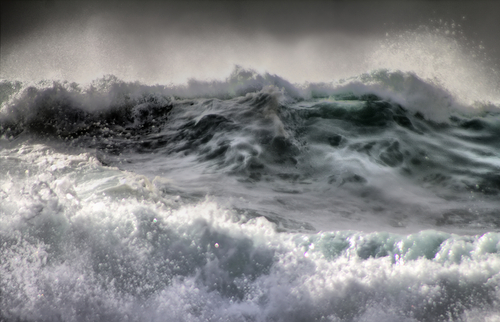
China is now conducting one of the largest ocean mapping operations in modern history, sending dozens of research vessels across the Pacific, Indian, and Arctic Oceans to gather detailed data on the seabed, water temperature, salinity, and currents, and while this is being presented publicly as scientific research, naval experts are openly warning that this data is critical for submarine warfare against the United States and its allies.
The data being collected allows war submarines to navigate more effectively, avoid detection, and position themselves for both offensive and defensive operations, and more importantly it allows for the detection of enemy submarines because sound propagation in the ocean depends entirely on environmental conditions, which means whoever understands the ocean best controls the battlefield beneath it.
China has already deployed hundreds of sensors and is building what has been described as an underwater surveillance network, often referred to as an “Underwater Great Wall,” designed to monitor submarine movement and control access to key maritime regions. This is the same principle the United States used during the Cold War with its SOSUS system, but what we are seeing now is a far more advanced version integrated with modern technology.
The scale of this effort is what should concern policymakers. Reuters identified more than 40 research vessels operating over multiple years, systematically mapping strategic regions including waters near Taiwan, Guam, Japan, and the Malacca Strait, which is one of the most critical choke points for global trade. These are not random locations. These are future battle zones.
This ties directly into what I have been warning about regarding the shift into a war cycle. As confidence declines domestically, governments turn outward, and the preparation for war begins long before the first shot is fired. The Economic Confidence Model has been pointing to rising geopolitical tensions into this period, and what we are seeing now is the infrastructure of that conflict being built quietly beneath the surface.
Submarine warfare is fundamentally different from traditional warfare. It is about stealth, detection, and control of information. The side that controls the undersea environment controls communication cables, energy pipelines, and the movement of naval forces. Roughly 95% of global data travels through undersea cables, and those cables are vulnerable targets in any conflict scenario. This is why seabed warfare has become a central focus among major powers.
China is expanding its submarine fleet, including nuclear-powered submarines that provide greater range and endurance, and is integrating mapping data with surveillance systems to create a comprehensive picture of the underwater battlespace. The nation displayed their new submarines and underwater drones last year at its historic military parade where it wowed the world with its technological advances.
The United States has historically held the advantage in submarine warfare because of decades of accumulated knowledge about the ocean. That advantage is now being challenged directly. Mapping the ocean floor does not make headlines like missile tests or troop movements. But it is far more important because it determines who controls the environment in which submarines operate.
This is why the distinction between civilian and military research is meaningless in this context. China’s strategy of civil-military fusion means that scientific data is immediately available for military use. What is being collected today under the guise of research becomes tomorrow’s combat capability. Even Chinese researchers have openly stated their intention to transform scientific achievements into military applications.
The real issue is that this is happening while Western governments remain focused on short-term political concerns rather than long-term strategic positioning. Mapping the ocean floor may seem like a technical exercise, but it is in fact the foundation of modern naval warfare.The next conflict will not be decided solely by ships or aircraft. It will be decided by who understands the ocean best.







-1024x683.jpg "Judge Who Helped Violent Illegal Alien Evade ICE Faces New Test")

-1024x683.jpg "Montana Puts Democrats in a Bind as Senate Hopes Fade")