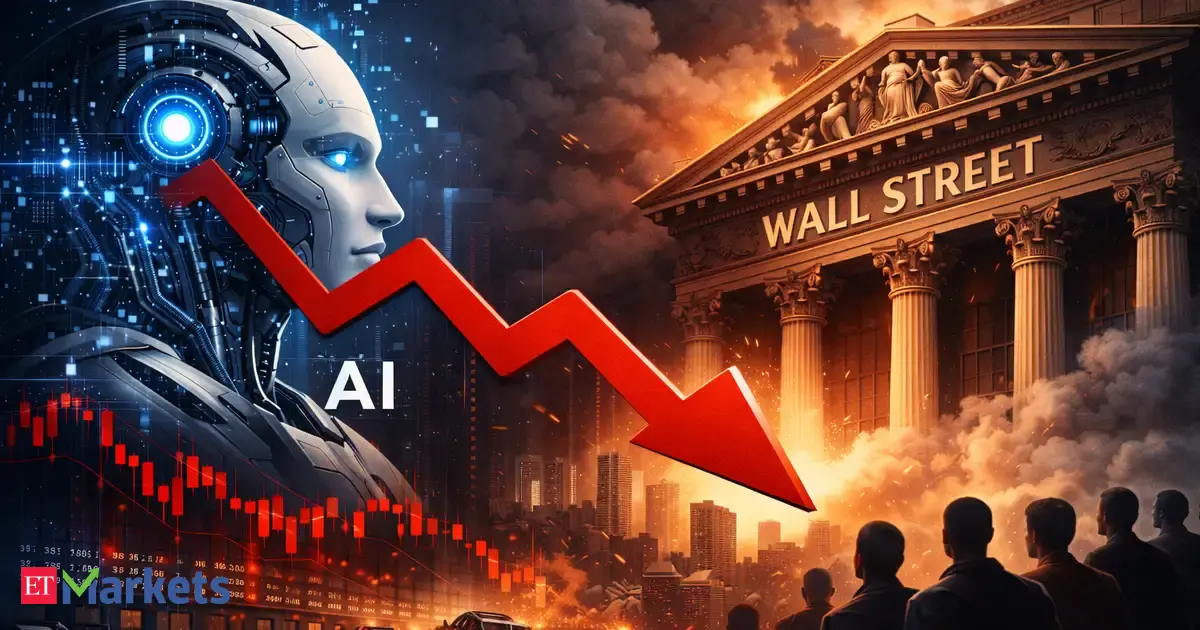
The founder of Citrini Research published “The 2028 Global Intelligence Crisis” on Sunday, outlining a hypothetical scenario in which accelerating AI adoption leads to widespread white-collar job losses, weaker consumption and mounting financial strain.
The essay describes a “deflationary cascade” in which AI doesn’t just augment workers, it replaces them so efficiently that it destabilises the broader economy.
In a market already jittery about rapid AI developments and heavily concentrated in tech stocks, the scenario struck a nerve. By Monday morning, the post had gone viral across trading desks.
What does the post say?
Citrini’s thesis imagines a near future in which rapidly improving AI agents hollow out software companies,displace white-collar workers, destabilise credit and housing markets, and inadvertently bankrupt the middle class.
It stresses that the scenario is a “thought exercise, not a prediction.” Still, its chain-reaction logic alarmed investors.The post is written as a retrospective from 2028. In its version of events, AI first drives a surge in productivity and profits before job losses start to weigh on spending and credit.
Here are the key triggers from the post that spooked the market:
1) Death of the middleman
At the heart of Citrini’s thesis is a sharp leap in AI capability. It points to increasingly autonomous tools such as Anthropic’s Claude Code and OpenAI’s Codex as early signs of systems able to execute complex business tasks with minimal human input.
The impact would extend beyond software to travel booking, insurance, real estate commissions, and other industries built on transaction “friction.”If such agents scale, they could undercut demand for platforms such as Monday.com, Zapier and Asana by allowing companies to manage workflows internally at lower cost. That, in turn, could push vendors like Oracle into sharper price competition.
Nor would it stop there. In Citrini’s framework, personal AI agents transact directly for consumers, bypassing intermediaries such as Uber and DoorDash. Payment networks, including Visa and Mastercard, could face pressure if transactions shift to lower-cost crypto rails.
The common thread: when machines optimise every transaction for efficiency, habitual app loyalty—a cornerstone of many digital business models–begins to erode.
2) Mass white-collar unemployment
Historically, technologies have created more jobs than they destroyed. Citrini argues AI could prove to be the exception.
“AI is now a general intelligence that improves at the very tasks humans would redeploy to. Displaced coders cannot simply move to ‘AI management’ because AI is already capable of that,” the report states.
In this scenario, layoffs in software and other white-collar sectors accelerate, and workers cannot easily transition into higher-value roles. Many shift into lower-paying or less stable jobs, putting pressure on wages and weakening consumer spending.
That softer demand then feeds back into corporate decisions. Instead of hiring, companies double down on automation to cut costs, reinforcing what Citrini describes as a cycle with no natural brake.
3) Financial spillovers
The report extends the shock into the private credit and housing sectors.
Many software firms have been financed by private-credit lenders based on assumptions of steady long-term revenue. If AI undermines those assumptions, defaults could surge. Asset managers such as Hellman & Friedman and Permira, cited in the report, could face pressure if software-backed loans sour.
At the same time, laid-off white-collar workers struggle to service mortgages, triggering housing stress. Combined credit tightening and falling consumer confidence could amplify the downturn.
Citrini ultimately sketches a late-2027 crash that wipes out 57% of the S&P 500.
4) The paradox of “ghost GDP”
Citrini flags what it sees as a growing imbalance: the economy looks healthy on paper, but many households are under strain.
In one scenario, large AI companies continue to post strong profits and productivity gains. Given their heavyweight in stock indices and overall output, headline GDP and market indicators remain resilient.
The problem, the firm argues, is that machines don’t spend. They don’t buy homes, cars or everyday services.
The result is what Citrini calls “ghost GDP” – economic output that shows up in the data but doesn’t filter through to the wider population.
That gap between rising corporate profits and squeezed household finances, the firm warns, could heighten social and political tensions, with anger directed less at Wall Street and more at Silicon Valley.
How did markets react?
Investors were already uneasy about AI disruption. The Substack post sharpened those fears.
US software stocks led the slide. Shares of Datadog, CrowdStrike and Zscaler fell sharply, while International Business Machines suffered its worst one-day drop in decades. Private-equity groups KKR and Blackstone, both cited in the report, also declined.
The broader selloff, which coincided with renewed trade-policy uncertainty in Washington, pushed the Dow Jones Industrial Average down 1.7%, or 822 points, on Monday.
Shares of DoorDash fell about 7% after the note called it a “poster child” for businesses that monetise friction between buyers and sellers. In the scenario, AI agents enable customers and drivers to transact more directly, squeezing margins. On social media, co-founder Andy Fang said the rise of “agentic commerce” would force the company to adapt. “The ground is shifting underneath our feet,” he wrote.
“So far this year, the stock market has been discounting a scenario in which AI is our Frankenstein monster,” said Ed Yardeni of Yardeni Research. His base case is less dire: “We continue to believe that AI is augmenting workers’ productivity rather than making them extinct.”
Also read: IT stock crash wipes out Rs 1.2 lakh crore for LIC & mutual funds in bloodbath not seen since 2008After the selloff, van Geelen said the report was a scenario, not a forecast. Speaking to Bloomberg, he described it as an attempt to “start a conversation” about a world in which human intelligence is no longer the scarcest resource.
Whether that future materialises is unclear. But the episode shows how quickly AI enthusiasm can turn into market anxiety.
(Disclaimer: Recommendations, suggestions, views and opinions given by the experts are their own. These do not represent the views of The Economic Times)