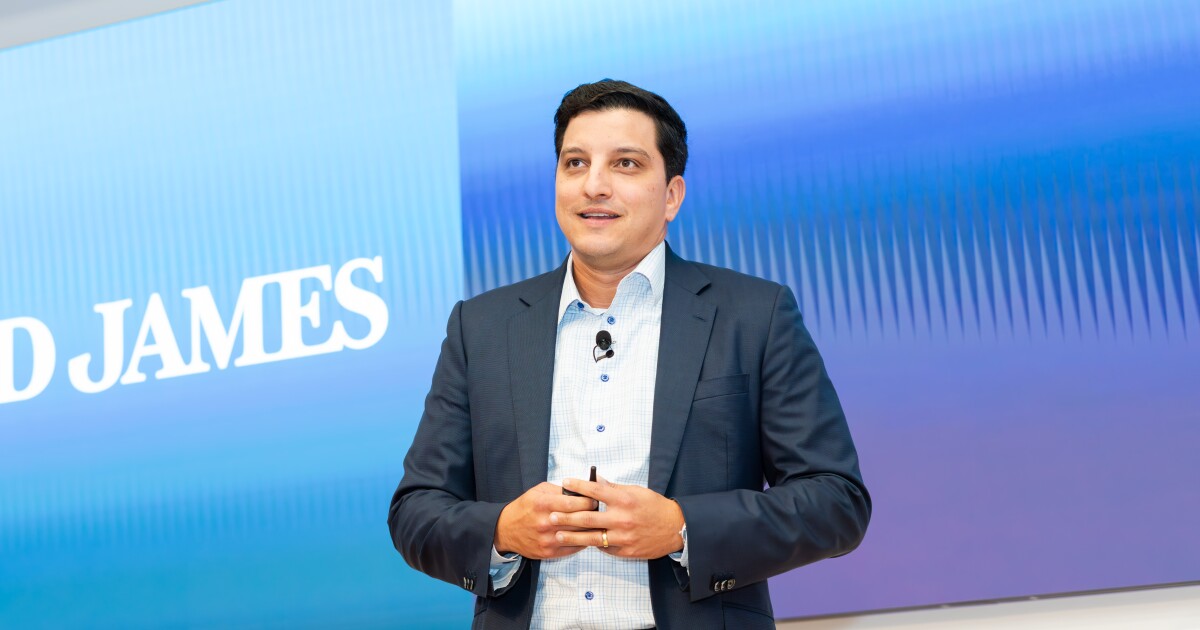
Raymond James CEO Paul Shoukry says his firm has become expert at recruiting advisors who don’t leave “every seven to eight years” in search of a big transition check somewhere else.
Processing Content
Speaking Wednesday at the Bank of America Financial Services Conference in Miami, Shoukry acknowledged that some of Raymond James’ recruiting rivals offer advisors higher transition deals for coming over from other firms. Raymond James, he said, is happy to cede that ground.
That’s especially true, he said, if it means recruiting advisors who are likely to stay with the firm “because they’re convinced that over a long period of time they’ll be able to grow their business more, develop better relationships with their clients and make more money over the long term Raymond James.”
“The longer they stay at Raymond James, the more money they’ll make for the clients and for themselves and for the firm,” Shoukry said. “By pursuing that strategy, we are self-selecting advisors who are less likely to leave every seven or eight years to recapitalize for the highest check.”
READ MORE: Recruiting splurge helps Raymond James post near-record net new assets
Raymond James’ big recruiting year
Shoukry’s remarks come after a year when Raymond James indeed saw some remarkable recruiting successes. In an earnings call last month, Shoukry and other executives reported the firm had recruited advisors in 2025 who had $460 million in annual revenue production at their previous firms.
“That’s equivalent to a pretty decent-sized acquisition in our space, especially when you look at what is remaining out there,” Shoukry said at the time.
On Wednesday, Shoukry contrasted Raymond James with one of his favorite targets: the private-equity firms that are now driving much industry consolidation. Shoukry and others have said competition for advisor talent from PE-backed wealth managers has helped drive average recruiting deals to perhaps unreasonable highs.
Shoukry suggested Wednesday that advisors who leave a firm once in pursuit of a big check are likely to do it again as soon as the opportunity presents itself. Raymond James, he said, has a “long-term strategy” for advisor retention, whereas some of its competitors “have maybe three- to five-year exit time horizons.”
“So their strategies are different,” he said. “Not that one strategy is better than the other. It’s just for us, what makes sense is what makes sense for the next five to 10 years and beyond, not what makes sense for the next five to 10 quarters.”
READ MORE: As private equity reshapes RIAs, advisors look for alternatives
Is private equity getting a bad name?
Phil Waxelbaum, the founder of the recruiting firm Masada Consulting, said a few caveats should be added to Shoukry’s statements. For starters, Waxelbaum said, it’s highly unlikely that any wealth management firm goes into recruiting deals thinking ahead only to the next five years.
It’s true that most private equity owners buy businesses with an eventual plan to sell them at a later date at a profit. But what sort of price could a wealth management firm fetch, Waxelbaum asked, if all its advisors were expected to leave within a few short years?
“If recruiting deals were priced to a three- to five-year time horizon, how would they sell that?” Waxelbaum said. “‘Hey, oh, by the way, all those advisors who were recruited in the last 10 years, here’s their likely departure schedule. They’re all going to be leaving, so you’ll have to start all over again. But, boy, isn’t this a great place?'”
Waxelbaum also acknowledged that Raymond James enjoyed a strong recruiting year in 2025 without offering the highest deals. But unmentioned was the fact that the new advisors were predominantly pulled from one firm: Commonwealth Financial Network.
READ MORE: Raymond James is winning the war for Commonwealth talent. Here’s why
The Commonwealth factor in advisor recruiting
Not only Raymond James but also many of its industry rivals enjoyed a recruiting bonanza last year following the announcement that Commonwealth was being acquired by its longtime industry rival LPL Financial. That deal forced many longtime Commonwealth advisors to choose between taking their business to the much larger LPL or finding a home elsewhere.
Raymond James has been the biggest magnet for departing Commonwealth advisors. Waxelbaum said it’s impossible to predict if another big acquisition deal might disrupt the industry again this year — very few foresaw the Commonwealth deal.
But the chances of something similar happening in 2026 are slim enough that firms shouldn’t count on it.
“If you can even maintain the current recruiting pace, it’s wonderful,” Waxelbaum said. “But if they have some expectation that the pace is going to enhance, it’s not reality. It’s impractical. So this entire recruiting exercise is somewhat of a maturing event.”
Raymond James’ recruitment of Commonwealth advisors continues apace. Just this week, it announced it had pulled over a five-person team that had formerly managed $730 million in client assets at Commonwealth in Green Bay, Wisconsin.
The team, going by the name Financial Consulting Services, said in a statement that it joined Raymond James for “its people-focused culture and innovative resources.”
“The firm’s modern tools and private wealth capabilities give our team the support to continue tailoring strategies that reflect each client’s goals in an impactful way,” according to the statement.
Shoukry on Wednesday said another aspect of Raymond James’ appeal is its size. The firm reported in October that its advisor headcount had hit a record of 8,943 and assets in its wealth management business now top $1.7 trillion.
Shoukry suggested advisors who desire to stay with one firm for the long term need to choose a partner that’s large enough to supply the needs of a fast-growing practice.
“You have to have scale in our business,” he said. “The size really does matter in terms of being able to generate efficiencies in the business and the support areas and the product areas, and then that technology that is required to be competitive.
“We spend over $1 billion a year on technology,” he added. “We’re fortunate to have the size now to be able to invest over $1 billion a year, because I can’t imagine being competitive in this highly competitive space if we had a fraction of that technology budget.”