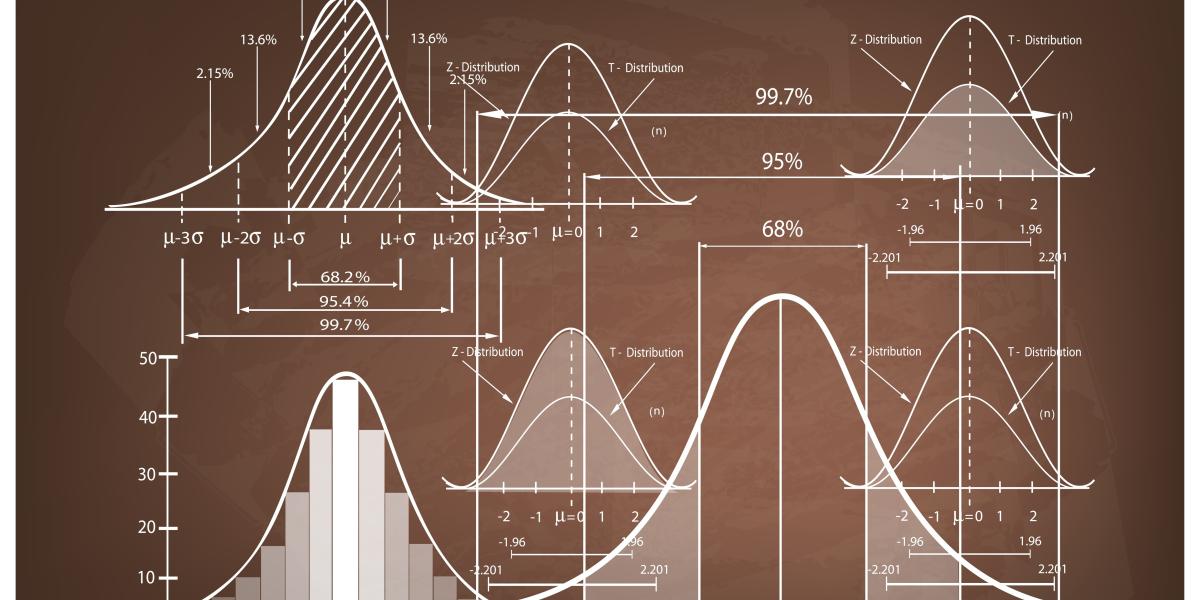
What is probability? The probability of an event is the proportion of times the event occurs out of a large number of trials. For instance, the probability of obtaining heads when a coin is tossed is 0.5. This does not mean that when a coin is tossed 10 times, five heads are always obtained. However, if the experiment is repeated a large number of times, then it is likely that 50 percent will be obtained. The greater the number of throws, the nearer the approximation is likely to be.
Alternatively, say it has been established that, in a particular area, the probability of wooden houses catching fire is 0.01. This means that, on the basis of experience, on average, one percent of wooden houses will catch fire. This does not mean that this year or the following year the percentage of houses catching fire will be exactly one percent. The percentage might be one percent or not each year. However, over time, the average of these percentages is likely to be 1 percent.
This information, in turn, can be converted into the cost of fire damage, thereby establishing the case for insuring against the risk of fire. Owners of wooden houses might decide to spread the risk by setting up a fund. Every owner of a wooden house will contribute a certain proportion to the total amount of money that is required in order to cover the damages of those owners whose houses are damaged by the fire. Note that insurance against fire risk can only take place because we know its probability distribution and because there are enough owners of wooden houses to spread the cost of fire damage among them so that the premium will not be prohibitive.
In his writings, Ludwig von Mises labeled this type of probability as a class probability. According to Mises,
Class probability means: we know or assume to know, with regard to the problem concerned, everything about the behavior of a whole class of events or phenomena; but about the actual singular events or phenomena we know nothing but that they are elements of this class.
Thus, the owners of wooden houses are all members of a particular group or class that can be affected in a similar way by a fire. We know that, on average, one percent of the members of this group is likely to be affected by fire. However, we do not know exactly who or when it will be. The important thing for insurance is that the members of a group must be homogeneous as far as a particular event is concerned.
Is Probability Distribution Relevant in Economics?
In economics, we do not deal with homogeneous cases. Each observation is a unique, non-repeatable event, which is not a member of any class—it is a class on its own. Consequently, no probability distribution can be established. Again, probability distribution rests on the assumption that we are dealing with a particular repeatable event.
Let us take, for instance, entrepreneurial activities. If these activities were repeatable, with known probability distributions, then we would not need entrepreneurs. After all, an entrepreneur is an individual who arranges his activities towards finding out consumers’ future wants. Now, individuals are consciously pursuing various ends. These ends never stay the same. Hence, a given good that is on the high priority list of consumers at present could be out of favor in the future. Thus, individuals’ requirements are never constant with respect to a particular good.
Since entrepreneurial activities are not homogeneous this means that probability distribution for entrepreneurial returns cannot be formed. For instance, in year one, an entrepreneurial activity yielded 10 percent return on investment. In year, two; another entrepreneurial activity produced a return of 15 percent. In year three, a third entrepreneurial activity secured a return of 1 percent. And, in year four, a fourth entrepreneurial activity generated a return of 2 percent—the average of these returns is 7 percent. By no means, however, does it imply that we can establish a probability distribution of returns on the basis as one can establish for the risk of fire or for obtaining heads in tossing a coin.
The returns in various years are the result of specific entrepreneurial activities. These activities are not homogeneous and repeatable and cannot be regarded as members of the same class. Profit emerges once an entrepreneur discovers that the prices of certain factors are undervalued relative to the potential value of the products that these factors, once employed, could produce. By recognizing the discrepancy and doing something about it, an entrepreneur removes the discrepancy (i.e., eliminates the potential for a further profit).
The recognition of the existence of potential profits means that an entrepreneur has a particular, subjective knowledge that other individuals do not have. Having this unique knowledge means that profits are not the outcome of random events. Mises labeled this as a case probability, which he defined as,
Case probability means: We know, with regard to a particular event, some of the factors which determine its outcome; but there are other determining factors about which we know nothing.
Mises held that the case probability is not open to any kind of numerical valuation. Human action cannot be analyzed in the same way that one would analyze objects where the class probability is relevant.
To make sense of the data in economics one must scrutinize it not by means of statistical methods but by means of trying to grasp and understand how it emerged. The assumption that mainstream economics makes that probability is valid in economics leads to absurd results. For it describes not a world of human beings who exercise their minds in making choices, but mechanistic, non-choosing, non-acting machines.
The employment of probabilities in economic analyses implies that the various pieces of economic data were generated by a random process similar to tossing a coin. Random means arbitrary (i.e., without method or conscious decision). However, if this had been the case, human beings would not be able to survive for too long. Human beings must act consciously and purposefully; they must plan their actions and employ suitable means.
Subjective versus Objective Probability
Now, if numerical probability cannot be established in economics objectively, what about subjective probability? The moment one moves into the subjective assignments of numbers, one could say anything. One could say that, based on personal feelings, there is a high likelihood of a recession in a few months’ time. Alternatively, one could say that he feels that the stock market must correct very soon. This way of stating things is derived from personal experience or some knowledge that an individual has.
This is part of the case probability (i.e. we know, with regard to a particular event certain things, but there are other determining factors about which we know nothing). For instance, we know that an increase in the money supply will unevenly exert in the future an upward pressure on the prices of goods. We, however, cannot be certain that prices will increase since there could be other off-setting factors about which we know nothing. It will not be of great benefit to arbitrarily assign numerical probabilities here.
Conclusion
Contrary to popular thinking, numerical probability is not applicable in economics. The numerical probability is relevant in the world of objects where homogenous cases are observed. In economics, we do not deal with homogeneous cases. Each observation is a unique, non-repeatable event caused by a particular action by individuals. Consequently, no probability distribution can be established. Human action cannot be analyzed in the same way that one would analyze objects. To make sense of an historical data one must scrutinize it not by means of statistical methods but by means of trying to grasp and understand the true nature of it.
The assumption that mainstream economics makes that probability distribution exists and can be quantified describes, not a world of human beings who exercise their minds in making choices, but machines.