No Result
View All Result
SUBMIT YOUR ARTICLES
  • Login
Sunday, March 1, 2026
TheAdviserMagazine.com
  • Home
  • Financial Planning
    • Financial Planning
    • Personal Finance
  • Market Research
    • Business
    • Investing
    • Money
    • Economy
    • Markets
    • Stocks
    • Trading
  • 401k Plans
  • College
  • IRS & Taxes
  • Estate Plans
  • Social Security
  • Medicare
  • Legal
  • Home
  • Financial Planning
    • Financial Planning
    • Personal Finance
  • Market Research
    • Business
    • Investing
    • Money
    • Economy
    • Markets
    • Stocks
    • Trading
  • 401k Plans
  • College
  • IRS & Taxes
  • Estate Plans
  • Social Security
  • Medicare
  • Legal
No Result
View All Result
TheAdviserMagazine.com
No Result
View All Result
Home Market Research Economy

Status of the US Dollar as Global Reserve Currency: USD Share Drops to Lowest Since 1994

by TheAdviserMagazine
2 months ago
in Economy
Reading Time: 5 mins read
A A
Status of the US Dollar as Global Reserve Currency: USD Share Drops to Lowest Since 1994
Share on FacebookShare on TwitterShare on LInkedIn


Yves here. This Wolf Richter provides some important context on the status of the dollar. Recall that 1994 was just after the fall of the USSR and hence during peak US hegemony, at least militarily. And independent of the Trump Administration’s considerable self-inflicted wounds, the position of the dollar as reserve currency should be expected to diminish over time as US share of global GDP falls.

By Wolf Richter, editor at Wolf Street. Originally published at Wolf Street

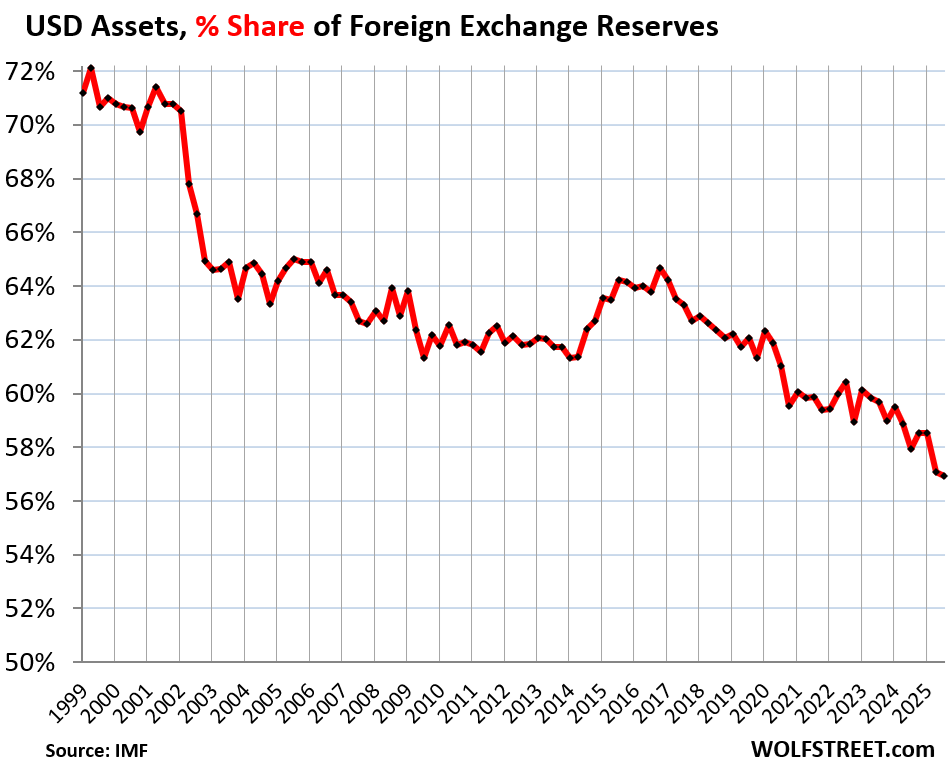
The share of USD-denominated assets held by other central banks dropped to 56.9% of total foreign exchange reserves in Q3, the lowest since 1994, from 57.1% in Q2 and 58.5% in Q1, according to the IMF’s new data on Currency Composition of Official Foreign Exchange Reserves.

USD-denominated foreign exchange reserves include US Treasury securities, US mortgage-backed securities (MBS), US agency securities, US corporate bonds, and other USD-denominated assets held by central banks other than the Fed.

Excluded are any central bank’s assets denominated in its own currency, such as the Fed’s Treasury securities or the ECB’s euro-denominated securities.

It’s not that foreign central banks dumped US-dollar-denominated assets, such as Treasury securities. They did not. They added a little to their holdings. But they added more assets denominated in other currencies, particularly a gaggle of smaller currencies whose combined share has surged, while central banks’ holdings of USD-denominated assets haven’t changed much for a decade, and so the percentage share of those USD assets continued to decline.

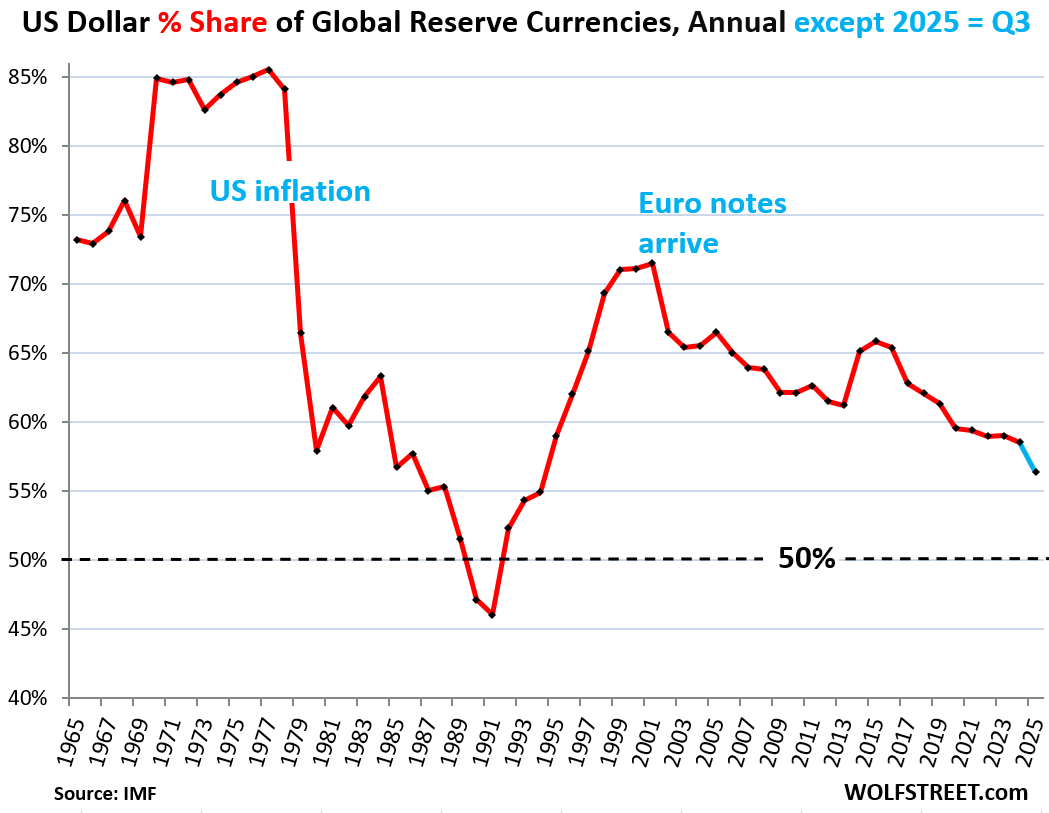
As the dollar’s share declines toward the 50% line, the dollar would still be by far the largest reserve currency, as all other currencies combined would weigh as much as the dollar. But it does have consequences.

Why Is Having the Top Reserve Currency Important for the US?

Foreign central banks buying USD-denominated assets, such as Treasury securities, helps push up prices and push down yields of those assets. Being the dominant reserve currency had the effect of helping the US borrow more cheaply to fund its huge twin deficits – the trade deficit and the budget deficit – and thereby has enabled the US to run those huge twin deficits for decades. At some point, this continued decline as a reserve currency, as it reduces demand for USD debt, would make the trade deficit and the budget deficit more difficult to sustain.

The dollar’s share had already been below 50% before, in 1990 and 1991, after a long plunge from the peak in 1977 (share of 85.5%). This plunge accompanied a deep crisis in the US with sky-high inflation and interest rates, and four recessions over those years, including the nasty double-dip recession. Central banks lost confidence in the Fed’s willingness or ability to do what it takes to get this inflation under control that had washed over the US in three ever larger waves.

The dotted line in the chart below indicates the 50%-share. The dollar’s share bottomed out at 46% in 1991, by which time the Fed had brought inflation under control, and soon, central banks began loading up on dollar-assets.

Then came the euro, which turned into the next set-back for the dollar, but not nearly as much as European politicians had promised when pushing the euro through the system; they were talking about parity with the dollar. That talk ended with the Euro Debt Crisis that began in 2009.

Then, over the past 10 years, came dozens of smaller “non-traditional reserve currencies,” as the IMF calls them.

The chart shows the dollar’s share at the end of each year, except 2025 where it shows the share in Q3:
But They Didn’t Actually Dump USD-Denominated Securities

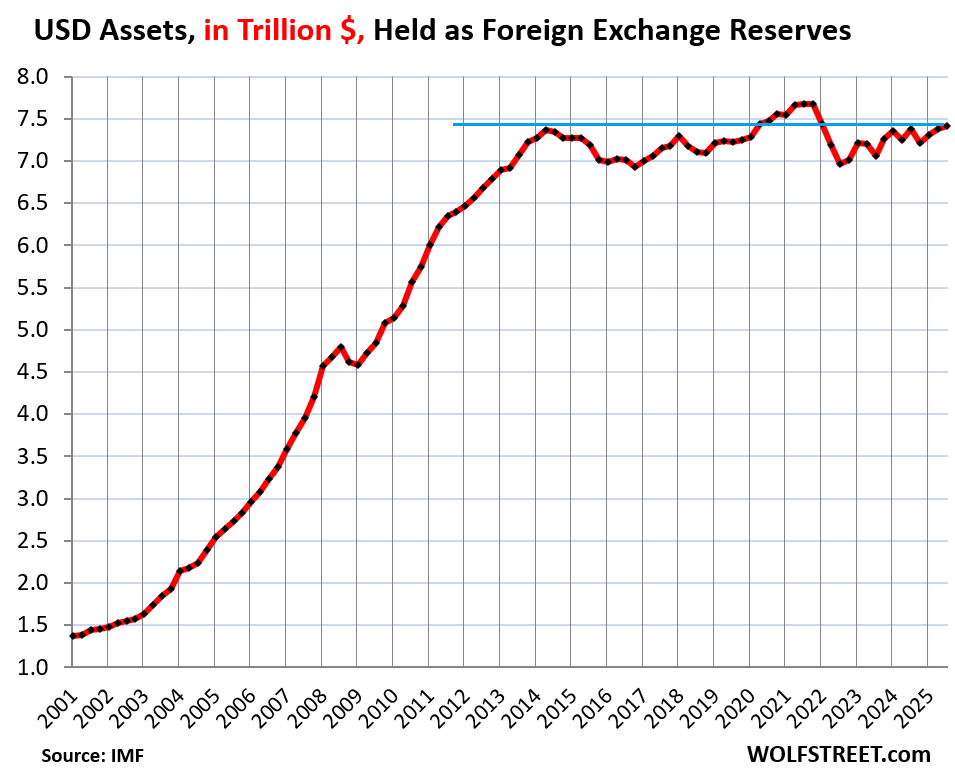
Foreign central banks increased their holdings of USD-denominated assets by a hair in Q3 to $7.4 trillion, the third increase in a row.

Since mid-2014, despite some sharp ups and downs, their holdings of USD-assets have remained essentially flat.

So, what has caused the percentage share of USD assets to decline over the years is the growth of foreign exchange reserves denominated in other currencies, particularly many smaller currencies, as central banks have been diversifying their growing pile of foreign exchange assets.

The chart below shows foreign central banks’ holdings of USD-denominated assets – US Treasury securities, US MBS, US agency securities, US corporate bonds, etc. – in trillions of dollars:
The Top Foreign Exchange Reserves by Currency

Central banks’ holdings of foreign exchange reserves in all currencies, and expressed in USD, rose to $13.0 trillion in Q3.

Top holdings, expressed in USD:

USD assets: $7.41 trillion
Euro assets (EUR): $2.65 trillion
Yen assets (YEN): $0.76 trillion
British pound assets (GBP): $0.58 trillion
Canadian dollar assets (CAD): $0.35 trillion
Australian dollar assets (AUD): $0.27 trillion
Chinese renminbi (RMB) assets: $0.25 trillion

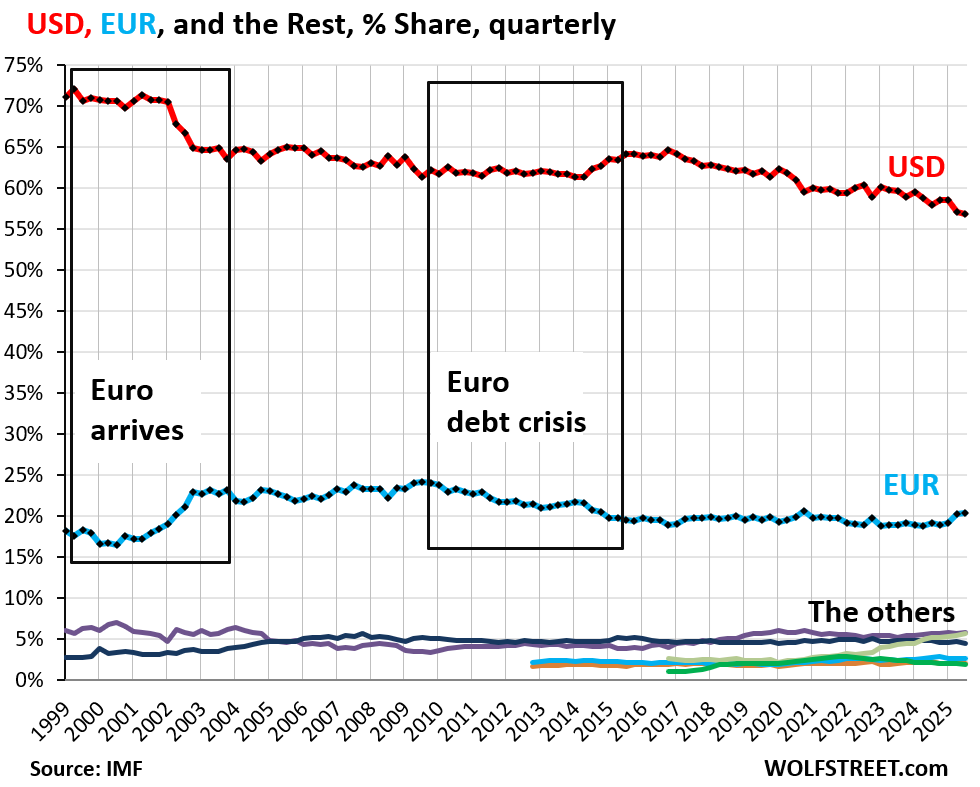
The euro’s share, #2, has been around 20% since 2015. Before the Euro Debt Crisis, it was on an upward trajectory and had already risen to nearly 25%.

The rest of the reserve currencies are the colorful spaghetti at the bottom of the chart (more in a moment). Combined, they have gained share over the years, at the expense of the dollar, while the euro’s share has remained roughly stable since 2015.
The rise of the “non-traditional” reserve currencies

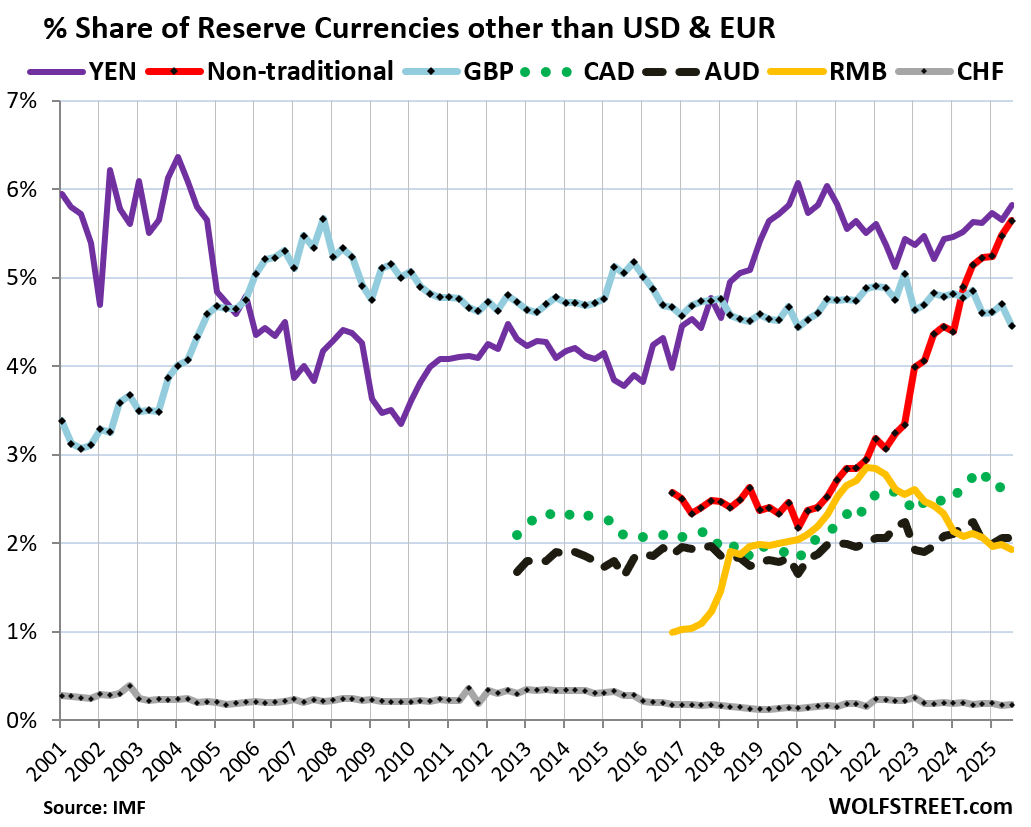
The chart below takes a magnifying glass to the colorful spaghetti at the bottom of the chart above.

The soaring red line shows the combined surge of assets denominated in dozens of smaller “nontraditional reserve currencies,” as the IMF calls them. Combined, they reached a share of 5.6%, just below the yen-denominated assets (5.8%).

But the share of the RMB (yellow) has been declining since Q1 2022, and its share is now back where it had been in 2019, amid ongoing capital controls, convertibility issues, and a slew of other issues.

In other words, the USD and the RMB both have given up share to the “non-traditional reserve currencies” as other central banks have been diversifying away from assets denominated in USD and RMB.
In case you missed my update on a slightly less ugly situation: US Government Interest Payments to Tax Receipts, Average Interest Rate on the Debt, and Debt-to-GDP Ratio in Q3 2025

Print Friendly, PDF & Email


Source link

Tags: CurrencydollardropsGlobalLowestReserveSharestatusUSD
ShareTweetShare
Previous Post

Warren Buffett retires on December 31 and leaves behind a manual for a life in investing

Next Post

8 “cheap” habits of lower-middle-class people that are actually genius financial moves

Related Posts

edit post
US & Israel Vs Iran

US & Israel Vs Iran

by TheAdviserMagazine
February 28, 2026
0

QUESTION: Mr. Armstrong, you pointed out previously that Zelensky was a war criminal for targeting leaders in Russia. You wrote:...

edit post
US Iran War – Here We Go Again

US Iran War – Here We Go Again

by TheAdviserMagazine
February 28, 2026
0

This is an important report discussing the real implications of this War which has always been about Regime Change and...

edit post
Iran Attacks UAE | Armstrong Economics

Iran Attacks UAE | Armstrong Economics

by TheAdviserMagazine
February 28, 2026
0

  We are in contact with UAE since we do have officies there. All flights have been cancelled. The explosions...

edit post
The Multipolar Collapse And The Illusion Of AI With Martin Armstrong

The Multipolar Collapse And The Illusion Of AI With Martin Armstrong

by TheAdviserMagazine
February 28, 2026
0

Legendary forecaster Martin Armstrong appears on Outer Limits of Inner Truth and warns that the world is entering a new...

edit post
Market Talk – February 27, 2026

Market Talk – February 27, 2026

by TheAdviserMagazine
February 27, 2026
0

ASIA: The major Asian stock markets had a mixed day today: • NIKKEI 225 increased 96.88 points or 0.16% to...

edit post
Are Dorsey’s giant job cuts the start of an AI jobs apocalypse? Economists weigh in

Are Dorsey’s giant job cuts the start of an AI jobs apocalypse? Economists weigh in

by TheAdviserMagazine
February 27, 2026
0

Block CEO Jack Dorsey's move to cut nearly half the company's workforce is shining a spotlight on a growing question...

Next Post
edit post
8 “cheap” habits of lower-middle-class people that are actually genius financial moves

8 "cheap" habits of lower-middle-class people that are actually genius financial moves

edit post
Vijay Kedia’s Portfolio in CY25: Most stocks slide, 6 drop up to 68% — Are you impacted? – Vijay Kedia Portfolio

Vijay Kedia’s Portfolio in CY25: Most stocks slide, 6 drop up to 68% — Are you impacted? - Vijay Kedia Portfolio

  • Trending
  • Comments
  • Latest
edit post
Foreclosure Starts are Up 19%—These Counties are Seeing the Highest Distress

Foreclosure Starts are Up 19%—These Counties are Seeing the Highest Distress

February 24, 2026
edit post
Medicare Fraud In California – 2.5% Of The Population Accounts For 18% Of NATIONWIDE Healthcare Spending

Medicare Fraud In California – 2.5% Of The Population Accounts For 18% Of NATIONWIDE Healthcare Spending

February 3, 2026
edit post
North Carolina Updates How Wills Can Be Stored

North Carolina Updates How Wills Can Be Stored

February 10, 2026
edit post
Gasoline-starved California is turning to fuel from the Bahamas

Gasoline-starved California is turning to fuel from the Bahamas

February 15, 2026
edit post
Where Is My 2025 Oregon State Tax Refund

Where Is My 2025 Oregon State Tax Refund

February 13, 2026
edit post
7 States Reporting a Surge in Norovirus Cases

7 States Reporting a Surge in Norovirus Cases

February 22, 2026
edit post
The Overlooked Link Between Social Security COLA and Medicare IRMAA Brackets

The Overlooked Link Between Social Security COLA and Medicare IRMAA Brackets

0
edit post
OPEC+ to resume oil output increases as Iran conflict rages

OPEC+ to resume oil output increases as Iran conflict rages

0
edit post
University of Iowa seeks to cut 7 degrees

University of Iowa seeks to cut 7 degrees

0
edit post
IRS Notice CP501 vs CP503: What’s the Difference?

IRS Notice CP501 vs CP503: What’s the Difference?

0
edit post
13 of the Best Places to Retire in Nevada

13 of the Best Places to Retire in Nevada

0
edit post
Nine killed as Iranian missile hits Beit Shemesh

Nine killed as Iranian missile hits Beit Shemesh

0
edit post
OPEC+ to resume oil output increases as Iran conflict rages

OPEC+ to resume oil output increases as Iran conflict rages

March 1, 2026
edit post
Who buys Bitcoin after five straight weeks of ETF outflows?

Who buys Bitcoin after five straight weeks of ETF outflows?

March 1, 2026
edit post
Nine killed as Iranian missile hits Beit Shemesh

Nine killed as Iranian missile hits Beit Shemesh

March 1, 2026
edit post
Gold, silver prices likely to soar tomorrow amid escalating Middle East war; what lies ahead?

Gold, silver prices likely to soar tomorrow amid escalating Middle East war; what lies ahead?

March 1, 2026
edit post
Why Ray Dalio, Scott Bessent and others are rallying around a ‘3% solution’ to the national debt

Why Ray Dalio, Scott Bessent and others are rallying around a ‘3% solution’ to the national debt

March 1, 2026
edit post
Psychology says the way someone behaves at an airport gate when their flight is delayed reveals the difference between people who complain and people who go quiet tells you almost everything about how they were taught to handle situations they can’t control

Psychology says the way someone behaves at an airport gate when their flight is delayed reveals the difference between people who complain and people who go quiet tells you almost everything about how they were taught to handle situations they can’t control

March 1, 2026
The Adviser Magazine

The first and only national digital and print magazine that connects individuals, families, and businesses to Fee-Only financial advisers, accountants, attorneys and college guidance counselors.

CATEGORIES

  • 401k Plans
  • Business
  • College
  • Cryptocurrency
  • Economy
  • Estate Plans
  • Financial Planning
  • Investing
  • IRS & Taxes
  • Legal
  • Market Analysis
  • Markets
  • Medicare
  • Money
  • Personal Finance
  • Social Security
  • Startups
  • Stock Market
  • Trading

LATEST UPDATES

  • OPEC+ to resume oil output increases as Iran conflict rages
  • Who buys Bitcoin after five straight weeks of ETF outflows?
  • Nine killed as Iranian missile hits Beit Shemesh
  • Our Great Privacy Policy
  • Terms of Use, Legal Notices & Disclosures
  • Contact us
  • About Us

© Copyright 2024 All Rights Reserved
See articles for original source and related links to external sites.

Welcome Back!

Login to your account below

Forgotten Password?

Retrieve your password

Please enter your username or email address to reset your password.

Log In
No Result
View All Result
  • Home
  • Financial Planning
    • Financial Planning
    • Personal Finance
  • Market Research
    • Business
    • Investing
    • Money
    • Economy
    • Markets
    • Stocks
    • Trading
  • 401k Plans
  • College
  • IRS & Taxes
  • Estate Plans
  • Social Security
  • Medicare
  • Legal

© Copyright 2024 All Rights Reserved
See articles for original source and related links to external sites.