9 minutes read
Published Dec 22, 2025
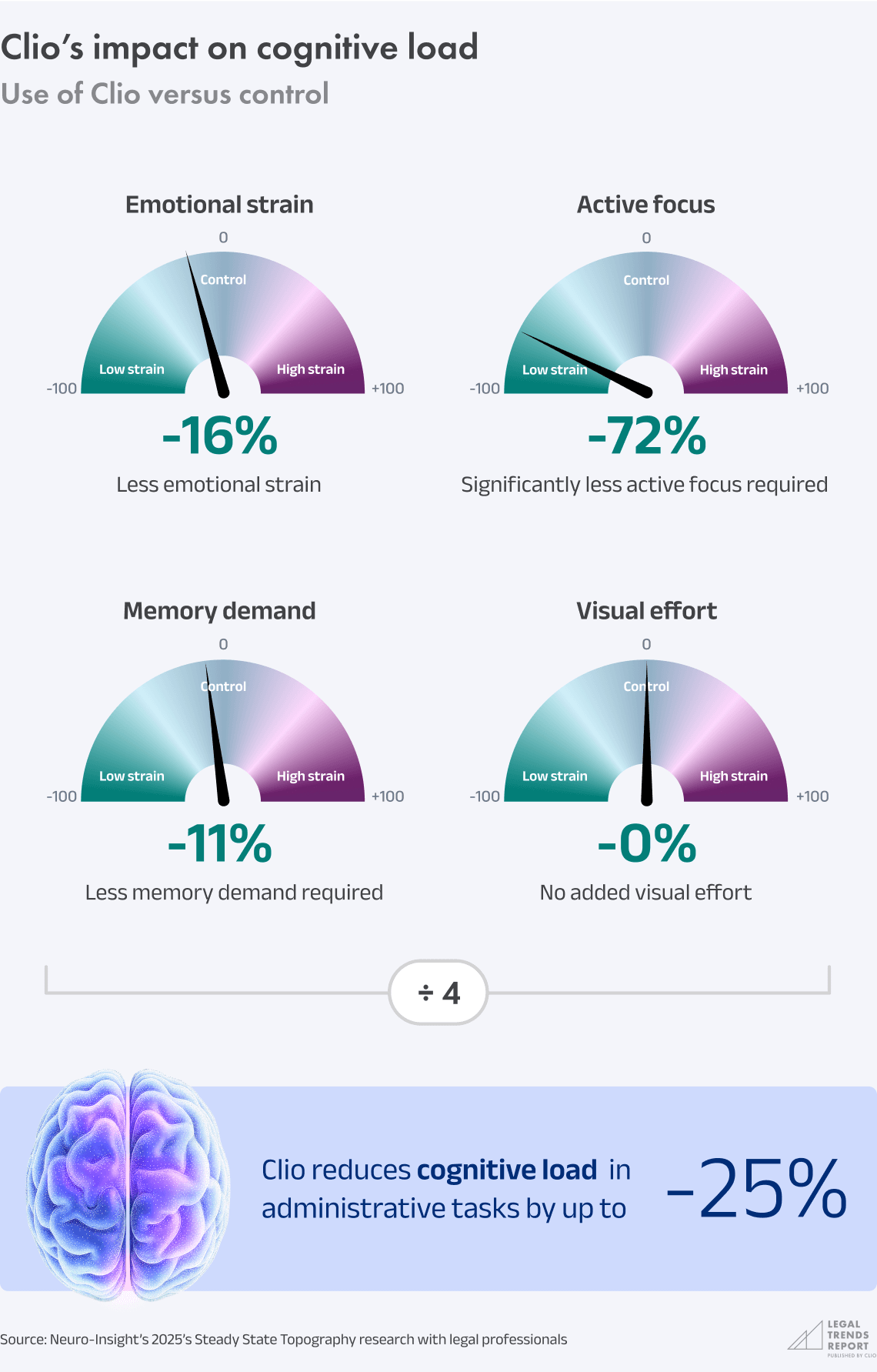
Combatting the inevitable cognitive strain in legal work is essential for improving mental health and reducing error risk. New research shows that adopting legal technology significantly reduces mental load, allowing legal professionals to conserve mental energy for more demanding work:
Reduces total cognitive load by up to 25%, making your team more effective.
Cuts the active mental focus
Lowers emotional strain by 16% during client intake, fostering more positive work experiences
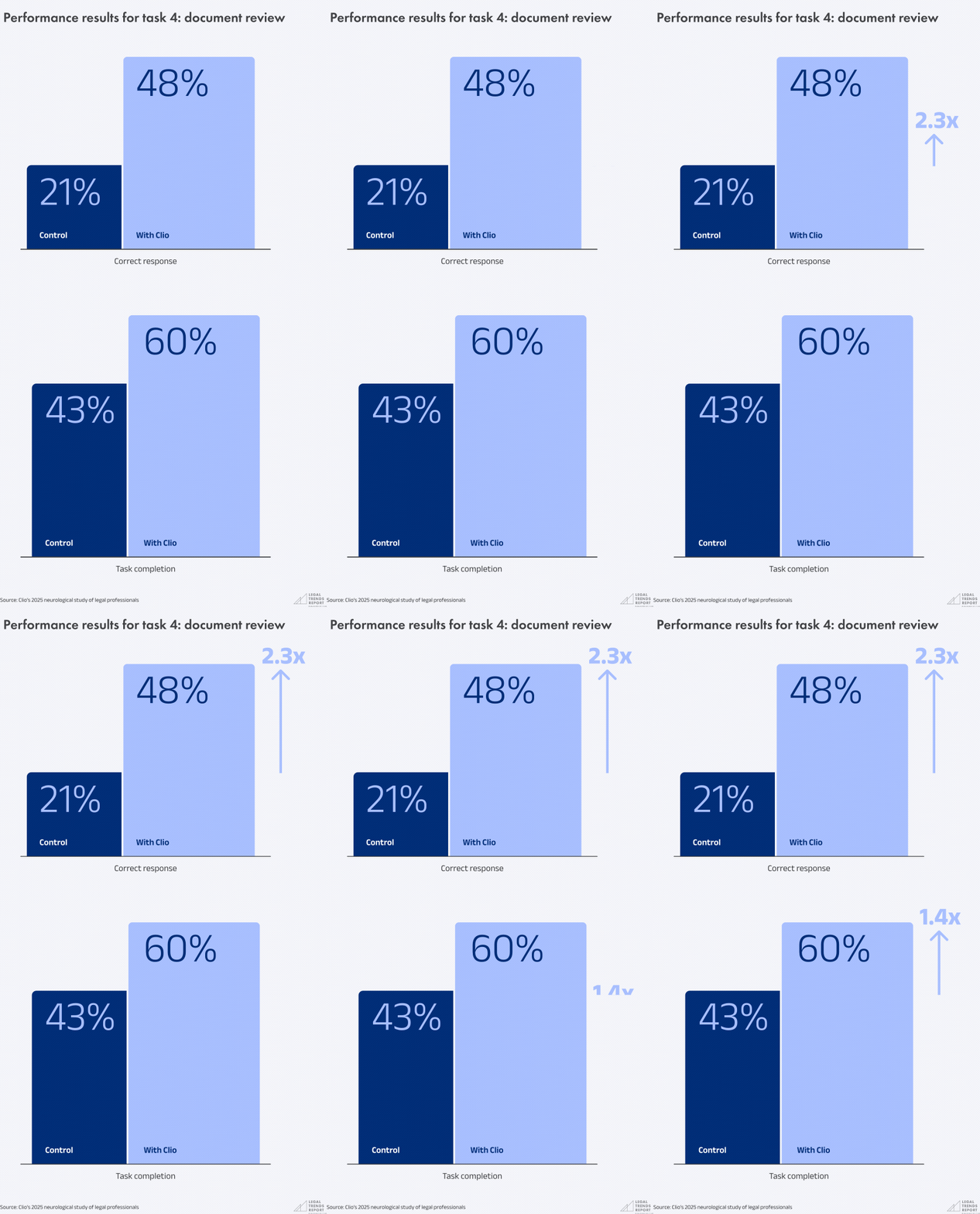
Eases memory demand in complex document review, leading to higher accuracy and completion rates (up to 40% improvement).
On its own, cognitive overload in lawyers may seem to be an inalienable part of working in a law firm. But when examined more closely, cognitive overload should be a cause for concern for both lawyers and their law firms.
It’s no secret that working in the legal profession is highly demanding. The long hours, the information-heavy nature of the work, and the stress of avoiding costly mistakes all take a heavy toll on mental health and work-life balance.
As humans, our brains only have so much capacity for processing information, focusing attention, and remembering key details, while also having to take countless client problems to heart. Pushing yourself beyond this capacity can bring on significant bouts of mental fatigue, and regularly pushing beyond your limit can bring about more chronic issues such as burnout and depression, and in some cases even lead to substance abuse.
In this post, we’ll look at research on what contributes to cognitive overload, as well as new findings in the Legal Trends Report that look at how the use of technology can reduce mental strain in legal professionals in their daily work.
Mental health is a known problem in the legal profession
It can’t be talked about enough: legal professionals suffer disproportionally from mental health issues.
A recent study from Bloomberg Law found that lawyers reported feeling burned out in their work 42% of the time. Two key factors were that 49% were unable to disconnect from their work and 44% had trouble focusing while performing work tasks. Another study from ALM Intelligence and Law.com Compass found that 73% of lawyers and their staff felt their work environment contributed to mental health issues.
Mental fatigue has been shown to be a key contributor to these types of health issues. Over time, individuals who are put under sustained cognitive overload often feel mentally fatigued, stressed, and anxious about their work. These symptoms lead to burnout, emotional exhaustion, and depression.
Cognitive overload and mental fatigue in staff can also affect the law firms they work for. Mental fatigue can reduce the ability to concentrate and process information, which in turn can lead to a greater risk of error. Stress, long hours, and on-the-job strain can also be a complicating factor for mental fatigue, especially when doing work that requires a high degree of attention to detail.
Repetition and context switching are part of the problem
Most law firms can’t simply reduce the amount of work they take on, especially if high hourly billing targets are at stake. What firms can do, however, is create better working environments that offer more efficient processes and automations (more on this below).
Simply having to do the same, repetitive rote work over and over can be a significant drain on the brain’s executive functioning, which only exacerbates the problems of cognitive overload. Tasks like checking email, managing time tracking, or reviewing client bills can very quickly add up in terms of the amount of time they take, and the attention they require. Simple tasks often involve a lot of context switching, which can be taxing in and of itself.
Recent research shows that it takes workers an average of 9.5 minutes to regain focus after switching between two different contexts. Even switching between software applications has been shown to create stress hormones that have a negative impact on the ability to focus. The time to redirect attention can add up. Another study found that the average worker spends four hours per week reorienting between apps. Over the course of a year, that amounts to five weeks, or 9%, of annual work time.
Get the Latest Legal Trends Report
The latest Legal Trends Report is here! See how firms achieve 4x faster growth, meet AI-first clients, and reduce stress by 25%, plus more insights driving the future of law.
Get the report

New research into reducing cognitive overload in legal work
To better understand how to reduce cognitive overload in legal professionals, Clio worked with Neuro-Insight, one of the world’s leading neuroanalytics researchers, to conduct a neurological study of legal professionals.
In the study, researchers used proprietary Steady State Topography™ to measure brain activity in 63 legal professionals as they performed a series of timed work tasks. Study participants performed each task twice, once with a method used as a control, and once modified with the use of Clio. The control and Clio tasks were performed in randomized order with the goal of investigating how legaltech can help reduce cognitive load in common tasks at a law firm.
When averaging the different areas of benefit to cognitive functioning, the researchers found that participants reduced total cognitive load by up to 25% when using Clio.
Here’s a breakdown on the key benefits that support better, more functional mental activities in legal professionals.
Reducing the active focus needed to calculate billable hours
Active mental focus: The conscious, deliberate effort spent on directing one’s attention to a task while ignoring distractions.
Lawyers often need to work through a lot of tedious information with a high amount of attention to detail. One of the biggest findings from the study is that Clio reduced the amount of active focus required for calculating billable hours by 72%.
For the task, participants were asked to create a work-in-progress report to inform a firm manager of their billable hours for a divorce case. For the control, participants reviewed their activities in a spreadsheet, which was compared to completing the same task by reviewing a list of activities logged in Clio Manage.
The fact that researchers saw such a drop in active focus while using Clio means that participants significantly reduced mental load in this area of brain activity. This allowed them to complete a routine task with less effort, conserving mental energy for more demanding legal work.
Reduced emotional strain while logging client information
Emotional strain: The mental and emotional cost on an individual that occurs while performing a task.
While dealing with the sheer amount of information in a law firm can be a challenge, the emotional toll is also a significant factor for many legal professionals, and any other stressors only add to the mental load that they bear.
In a client intake task, emotional strain was reduced by 16% by participants using Clio Grow’s quick intake workflow compared to those who logged a list of client details into a spreadsheet. Further, researchers found that 93% of all emotions felt while using Clio were positive—the most dominant feelings being excitement (47%) and happiness (47%).
For the intake task specifically, those using Clio Grow felt nothing but positive emotions. Comparatively, they were more likely to feel negative emotions like anger while filling out intake data in a spreadsheet.
Easing memory demand in legal document review
Memory demand: The mental effort required to remember information to complete tasks.
Even simple tasks can require a significant demand on remembering key details, which in turn puts a heavy strain on cognitive load. One of the simplest ways to reduce the cognitive strain is to minimize the amount of information that one has to remember.
In a task involving the review of a six-page legal document (in this case, a will), participants were asked to answer a legal question regarding a third-party contestation and how it could affect the beneficiary. In the control, participants reviewed the document as a PDF, which was compared to the effort required in using Clio’s AI to find and analyze the information needed for the task.
When comparing the data, the researchers found that Clio’s AI reduced memory demand in participants by 11%. This means that participants spent less mental energy remembering key details to complete the task.
Reducing cognitive load by 25%
When averaging the cognitive load benefits of using Clio, researchers determined that legal professionals can save up to 25% of their mental load.
This is in addition to reviewing the visual effort comparing the use of Clio to other methods for each task. Visual effort is typically looked at as an assessment of potential barriers introduced by certain tools or workflows, and it typically increases when study participants are asked to perform tasks in a new environment.
In this case, the majority of study participants were using Clio for the first time and saw no added difficulties in visual effort, which the researchers noted as a positive result for the intuitive user design of the Clio platform.
Added benefits to work quality and performance from Clio’s AI
Aside from reducing the cognitive effort in legal professionals, one of the most significant results from the study was that the use of Clio’s AI not only reduced cognitive load but also greatly improved the quality of work among participants.
In the document review task, when using Clio’s AI, participants were more than twice as likely to answer the beneficiary question correctly, and they increased completion rates for the task by 40%.
In addition to making the work easier for participants in the study, the use of Clio’s AI made these legal professionals better at their jobs. Looked at on another scale of impact, the data shows that the use of AI benefits both legal professionals (in terms of the ease of workload) and the law firms they work for (in terms of the quality of work done for clients).
Interested in learning more about the use of AI in the legal profession and getting access to insights based on aggregated and anonymized data from tens of thousands of legal professionals? Read more in the latest Legal Trends Report.
Your team is your law firm’s most important asset
Since legal work is so knowledge-intensive, the people you have at your law firm are your most valuable asset in delivering quality work for your clients and bringing revenue into your firm. The more you can do to take care of your people and minimize the mental burdens they take on, the better equipped (and valuable) they will be to you in the long run.
In fact, cognitive load management is becoming an important focus for people managers working in professional services.
Working in a law firm is intrinsically difficult and requires extensive knowledge management and task switching. Poor systems, disjointed tools, and administrative work add unnecessary burdens to firms, increasing cognitive fatigue and risk of error. To support legal professionals in their capacity to keep their minds on the tasks at hand, firms should:
Give staff the tools and resources to better navigate complex information
Automate routine busywork to minimize or eliminate distractions where possible
What makes lawyers feel less stressed and more motivated in their work?
Giving lawyers and their staff better tools can also give them more time to focus on the work that truly motivates them. In turn, staff who are motivated will deliver better-quality work, and they will be less likely to seek job opportunities elsewhere.
In interview studies with a group of legal professionals, discussed in the 2025 Legal Trends Report, Clio’s researchers explored what types of work were more likely to motivate lawyers and what types of work were more likely to cause stress and cognitive strain.
For example, in their conversations, researchers found that the biggest stress drivers were difficult clients, the emotional strain involved in contentious cases, and the burden of running a practice (especially among solo lawyers). Administrative work like timekeeping and managing schedules also contributed to mental load.
Conversely, lawyers reported feeling less stressed when they were immersed in more purpose-driven work, when they could see the positive impact of their work, and when they had more autonomy. Overall, they felt more balanced when they were in control of their schedule, had better systems and technology to support them, and had more positive relationships with their clients.
In other words, lawyers feel a lot better when they are able to put more time into the work that they find rewarding and feel more supported by the systems they work with.
Demotivators
Administrative and billing tasks
Client-related frustrations
Work overload
Fatigue
Poor work-life balance
Motivators
Positive relationships and impact with clients
Intellectual challenges and the ability to problem-solve
Autonomy and control
Building and running their own business
Professional growth and achievement
Legal technology that reduces cognitive overload
Clio’s legal technology is designed to help law firms be more organized and efficient, while also providing AI capabilities that support every task, from drafting monthly bills to conducting comprehensive research with one of the world’s largest legal databases.
Our team is also on hand to demonstrate how Clio can support the exact workflows looked at in these studies, which can help you automate billing work, streamline client intake, and help you get your work done a lot more efficiently, and with better quality results using AI.
Interested in learning more about how Clio’s Intelligent Legal Work Platform can reduce cognitive load and provide the foundational support for the business and practice of your law firm? Book your demo with Clio today.
Book a Clio demo
What is cognitive overload in legal work?
Cognitive overload in legal work occurs when the mental demands of managing information, decisions, and responsibilities exceed a lawyer’s working memory and attention capacity, reducing focus and judgment.
Does cognitive overload affect legal accuracy and risk?
Yes. Cognitive overload reduces attention and information processing, which can increase the likelihood of errors, missed details, and slower or poorer decision-making in legal work.
How is cognitive overload different from burnout?
Burnout is a long-term outcome, while cognitive overload is a day-to-day condition. Sustained cognitive overload often precedes burnout by creating ongoing mental fatigue and reduced performance.
How does technology help reduce cognitive overload for lawyers?
Legal technology can reduce cognitive overload by minimizing repetitive tasks, reducing memory demands, limiting context switching, and supporting faster access to relevant information during legal work.
Can cognitive overload be reduced without working fewer hours?
Yes. Reducing cognitive overload often involves changing workflows, tools, and information design rather than reducing workload. Automation, better systems, and memory offloading can lower mental strain without reducing output.
What are the earliest signs of cognitive overload lawyers often miss?
Early signs include difficulty focusing on complex tasks, needing to reread documents repeatedly, ruminating on unfinished tasks after hours, and increased reliance on memory instead of systems.
Which types of legal work create the highest cognitive load?
High-volume administrative tasks, frequent context switching between matters, emotionally demanding cases, and complex document review are among the most cognitively demanding aspects of legal work.
Is reducing cognitive overload mainly an individual or firm responsibility?
While individuals can adopt better habits, cognitive overload is largely driven by systems, tools, and workflows. Firms play a central role in reducing unnecessary cognitive strain through better technological infrastructure.
Loading …