No Result
View All Result
SUBMIT YOUR ARTICLES
  • Login
Wednesday, February 4, 2026
TheAdviserMagazine.com
  • Home
  • Financial Planning
    • Financial Planning
    • Personal Finance
  • Market Research
    • Business
    • Investing
    • Money
    • Economy
    • Markets
    • Stocks
    • Trading
  • 401k Plans
  • College
  • IRS & Taxes
  • Estate Plans
  • Social Security
  • Medicare
  • Legal
  • Home
  • Financial Planning
    • Financial Planning
    • Personal Finance
  • Market Research
    • Business
    • Investing
    • Money
    • Economy
    • Markets
    • Stocks
    • Trading
  • 401k Plans
  • College
  • IRS & Taxes
  • Estate Plans
  • Social Security
  • Medicare
  • Legal
No Result
View All Result
TheAdviserMagazine.com
No Result
View All Result
Home Market Research Market Analysis

The Synthetic Data Question in the Age of AI

by TheAdviserMagazine
5 months ago
in Market Analysis
Reading Time: 4 mins read
A A
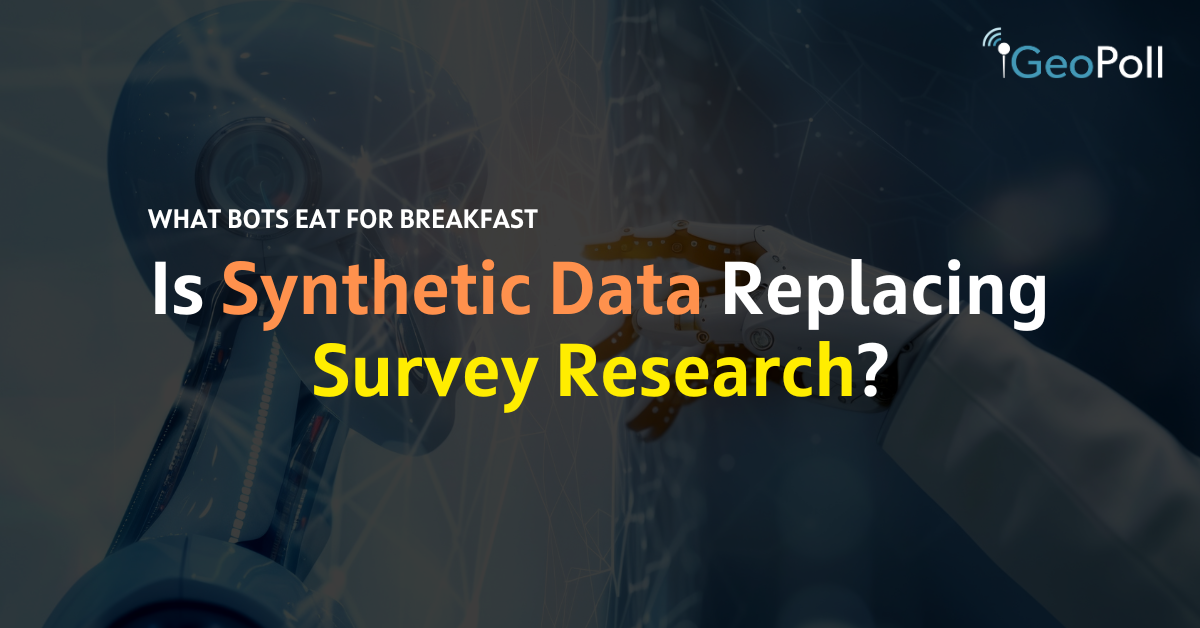
The Synthetic Data Question in the Age of AI
Share on FacebookShare on TwitterShare on LInkedIn


Last week, our lead software engineer, Nelson Masuki and I presented at the MSRA Annual Conference to a room full of brilliant researchers, data scientists, and development practitioners from across Kenya and Africa. We were there to address a quietly growing dilemma in our field: the rise of synthetic data and its implications for the future of research, particularly in the regions we serve.

Our presentation was anchored in findings from our whitepaper that compared results from a traditional CATI survey data with synthetic outputs generated using several large language models (LLMs). The session was a mix of curiosity, concern, and critical thinking, especially when we demonstrated how off-the-mark synthetic data can be in places where cultural context, language, or ground realities are complex and rapidly changing.

We started the presentation by asking everyone to prompt their favourite AI app with some exact questions to model survey results. No two people in the hall got the same answers. Even though the prompt was exactly the same, and many people used the same apps on the same models, issue one.

The experiment

We then presented the findings from our experiments. Starting with a CATI survey of over 1,000 respondents in Kenya, we conducted a 25-minute study on several areas: food consumption, media and technology use, knowledge and attitudes toward AI, and views on humanitarian assistance. We then took the respondents’ demographic information (age, gender, rural-urban setting, education level, and ADM1 location) and created synthetic data respondents (SDRs) that exactly matched those respondents, and administered the same questionnaire across several LLMs and models (even did repeat cycles with newer, more advanced models). The differences were as varied as they were skewed – almost always wrong. Synthetic data failed the one true test of accuracy – the authentic voice of the people.

Many in the room had faced the same tension: global funding cuts, increasing demands for speed, and now, the allure of AI-generated insights that promise “just as good” without ever leaving a desk. But for those of us grounded in the realities of Africa, Asia, and Latin America, the idea of simulating the truth, of replacing real people with probabilistic patterns, doesn’t sit right.

This conversation, and others we had throughout the conference, affirmed a growing truth – AI will undoubtedly shape the future of research, but it must not replace real human input. At least not yet, and not in the parts of the world where truth on the ground doesn’t live in neatly labeled datasets. We cannot model what we’ve never measured.

Why Synthetic Data Can’t Replace Reality – Yet

Synthetic data is exactly what it sounds like: data that hasn’t been collected from real people, but generated algorithmically based on what models think the answers should be. In the research world, this typically involves creating simulated survey responses based on patterns identified from historical data, statistical models, or large language models (LLMs). While synthetic data can serve as a functional testing tool, and we are continually testing its utility in controlled experiments, it still falls short in several critical areas: it lacks ground truth, it missed nuance and context, and therefore it’s hard to trust.

And that’s precisely the problem.

In our side-by-side comparison of real survey responses and synthetic responses generated via LLMs, the differences were not subtle – they were foundational. The models guessed wrong on major indicators like unemployment levels, digital platform usage, and even simple household demographics.

I don’t believe this is just a statistical issue. It’s a context issue. In regions such as Africa, Asia, and Latin America, ground realities change rapidly. Behaviors, opinions, and access to services are highly local and deeply tied to culture, infrastructure, and lived experience. These are not things a language model trained predominantly on Western internet content can intuit.

Synthetic data can, indeed, be used

Synthetic data isn’t inherently bad. Lest you think we are anti-tech (which we can never be accused of), at GeoPoll, we do use synthetic data, just not as a replacement of real research. We use it to test survey logic and optimize scripts before fieldwork, simulate potential outcomes and spot logical contradictions in surveys, and experiment with framing by running parallel simulations before data collection.

And yes, we could generate synthetic datasets from scratch. With more than 50 million completed surveys across emerging markets, our dataset is arguably one of the most representative foundations for localized modeling.

However, we’ve also tested its limits, and the findings are clear: synthetic data cannot replace real, human-sourced insights in low-data environments. We don’t believe it’s ethical or accurate to replace fieldwork with simulations, especially when decisions about policy, investment, or aid are at stake. Synthetic data has its place. But in our view, it is not, and should not be, a shortcut for understanding real people in underrepresented regions. It’s a tool to augment research, not a replacement for it.

Data Equity Starts with Inclusion – GeoPoll AI Data Streams

There’s a significant reason this matters. While some are racing to build the next large language model (LLM), few are asking: What data are these models trained on? And who gets represented in those datasets?

GeoPoll is in this space, too. We now work with tech companies and research institutions to provide high-quality, consented data from underrepresented languages and regions, data used to train and fine-tune LLMs. GeoPoll AI Data Streams is designed to fill the gaps where global datasets fall short – to help build more inclusive, representative, and accurate LLMs that understand the contexts they seek to serve.

Because if AI is going to be truly global, it needs to learn from the entire globe, not just guess. We must ensure that the voices of real people, especially in emerging markets, shape both decisions and the technologies of tomorrow.

Contact us to learn more about GeoPoll AI Data Streams and how we use AI to power research.



Source link

Tags: Agedataquestionsynthetic
ShareTweetShare
Previous Post

Is HCA Healthcare Stock Underperforming the Dow?

Next Post

Utrecht’s energy software startup Zympler raises €1.5M

Related Posts

edit post
Generational Travel Trends | Mintel

Generational Travel Trends | Mintel

by TheAdviserMagazine
February 4, 2026
0

From Inflation to Climate Anxiety: Travel Trends by Generation Across global travel markets, consumers are navigating a shared set of...

edit post
A Defining Moment For CPQ: Inside The Conga-PROS Merger

A Defining Moment For CPQ: Inside The Conga-PROS Merger

by TheAdviserMagazine
February 3, 2026
0

The Conga-PROS merger unites market leaders in CPQ configuration, quoting, workflows, and AI‑driven pricing optimization. Together, they will create an...

edit post
Enterprise Architecture Has Never Been Stronger

Enterprise Architecture Has Never Been Stronger

by TheAdviserMagazine
February 3, 2026
0

The Architecture Pendulum Is Stopping Every few years, a familiar argument resurfaces: Is enterprise architecture (EA) finally fading away? This...

edit post
How I’ll Help You Win with IT Finance in 2026

How I’ll Help You Win with IT Finance in 2026

by TheAdviserMagazine
February 3, 2026
0

Enterprises with high-performing IT organizations outgrow their peers because their IT organizations effectively collaborate with the business to cocreate value....

edit post
7 Deeply Oversold Stocks Entering February With Rebound Potential

7 Deeply Oversold Stocks Entering February With Rebound Potential

by TheAdviserMagazine
February 3, 2026
0

January saw record highs on the stock market, but some stocks plummeted. How can you tell if a stock has...

edit post
When A Hosting Provider Becomes A Hostile Provider: The Notepad++ Compromise

When A Hosting Provider Becomes A Hostile Provider: The Notepad++ Compromise

by TheAdviserMagazine
February 2, 2026
0

The detailed writeup from cybersecurity vendor Rapid7 about the Notepad++ compromise gives CISOs a clear demonstration of how a single...

Next Post
edit post
Utrecht’s energy software startup Zympler raises €1.5M

Utrecht’s energy software startup Zympler raises €1.5M

edit post
EIC Scaling Club’s deep tech scaleups, including Dutch-based Axelera AI, raise €1.2B funding

EIC Scaling Club’s deep tech scaleups, including Dutch-based Axelera AI, raise €1.2B funding

  • Trending
  • Comments
  • Latest
edit post
Most People Buy Mansions But This Virginia Lottery Winner Took the Lump Sum From a 8 Million Jackpot and Bought a Zero-Turn Lawn Mower Instead

Most People Buy Mansions But This Virginia Lottery Winner Took the Lump Sum From a $348 Million Jackpot and Bought a Zero-Turn Lawn Mower Instead

January 10, 2026
edit post
Utility Shutoff Policies Are Changing in Several Midwestern States

Utility Shutoff Policies Are Changing in Several Midwestern States

January 9, 2026
edit post
Medicare Fraud In California – 2.5% Of The Population Accounts For 18% Of NATIONWIDE Healthcare Spending

Medicare Fraud In California – 2.5% Of The Population Accounts For 18% Of NATIONWIDE Healthcare Spending

February 3, 2026
edit post
Tennessee theater professor reinstated, with 0,000 settlement, after losing his job over a Charlie Kirk-related social media post

Tennessee theater professor reinstated, with $500,000 settlement, after losing his job over a Charlie Kirk-related social media post

January 8, 2026
edit post
Florida Snowbirds Are Running Into Residency Documentation Problems

Florida Snowbirds Are Running Into Residency Documentation Problems

January 10, 2026
edit post
Where Is My South Carolina Tax Refund

Where Is My South Carolina Tax Refund

January 30, 2026
edit post
What Is Streamflation? (And Will Streaming Prices Keep Rising?)

What Is Streamflation? (And Will Streaming Prices Keep Rising?)

0
edit post
Struggling with loneliness? Psychology says these 8 behaviors might be why

Struggling with loneliness? Psychology says these 8 behaviors might be why

0
edit post
Generational Travel Trends | Mintel

Generational Travel Trends | Mintel

0
edit post
How financial advisors get quick buy-in from clients

How financial advisors get quick buy-in from clients

0
edit post
Tax Deductions for Therapists  | Optima Tax Relief

Tax Deductions for Therapists  | Optima Tax Relief

0
edit post
Resource Review – Strad (A Virtual Family Office Platform)

Resource Review – Strad (A Virtual Family Office Platform)

0
edit post
Struggling with loneliness? Psychology says these 8 behaviors might be why

Struggling with loneliness? Psychology says these 8 behaviors might be why

February 4, 2026
edit post
Generational Travel Trends | Mintel

Generational Travel Trends | Mintel

February 4, 2026
edit post
$MAXI Hits .5M During Sell-Off

$MAXI Hits $4.5M During Sell-Off

February 4, 2026
edit post
Crypto crime-fighting startup TRM Labs notches  billion valuation with  million funding round

Crypto crime-fighting startup TRM Labs notches $1 billion valuation with $70 million funding round

February 4, 2026
edit post
Silver & gold ETFs rally up to 9% as bullion boom continues. Should you invest now?

Silver & gold ETFs rally up to 9% as bullion boom continues. Should you invest now?

February 4, 2026
edit post
Big Short’s Michael Burry Says Bitcoin’s Drop Risks Cross-Market Fallout

Big Short’s Michael Burry Says Bitcoin’s Drop Risks Cross-Market Fallout

February 4, 2026
The Adviser Magazine

The first and only national digital and print magazine that connects individuals, families, and businesses to Fee-Only financial advisers, accountants, attorneys and college guidance counselors.

CATEGORIES

  • 401k Plans
  • Business
  • College
  • Cryptocurrency
  • Economy
  • Estate Plans
  • Financial Planning
  • Investing
  • IRS & Taxes
  • Legal
  • Market Analysis
  • Markets
  • Medicare
  • Money
  • Personal Finance
  • Social Security
  • Startups
  • Stock Market
  • Trading

LATEST UPDATES

  • Struggling with loneliness? Psychology says these 8 behaviors might be why
  • Generational Travel Trends | Mintel
  • $MAXI Hits $4.5M During Sell-Off
  • Our Great Privacy Policy
  • Terms of Use, Legal Notices & Disclosures
  • Contact us
  • About Us

© Copyright 2024 All Rights Reserved
See articles for original source and related links to external sites.

Welcome Back!

Login to your account below

Forgotten Password?

Retrieve your password

Please enter your username or email address to reset your password.

Log In
No Result
View All Result
  • Home
  • Financial Planning
    • Financial Planning
    • Personal Finance
  • Market Research
    • Business
    • Investing
    • Money
    • Economy
    • Markets
    • Stocks
    • Trading
  • 401k Plans
  • College
  • IRS & Taxes
  • Estate Plans
  • Social Security
  • Medicare
  • Legal

© Copyright 2024 All Rights Reserved
See articles for original source and related links to external sites.