RIO GRANDE CITY, Texas — Jake Margo Jr. stood in the triage room at Starr County Memorial Hospital explaining why a person with persistent fever who could be treated with over-the-counter medication didn’t need to be admitted to the emergency room.
“We’re going to take care of the sickest patients first,” Margo, a family medicine physician, said.
It’s not like there was space on that June afternoon anyway. A small monitor on the wall pulsed with the vitals of current patients, who filled the ER. An ambulance idled outside in the South Texas heat with a patient waiting for a bed to open up.
“Everybody shows up here,” Margo said. “When you’re overwhelmed and you’re overrun, there’s only so much you can do.”
Starr County, a largely rural, Hispanic community on the southern U.S. border, made headlines in 2024 when it voted Republican in a presidential election for the first time in more than a century. Immigration and the economy drove the flip in this community, where roughly a third of the population falls below the poverty line.
Now, recent actions by the Trump administration and the GOP-controlled Congress have triggered a new concern: the inability of doctors, hospitals, and other health providers to continue to care for uninsured patients. It’s a fear not only in Starr County, which has one of the highest uninsured rates in the nation. Communities across the U.S. with similarly high proportions of uninsured people could struggle as additional residents lose health coverage.
About 14 million fewer Americans are expected to have health insurance in a decade due to President Donald Trump’s new tax-and-spending law, which Republicans dubbed the One Big Beautiful Bill Act, and the pending expiration of enhanced subsidies that slashed the price of Affordable Care Act plans for millions of people. The new law also limits programs that send billions of dollars to help those who care for uninsured people stay afloat.
“You can’t disinsure this many people and not have, in many communities, just a collapse of the health care system,” said Sara Rosenbaum, founding chair of the Department of Health Policy and Management at George Washington University’s Milken Institute School of Public Health.
“The future is South Texas,” she said.
KFF Health News is examining the impact of national health care policy changes on uninsured people and their communities. Though the Trump administration told KFF Health News it is making “a historic investment in rural health care,” people who treat low-income patients, as well as researchers and consumer advocates, say recent policy decisions will make it harder for people to stay healthy. Doctors, hospitals, and clinics that make up the health care safety net could lose so much money they must close their doors, some of them warn.
“Because the patient’s bill is not going to get paid,” said Joseph Alpert, editor-in-chief of The American Journal of Medicine and a professor of medicine at the University of Arizona. “Uninsured patients stress the health care system.”
Starr County shows how this dynamic unfolds.
Primary care doctors in the county serve an average of just under 3,900 people each, nearly three times the U.S. average.
Margo, the family physician, said because so many people lack insurance and there are so few places to seek care, many residents treat the ER as their first stop when they’re sick.
In many cases, they have neglected their health, making them sicker and more expensive to treat. And federal law requires ERs at hospitals in the Medicare program to stabilize or transfer patients, regardless of their ability to pay.
That leaves Margo and his team to practice what he described as “disaster medicine.”
“They come in with chest pain or they stop breathing. They collapse. They’ve never seen a doctor,” Margo said. “They’re literally dying.”
Health Systems in ‘Survival Mode’
When people are uninsured or on Medicaid, they tend to rely on a safety net of doctors, hospitals, clinics, and community health centers, which offer services free of charge or absorb getting reimbursed at lower rates than they do treating patients on commercial insurance.
Those providers’ financial situations can often be precarious, leading them to rely on myriad federal supports. The Trump administration’s cuts to health care and Medicaid in the name of eliminating “waste, fraud, and abuse” have many concerned they won’t weather the additional financial strain.
Trump’s new law funds his priorities, like extending tax cuts that mainly benefit wealthier Americans and expanding immigration enforcement. Those costs are covered in part by a nearly $1 trillion reduction in federal health spending for Medicaid within the next decade and changes to the ACA, such as requiring additional paperwork and shortening the time for people to sign up.
Many Republicans have argued Medicaid has gotten too large and strayed from the state-federal program’s core mission of covering those with low incomes and disabilities. And the GOP has fought to roll back the ACA since its passage.
Kush Desai, a spokesperson for the White House, said projections from the nonpartisan Congressional Budget Office about how many people could lose health insurance are an “overestimate.” He did not provide an estimate the administration sees as more accurate.
Supporters of the “One Big Beautiful Bill” say those who need health coverage can still get it if they meet new requirements such as working in exchange for Medicaid coverage.
And Michael Cannon, director of health policy studies at the Cato Institute, a libertarian think tank, said even with the legislation, Medicaid spending will grow, just not as quickly.
The budget law won’t cause “the sky to fall,” Cannon said. “The inefficient providers should be shutting down.”
A recent survey from AMGA, formerly the American Medical Group Association, which represents health systems across the country, found nearly half of rural facilities could close or restructure due to Medicaid cuts. Nearly three-quarters of respondents said they anticipated layoffs or furloughs, including of front-line clinicians.
Public health departments, which often fill gaps in care, also face federal funding cuts that have reduced their capacity. In South Texas’ Cameron County, the health department has eliminated nearly a dozen positions, said agency head Esmer Guajardo. In neighboring Hidalgo County, the health department has laid off more than 30 people, said Ivan Melendez, who helps oversee its operations.
In July, the Texas Department of State Health Services canceled Operation Border Health, a massive annual event that last year provided free health services to nearly 6,000 South Texas residents.
Gateway Community Health Center in Laredo, a border city north of the Rio Grande Valley, is in “survival mode,” with about a third of patients already lacking insurance and even more who will struggle to afford health care if the ACA subsides aren’t renewed, said David Vasquez, its director of communications and public affairs. The center is looking for other forms of funding to avoid layoffs or cuts to services, and its expansion and hiring plans are on hold, Vasquez said.
That downsizing is happening as more people lose health insurance and need free or reduced-cost care.
Esther Rodriguez, 39, of McAllen has been out of work for two years and her husband makes $600 a week working in construction. Neither of them has health insurance.
Medicaid covered the bills for the births of her five children. Now, she depends on a mobile health clinic run by a local medical school, where she can pay out-of-pocket for routine checkups and drugs to control her Type 2 diabetes. If she needed more care, Rodriguez said, she would go to the ER.
“You have to adapt,” she said in Spanish.
‘Death by a Thousand Cuts’
People’s inability to pay results in uncompensated care, or services that hospitals, doctors, and clinics don’t get paid for, which, under an earlier version of the megabill, was projected to increase by $204 billion over the next decade, according to the Urban Institute, a nonprofit think tank.
But the Trump administration is also cutting other support that helped offset the cost of care for people who can’t pay. The new law caps federal programs that many health providers for low-income people have come to depend on, especially in rural areas, to shore up their budgets. These include taxes on hospitals, health plans, and other providers that states use to help fund their Medicaid programs. Such provider taxes are a “financial gimmick,” Desai said.
While the law creates a temporary $50 billion fund to support rural doctors and hospitals, that’s a little over a third of estimated Medicaid funding losses in rural areas, according to KFF, a health information nonprofit that includes KFF Health News. Desai called the analysis “flawed.”
Any loss in revenue could spell financial ruin, especially for small rural hospitals, said Quang Ngo, president of the Texas Organization of Rural & Community Hospitals Foundation.
“It’s kind of like death by a thousand cuts,” he said. “Some will probably not make it.”
And the hits could keep coming. The Trump administration’s budget request for the coming fiscal year calls for cuts to multiple rural health programs operated through the Health Resources and Services Administration. Desai said the spending law’s investment in rural health “dwarfs” the cuts.
In February, the Trump administration announced funding cuts of 90% to the ACA navigator program, which helps people find health insurance. That program has been “historically inefficient,” Desai said.
In December 2023, nearly 3 million of Texas’ uninsured were eligible for ACA subsidies, Medicaid, or the Children’s Health Insurance Program, according to Texas 2036, a public policy think tank.
Maria Salgado spends her workdays tabling at community events, dropping off flyers at doctors’ offices, and holding one-on-one meetings with clients of MHP Salud, a nonprofit that connects residents to Medicaid and ACA coverage.
She worried funding cuts would really set the organization’s efforts back: “A lot of community members here, they’re going to be left behind,” said Salgado, a community health worker, or promotora.
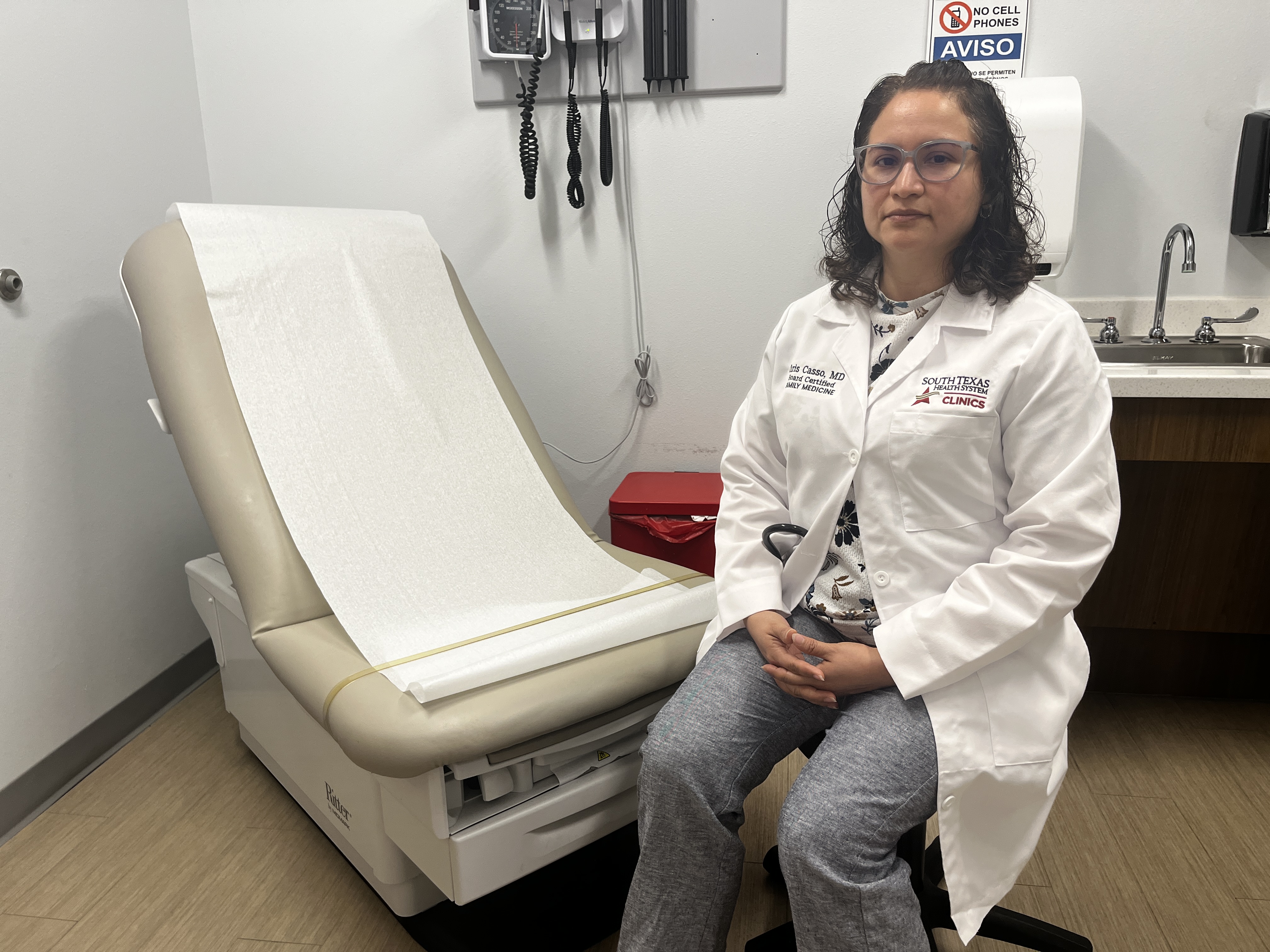
Chris Casso, a primary care physician who grew up in McAllen and now practices there, held back tears as she described treating patients who have put off seeing a doctor because of an inability to pay, only to have their preventable conditions deteriorate.
She worries about the future of her community as physician shortages worsen, potentially leaving few providers to treat uninsured people.
“It’s heartbreaking,” she said, sitting in a small back room in her office in a suburban strip mall, wedged between a Kohl’s and a Shoe Carnival. “These are hardworking people,” she said. “They try their best to take care of themselves.”
Casso said her own sister, who worked as a medical biller in a physician’s office, couldn’t afford health insurance. She delayed care and died at age 45 of complications from diabetes and heart disease. Casso worries the future will find more people in similar situations.
“Our population is going to suffer,” she said. “It’s going to be devastating.”
KFF Health News is a national newsroom that produces in-depth journalism about health issues and is one of the core operating programs at KFF—an independent source of health policy research, polling, and journalism. Learn more about KFF.
USE OUR CONTENT
This story can be republished for free (details).