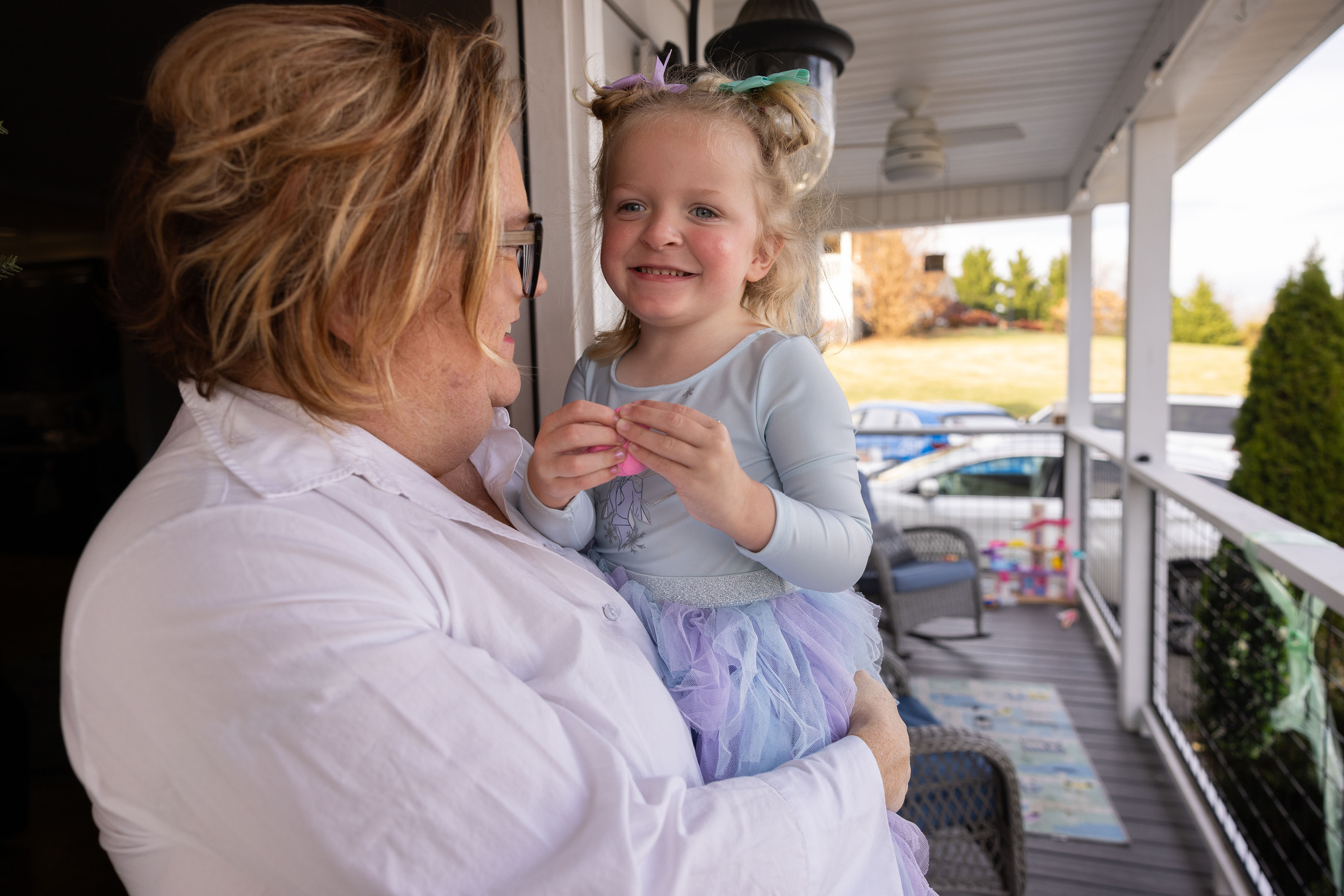
ALEXANDER, N.C. — Aubreigh Osborne has a new best friend.
Dressed in blue with a big ribbon in her blond curls, the 3-year-old sat in her mother’s lap carefully enunciating a classmate’s first name after hearing the words “best friend.” Just months ago, Gaile Osborne didn’t expect her adoptive daughter would make friends at school.
Diagnosed with autism at 14 months, Aubreigh Osborne started this year struggling to control outbursts and sometimes hurting herself. Her trouble with social interactions made her family reluctant to go out in public.
But this summer, they started applied behavior analysis therapy, commonly called ABA, which often is used to help people diagnosed with autism improve social interactions and communication. A tech comes to the family’s home five days a week to work with Aubreigh.
Since then, she has started preschool, begun eating more consistently, succeeded at toilet training, had a quiet, in-and-out grocery run with her mom, and made a best friend. All firsts.
“That’s what ABA is giving us: moments of normalcy,” Gaile Osborne said.
But in October, Aubreigh’s weekly therapy hours were abruptly halved from 30 to 15, a byproduct of her state’s effort to cut Medicaid spending.
Other families around the country have also recently had their access to the therapy challenged as state officials make deep cuts to Medicaid — the public health insurance that covers people with low incomes and disabilities. North Carolina attempted to cut payments to ABA providers by 10%. Nebraska cut payments by nearly 50% for some ABA providers. Payment reductions also are on the table in Colorado and Indiana, among other states.
Efforts to scale back come as state Medicaid programs have seen spending on the autism therapy balloon in recent years. Payments for the therapy in North Carolina, which were $122 million in fiscal year 2022, are projected to hit $639 million in fiscal 2026, a 423% increase. Nebraska saw a 1,700% jump in spending in recent years. Indiana saw a 2,800% rise.
Heightened awareness and diagnosis of autism means more families are seeking treatment for their children, which can range from 10 to 40 hours of services a week, according to Mariel Fernandez, vice president of government affairs at the Council of Autism Service Providers. The treatment is intensive: Comprehensive therapy can include 30-40 hours of direct treatment a week, while more focused therapy may still consist of 10-25 hours a week, according to guidelines released by the council.
It’s also a relatively recent coverage area for Medicaid. The federal government ordered states to cover autism treatments in 2014, but not all covered ABA, which Fernandez called the “gold standard,” until 2022.
State budget shortfalls and the nearly $1 trillion in looming Medicaid spending reductions from President Donald Trump’s One Big Beautiful Bill Act have prompted state budget managers to trim the autism therapy and other growing line items in their Medicaid spending.
So, too, have a series of state and federal audits that raised questions about payments to some ABA providers. A federal audit of Indiana’s Medicaid program estimated at least $56 million in improper payments in 2019 and 2020, noting some providers had billed for excessive hours, including during nap time. A similar audit in Wisconsin estimated at least $18.5 million in improper payments in 2021 and 2022. In Minnesota, state officials had 85 open investigations into autism providers as of this summer, after the FBI raided two providers late last year as part of an investigation into Medicaid fraud.
Families Fight Back
But efforts to rein in spending on the therapy have also triggered backlash from families who depend on it.
In North Carolina, families of 21 children with autism filed a lawsuit challenging the 10% provider payment cut. In Colorado, a group of providers and parents is suing the state over its move to require prior authorization and reduce reimbursement rates for the therapy.
And in Nebraska, families and advocates say cuts of the magnitude the state implemented — from 28% to 79%, depending on the service — could jeopardize their access to the treatment.
“They’re scared that they’ve had this access, their children have made great progress, and now the rug is being yanked out from under them,” said Cathy Martinez, president of the Autism Family Network, a nonprofit in Lincoln, Nebraska, that supports autistic people and their families.
Martinez spent years advocating for Nebraska to mandate coverage of ABA therapy after her family went bankrupt paying out-of-pocket for the treatment for her son Jake. He was diagnosed with autism as a 2-year-old in 2005 and began ABA therapy in 2006, which Martinez credited with helping him learn to read, write, use an assistive communication device, and use the bathroom.
To pay for the $60,000-a-year treatment, Martinez said, her family borrowed money from a relative and took out a second mortgage before ultimately filing for bankruptcy.
“I was very angry that my family had to file bankruptcy in order to provide our son with something that every doctor that he saw recommended,” Martinez said. “No family should have to choose between bankruptcy and helping their child.”
Nebraska mandated insurance coverage for autism services in 2014. Now, Martinez worries the state’s rate cuts could prompt providers to pull out, limiting the access she fought hard to win.
Her fears appeared substantiated in late September when Above and Beyond Therapy, one of the largest ABA service providers in Nebraska, notified families it planned to terminate its participation in Nebraska’s Medicaid program, citing the provider rate cuts.
Above and Beyond’s website advertises services in at least eight states. The company was paid more than $28.5 million by Nebraska’s Medicaid managed-care program in 2024, according to a state audit. That was about a third of the program’s total spending on the therapy that year and four times as much as the next largest provider. CEO Matt Rokowsky did not respond to multiple interview requests.
A week after announcing it would stop participating in Nebraska Medicaid, the company reversed course, citing a “tremendous outpouring of calls, emails, and heartfelt messages” in a letter to families.
Danielle Westman, whose 15-year-old son, Caleb, receives 10 hours of at-home ABA services a week from Above and Beyond, was relieved by the announcement. Caleb is semiverbal and has a history of wandering away from caregivers.
“I won’t go to any other company,” Westman said. “A lot of other ABA companies want us to go to a center during normal business hours. My son has a lot of anxiety, high anxiety, so being at home in his safe area has been amazing.”
Nebraska officials have said the state previously had the highest Medicaid reimbursement rates for ABA in the nation and that the new rates still compare favorably to neighboring states’ but will ensure the services are “available and sustainable going forward.”
States Struggle With High Spending
State Medicaid Director Drew Gonshorowski said his agency is closely tracking fallout. Deputy Director Matthew Ahern said that while no ABA providers have left the state following the cuts, one provider stopped taking Medicaid payments for the therapy. New providers have also entered Nebraska since officials announced the cuts.
One Nebraska ABA provider has even applauded the rate cuts. Corey Cohrs, CEO of Radical Minds, which has seven locations in the Omaha area, has been critical of what he sees as an overemphasis by some ABA providers on providing a blanket 40 hours of services per child per week. He likened it to prescribing chemotherapy to every cancer patient, regardless of severity, because it’s the most expensive.
“You can then, as a result, make more money per patient and you’re not using clinical decision-making to determine what’s the right path,” Cohrs said.

Nebraska put a 30 hour-a-week cap on the services without additional review, and the new rates are workable for providers, Cohrs said, unless their business model is overly predicated on high Medicaid rates.
In North Carolina, Aubreigh Osborne’s ABA services were restored largely due to her mother’s persistence in calling person after person in the state’s Medicaid system to make the case for her daughter’s care.
And for the time being, Gaile Osborne won’t have to worry about the legislative squabbles affecting her daughter’s care. In early December, North Carolina Gov. Josh Stein canceled all the Medicaid cuts enacted in October, citing lawsuits like the one brought by families of children with autism.
“DHHS can read the writing on the wall,” Stein said, announcing the state health department’s reversal. “That’s what’s changed. Here’s what has not changed. Medicaid still does not have enough money to get through the rest of the budget year.”
Osborne is executive director of Foster Family Alliance, a prominent foster care advocacy organization in the state, and taught special education for nearly 20 years. Despite her experience, she didn’t know how to help Aubreigh improve socially. Initially skeptical about ABA, she now sees it as a bridge to her daughter’s well-being.
“It’s not perfect,” Osborne said. “But the growth in under a year is just unreal.”
Do you have an experience with cuts to autism services that you’d like to share? Click here to tell KFF Health News your story.
[email protected],
@besables
@arjonesreports