Most adults assume teenagers flock to social media because they’re addicted to superficiality — the filters, the highlight reels, the dopamine hits of likes. Some research suggests the opposite: adolescents may actually turn to social media because they find it more authentic than the curated personas they feel pressured to maintain in person.
That finding inverts a decade of parental anxiety. It also raises a harder question that no single study can answer: if young people experience more emotional honesty online than offline, what does that tell us about the environments we’ve built for them in the physical world?
I should say upfront: I’m not a psychologist or a researcher. I’m a retired electrician who spent over 30 years working with his hands, running my own small business out of South Boston. I started writing after my wife Donna bought me a journal as a joke, and it turned out the joke was on both of us because I couldn’t stop. Now I’m watching a whole generation grow up in a world I barely recognize, and I pay attention to this stuff because I feel like I have to. What I bring isn’t expertise — it’s experience, and the hard-won knowledge that the adults in the room don’t always understand what the kids actually need.
What recent research suggests
Some research has examined how adolescents perceive authenticity across different social contexts. Studies have indicated that young people sometimes rate their social media interactions as spaces where they could be more genuinely themselves — not less.
This wasn’t about performative vulnerability or curated “realness.” The adolescents in these contexts have described feeling freer to express their actual thoughts, interests, and emotional states in digital spaces than in face-to-face settings where social hierarchies, peer pressure, and the immediate judgment of others shaped what they felt safe revealing.
The finding challenges a widespread assumption. For years, the dominant narrative has been that social media corrodes authenticity — that teens construct false selves online, chasing validation through increasingly distorted self-presentation. Some research suggests many young people experience it the other way around: the performance happens at school, in hallways, at family dinners. The screen is where the mask comes off.
The school phone debate gets more complicated
This matters because the policy world is moving fast in the opposite direction. Many schools across the United States appear to be restricting or banning phone use, and some preliminary research suggests potential benefits from those efforts.
Studies have indicated preliminary benefits from reduced phone use during school hours — including improvements in attention and social engagement among students who participated.
Those findings are real. But they sit in tension with what other research has observed. If some adolescents experience digital spaces as their primary environment for honest self-expression, then removing access during the hours they spend surrounded by peers may not simply improve focus. It may also eliminate a psychological outlet.
This is not an argument against phone-free schools. It’s a recognition that the emotional function social media serves for teenagers is more layered than many policy conversations acknowledge.
The question of what we’re actually measuring
Any honest discussion of these findings has to contend with a broader challenge in psychological research: the tools used to measure human experience are imperfect, and sometimes deeply flawed.
Some scholars have explored problems that go beyond the well-known replication crisis in psychology. Such work argues that the very foundations of how psychological constructs are measured — including subjective states like authenticity — deserve scrutiny. When an adolescent reports feeling “more authentic” online, what exactly are they reporting? Are they describing genuine self-expression, or the comfort of a lower-stakes environment where consequences feel distant?
These are not trivial distinctions. They shape whether we interpret recent findings as evidence that social media is meeting a real emotional need, or as evidence that teenagers — like all of us — sometimes confuse comfort with honesty.
And the stakes of getting this right are high. Research has shown that the way people engage with digital platforms is far more varied and intentional than the simple active-versus-passive binary suggests. Some people browse but never post. Some perform. Some watch. Adolescents are no different. Some are finding the only space where they feel safe enough to say what they mean.
Why authenticity feels so scarce offline
Recent findings about adolescent authenticity land differently when you consider what adolescents are navigating in their physical environments. School is a performance space. Family can be too. The pressure to present a certain version of yourself — agreeable, competent, unfazed — starts early and compounds through the teenage years.
Some research offers an indirect but illuminating parallel. Studies have suggested that patience might function not as a virtue but as a coping mechanism — a way people manage day-to-day frustrations rather than a marker of moral character.
The relevance here isn’t direct, but it’s structural. What if adolescent social media use functions similarly — not as a sign of addiction or moral failing, but as a coping mechanism for environments that demand inauthenticity? What if the screen isn’t the problem but the pressure valve?
I grew up in a house in South Boston where men didn’t cry, didn’t complain, and didn’t talk about feelings. I spent most of my adult life believing that was strength. It wasn’t — it was just silence dressed up as strength, and I’ve spent my sixties unlearning all three. Entire generations learned to confuse endurance with emotional health. The pattern repeats in different forms. For adolescents today, the mandate isn’t necessarily “be strong” — it’s “be likeable, be appropriate, be what this room needs you to be.” Social media may simply be the first space where that mandate loosens.

Where the threads converge
Despite approaching the question from different angles, several threads of agreement emerge across these sources.
Context shapes behaviour more than character does. Whether it’s research reframing patience as situational coping or findings that authenticity shifts based on environment, the consistent insight is that human behaviour is less about who someone is and more about what the situation demands.
Simplistic narratives about technology are insufficient. Studies on phone use and authenticity are both valid — and they point in different directions. This isn’t a contradiction. It’s a reflection of the fact that social media serves multiple functions simultaneously, some beneficial and some harmful, often for the same person on the same day.
Measurement matters enormously. Warnings about research fundamentals apply to every study in this space. Self-reported authenticity is a construct, not a fact. This doesn’t invalidate the research, but it demands humility about what we claim to know.
Where the tension lives
The genuine disagreement is about what follows from these findings.
One position — implicit in the school phone ban movement and some research — is that reducing screen time creates space for richer offline connection. The logic is intuitive: remove the digital crutch, and adolescents will develop the interpersonal skills they need.
The other position — supported by research on authenticity — is that for many teenagers, offline environments are the problem, not the solution. If you take away the space where they feel most themselves and return them to the hallway where they feel most surveilled, you haven’t solved anything. You’ve just removed the relief.
Neither position is entirely right. Both are partially true. The difficult work is in holding them simultaneously.
Some work in positive psychology has gestured at this complexity by arguing against chasing momentary emotional states and instead building a life that sustains wellbeing structurally. The same principle applies here: the question isn’t whether a teenager feels authentic on Instagram at 11 p.m. It’s whether the architecture of their daily life — school, home, friendships, digital spaces — allows for enough honesty that they don’t need to find it exclusively through a screen.
The structural problem nobody wants to name
Here’s what sits beneath all of these findings: we have designed adolescent life around performance, and then we are surprised when teenagers seek out spaces that don’t require it.
Schools are assessment environments. Social hierarchies are rigid. Family dynamics often require emotional labour that teenagers are only beginning to understand they’re performing. The physical world, for many adolescents, is a place where they are constantly being evaluated — by teachers, by peers, by parents, by themselves.
Social media didn’t create the need for authenticity. It revealed how little of it was available elsewhere.
This doesn’t mean platforms are benign. The same digital space that allows a teenager to express their real interests can also expose them to comparison, harassment, and algorithmically amplified distress. Recent research measured one dimension of a multi-dimensional experience. But the dimension it measured — the felt sense of being able to be yourself — is not a trivial one. It is, according to many psychologists, foundational to wellbeing.
The adults debating phone bans and screen time limits are not wrong to be concerned. But they are often concerned about the wrong thing. The question isn’t: how do we get teenagers off their phones? The question is: what would their offline lives need to look like for them not to need their phones as an emotional refuge?
That’s a harder question. It implicates school culture, family dynamics, social norms, and the relentless evaluation that defines adolescence in most societies worldwide — from Seoul to São Paulo to suburban Sydney. It can’t be solved with a policy about where phones are stored during third period.
I think about this every other Saturday morning at the diner with my crew. There’s a waitress there whose kid is eleven now, and she’s already navigating a world I can barely keep up with. And what I’ve noticed, watching the young people around me grow up, is that kids notice everything. They notice when you’re really listening and when you’re just waiting to talk. They notice when the adults around them are performing, too. If we want them to be honest with us, we have to build spaces — real, physical spaces — where honesty doesn’t cost them anything. That’s not a technology problem. That’s a human one.
What to watch
Longitudinal data will be decisive. Recent findings are snapshots. What matters is whether adolescents who report greater online authenticity also show better long-term psychological outcomes — or whether the sense of authenticity doesn’t translate into the kind of deep relational connection that sustains people over time.
School phone bans will become natural experiments. As more districts implement restrictions, researchers will have opportunities to examine not just attention and grades, but emotional wellbeing, self-expression, and the subtler metrics that recent studies have surfaced. Early research is just that — early. More is coming.
The measurement conversation will intensify. As ongoing discussions signal, psychology is in a period of methodological self-examination. How we measure constructs like “authenticity” and “wellbeing” will shape the conclusions we draw — and the policies we build on them.
The global dimension matters. Adolescent social media use looks different in Jakarta than in Los Angeles, in Lagos than in London. Cultural norms around self-expression, family obligation, and public versus private identity vary enormously. Studies rooted in Western university populations capture one slice of a much larger human experience.
What recent research gave us isn’t a definitive answer. It’s a better question. And the question — why do so many young people feel more real on a screen than in a room? — deserves to sit with us longer than the next news cycle allows.
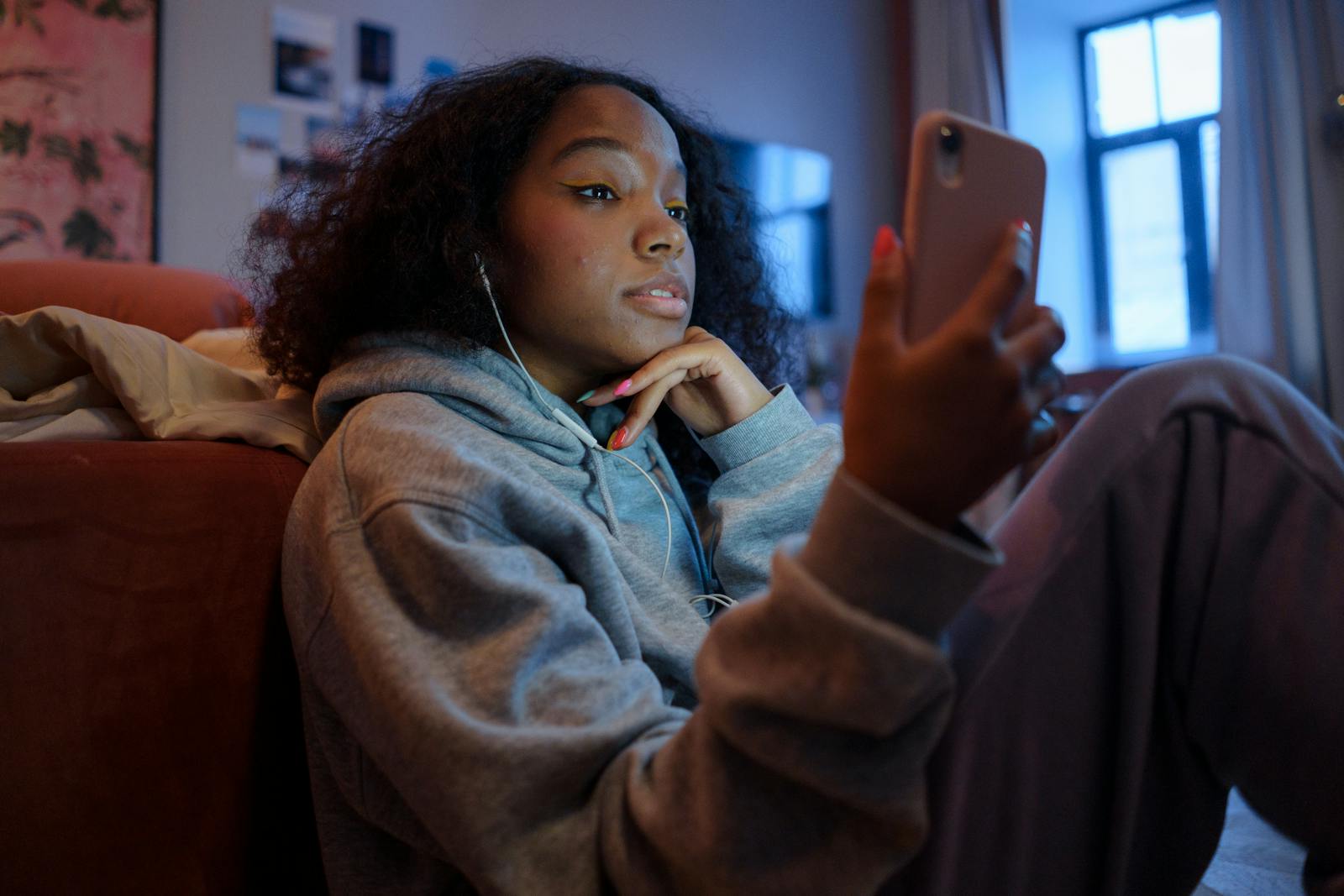
Feature image by cottonbro studio on Pexels