No Result
View All Result
SUBMIT YOUR ARTICLES
  • Login
Tuesday, March 31, 2026
TheAdviserMagazine.com
  • Home
  • Financial Planning
    • Financial Planning
    • Personal Finance
  • Market Research
    • Business
    • Investing
    • Money
    • Economy
    • Markets
    • Stocks
    • Trading
  • 401k Plans
  • College
  • IRS & Taxes
  • Estate Plans
  • Social Security
  • Medicare
  • Legal
  • Home
  • Financial Planning
    • Financial Planning
    • Personal Finance
  • Market Research
    • Business
    • Investing
    • Money
    • Economy
    • Markets
    • Stocks
    • Trading
  • 401k Plans
  • College
  • IRS & Taxes
  • Estate Plans
  • Social Security
  • Medicare
  • Legal
No Result
View All Result
TheAdviserMagazine.com
No Result
View All Result
Home Market Research Markets

Did Meta Just Redefine How We Will Use Computers?

by TheAdviserMagazine
8 months ago
in Markets
Reading Time: 7 mins read
A A
Did Meta Just Redefine How We Will Use Computers?
Share on FacebookShare on TwitterShare on LInkedIn


Sixty years ago, an American psychologist and computer scientist named J.C.R. Licklider published a groundbreaking paper titled Man-Computer Symbiosis.

In it, Licklider made the case that computers were an extension of human intelligence.

“Men are noisy, narrow-band devices,” wrote Licklider. On the other hand, computers are “single-minded, constrained.”

A computer doesn’t have to stop to use the restroom or drink a cup of coffee. It doesn’t get distracted by pop-up emails, and it doesn’t have to pace the halls to find creativity.

(I had to engage in several of these tasks to write this article.)

Licklider envisioned a future where computers and humans work together. He analogized the symbiotic relationships in nature, such as the way insects pollinate fig trees. In some cases, the tree and insect need each other to survive.

At the time of Licklider’s paper, only giant mainframe computers existed.

Over the next few decades, the machines not only shrank in size, they also became more powerful.

The mainframe evolved into the PC, which then shrunk into the laptop, which shrunk further into the smartphone.

We now have computers in the palm of our hands. The iPhone in my pocket is 100 million times faster than the giant mainframe computer used to guide the Apollo 11 to the moon and back.

Nowadays, smartphones are everywhere. According to the World Economic forum, as of 2023, over 5.4 billion people worldwide had at least one mobile subscription.

The average American spends over five hours a day texting, making calls and using social media on their smartphone.

But just like the PC gave way to the smartphone, there will soon be a new way to interact with intelligent devices.

This week, we’ve witnessed how the next evolution of Licklider’s futuristic vision will become reality.

And it involves one of the biggest names in technology…

Meta.

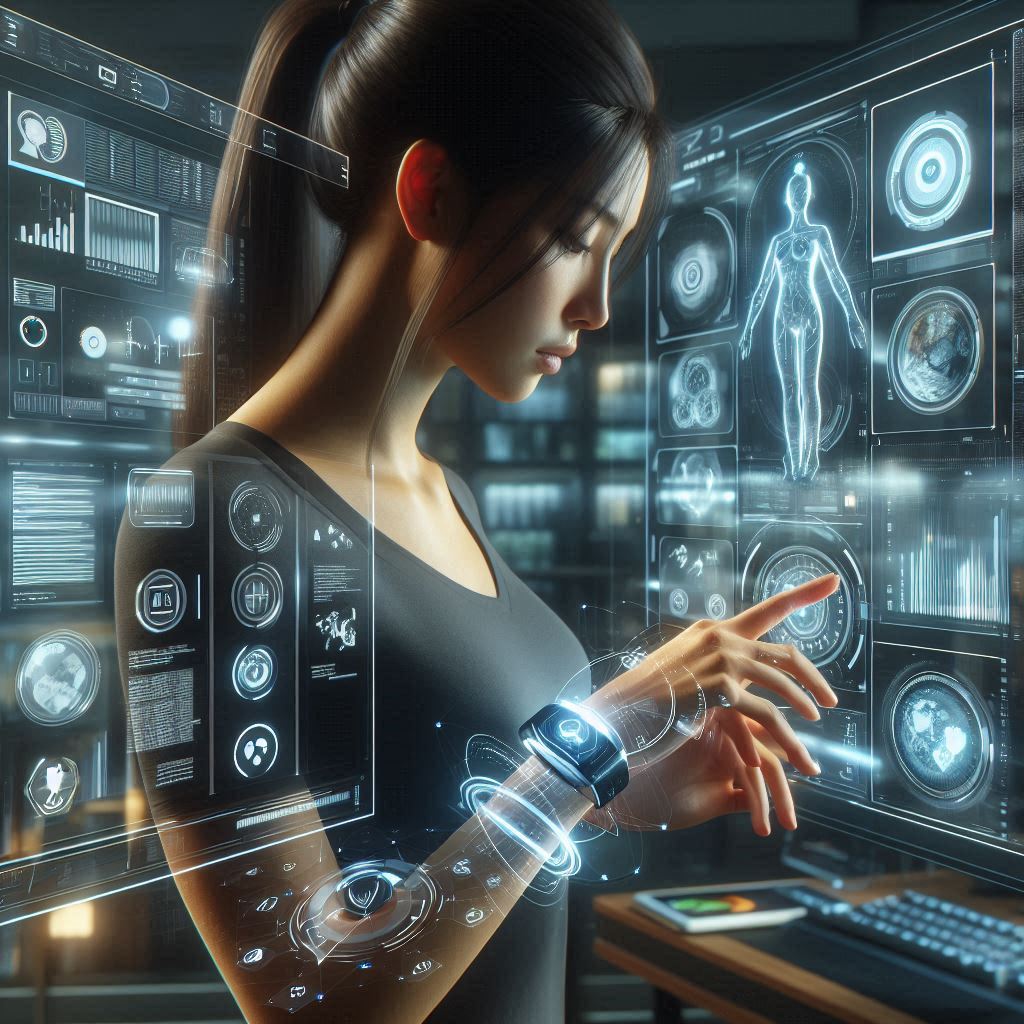
What Meta designed kind of looks like a chunky smartwatch.

Source: Reality Labs, Meta

But this prototype doesn’t include a clock. Or fitness rings. And it won’t send you any notifications.

But it might represent the next evolution of how humans interact with computers.

Because it enables you to wave your hand from across the room…

And your laptop obeys.

With a flick of the wrist, the cursor slides across the screen. Pinch your fingers, and an app launches. Air-draw your signature, and your name appears — letter by letter — on your phone.

Meta unveiled this device in a new research paper published last week in Nature.

We’ve talked about wearables before, but this is far more advanced than glasses with a camera in them.

Without holding a stylus or wearing gloves, you can control a computer simply through the motion of your hand.

But that’s not the wildest part.

It’s what happens just before you move your fingers that’s the real magic trick…

Just Intend to Move

What’s impressive about this new device from Meta is that it works by just thinking about what you want to do.

It reads your intention before you move… literally faster than your muscles.

As Dr. Thomas Reardon, a VP of research at Meta, told the New York Times: “You don’t have to actually move. You just have to intend the move.”

That’s because Meta’s new wristband reads the electrical signals that travel from your brain to your muscles.

Which means the moment you think about moving a finger, the device responds.

Even before your finger twitches.

This incredible tech is called EMG, short for electromyography. And it’s not new. In fact, it’s been used for years to help amputees control prosthetic limbs.

But what Meta has done is fuse EMG with machine learning — training neural networks on muscle signal data from over 10,000 people.

That’s what makes this device so responsive and accurate.

And crucially for Meta, it also makes it usable right out of the box.

It works just by touching the surface of the skin. And once trained, the system can recognize what any new user intends to do, even if they don’t physically move.

But as impressive as this wristband is, it’s just one step toward the far more ambitious goal of merging minds with machines.

Meta’s prototype wristband doesn’t read your thoughts. Instead, it reads the signals your brain sends to your muscles.

But not everyone is taking the same approach.

Elon Musk’s Neuralink is betting on something far more radical: brain implants.

Last year, Neuralink made headlines when it showed a monkey using only its brain to type on a screen.

Turn Your Images On

Source: YouTube/Neuralink

The company recently began human trials, implanting a chip under the skull that communicates directly with the brain’s motor cortex.

The idea is to give people the ability to control computers, prosthetics or even entire digital environments…

Just by thinking.

But Neuralink is years away from mass-market use. This path to a brain-computer merger requires surgery, follow-up scans and enormous personalization.

It’s cutting-edge technology, for sure. But it’s not practical right now.

Another company called Synchron is trying a middle-ground strategy. It’s inserting tiny devices through blood vessels in the neck.

This is still invasive, but it’s less risky than brain surgery.

However, Meta is sidestepping all of that.

Instead of digging into your skull, its research arm — Reality Labs — is focused on creating non-invasive, AI-powered interfaces like the prototype I just showed you.

These interfaces can understand your nervous system using muscle signals alone.

Which might not sound as sexy as “telepathic typing.” But it doesn’t require a neurosurgeon, and it means this product could go to market quickly.

Which isn’t to say Meta is rushing into it. In 2019, the company acquired a startup co-founded by Dr. Reardon that was pioneering this EMG-based interface.

So it has been working on products like this for a while now.

What changed recently is scale.

Thanks to advances in AI, specifically neural networks similar to those used in ChatGPT, Meta can now decode EMG signals with unmatched precision.

It has learned the language of the human nervous system…

And the result is a prototype that responds faster than your fingers.

Since the signals that control your muscles travel faster than your muscles can move, this interface could eventually outpace touchscreens, keyboards or even voice commands.

In fact, researchers at Carnegie Mellon are already testing it with patients who have spinal cord injuries.

These are people who can no longer move their hands, but still retain some muscle signal activity.

Yet this device lets them type, browse and communicate using only the intent to move.

To be clear, it isn’t mind-reading…

But it sure seems like it.

Here’s My Take

Meta’s prototype is a fascinating new gadget.

I believe it represents an early version of a totally new human-computer interface.

The company recently hinted that it could spend $100 billion on capital expenditures in 2026 as it plays catch-up with its artificial intelligence initiatives.

This device is a reminder that AI isn’t just about models and chips.

It’s also about the interfaces that let us use them.

Of course, there’s still a long road between research and reality, but this wristband suggests that Meta is serious about redefining the future of computing…

A future where touchscreens are replaced with thought, and your nervous system becomes a controller.

In other words, a world where the distinction between tech and human becomes blurred… because we’re the interface.

What excites me about this paradigm shift is that it will lead to huge investment opportunities.

Just as the shift from mainframes to PCs to mobile did before.

Regards,

Ian King's SignatureIan KingChief Strategist, Banyan Hill Publishing

Editor’s Note: We’d love to hear from you!

If you want to share your thoughts or suggestions about the Daily Disruptor, or if there are any specific topics you’d like us to cover, just send an email to [email protected].

Don’t worry, we won’t reveal your full name in the event we publish a response. So feel free to comment away!



Source link

Tags: computersMetaredefine
ShareTweetShare
Previous Post

8 Companies That Will Reward You With Cold, Hard Cash

Next Post

Can You Paint Vinyl Siding?

Related Posts

edit post
Price of tungsten, sulfur and helium

Price of tungsten, sulfur and helium

by TheAdviserMagazine
March 31, 2026
0

Almonty's tungsten mine in Sangdong, South Korea, in March 2026.AlmontyBEIJING — The Iran war is squeezing a global commodities market...

edit post
7 Ways the Iran Conflict Is Draining Your Wallet

7 Ways the Iran Conflict Is Draining Your Wallet

by TheAdviserMagazine
March 30, 2026
0

If you think a war halfway across the world doesn’t affect your wallet, you aren’t paying attention. I’ve been watching...

edit post
Powell sees inflation outlook in check, no need to hike rates because of oil shock

Powell sees inflation outlook in check, no need to hike rates because of oil shock

by TheAdviserMagazine
March 30, 2026
0

Federal Reserve Chair Jerome Powell, in a wide-ranging talk at Harvard University, said Monday that he sees inflation expectations as...

edit post
Palantir (PLTR) Looks Compelling on Paper — But These 3 Weaknesses Could Stall the Rally

Palantir (PLTR) Looks Compelling on Paper — But These 3 Weaknesses Could Stall the Rally

by TheAdviserMagazine
March 30, 2026
0

Palantir Technologies has entered 2026 with a narrative that reads unusually clean: accelerating growth, a marquee AI product cycle, and...

edit post
AI Just Started Improving Itself

AI Just Started Improving Itself

by TheAdviserMagazine
March 30, 2026
0

For more than 25 years, Ray Kurzweil has been saying that artificial general intelligence (AGI) would arrive by 2029. I...

edit post
Americas Gold and Silver Corporation (USAS) FY2025 Earnings: Misses on EPS, Revenue Recap

Americas Gold and Silver Corporation (USAS) FY2025 Earnings: Misses on EPS, Revenue Recap

by TheAdviserMagazine
March 30, 2026
0

USAS|EPS -$0.13 vs $0.04 est (-425.0%)|Rev $118.0M vs $65.3M est (+80.8%)|Net Loss $87.4M Stock $4.76  Mixed Results. Americas Gold and...

Next Post
edit post
Can You Paint Vinyl Siding?

Can You Paint Vinyl Siding?

edit post
Can’t Keep Up With Tariffs? Here’s Your Cheat Sheet

Can’t Keep Up With Tariffs? Here’s Your Cheat Sheet

  • Trending
  • Comments
  • Latest
edit post
Massachusetts loses billions in income after millionaire tax

Massachusetts loses billions in income after millionaire tax

March 24, 2026
edit post
Illinois’ Paid Leave for All Workers Act Takes Effect — Every Employee Now Gets Guaranteed Time Off

Illinois’ Paid Leave for All Workers Act Takes Effect — Every Employee Now Gets Guaranteed Time Off

March 27, 2026
edit post
Publix to Open 5 New Stores by End of April. See Upcoming Locations.

Publix to Open 5 New Stores by End of April. See Upcoming Locations.

March 20, 2026
edit post
Virginia Permits ADULT MIGRANT MEN To Attend High School

Virginia Permits ADULT MIGRANT MEN To Attend High School

March 30, 2026
edit post
Hospitals in This State Routinely Sue Patients Over Unpaid Bills

Hospitals in This State Routinely Sue Patients Over Unpaid Bills

March 27, 2026
edit post
Who Is Legally Next of Kin in North Carolina?

Who Is Legally Next of Kin in North Carolina?

February 28, 2026
edit post
What is Reasonable Collection Potential (RCP)?  | Optima Tax Relief

What is Reasonable Collection Potential (RCP)?  | Optima Tax Relief

0
edit post
Nordstrom’s .25 billion deal to go private is paying off—and don’t expect an IPO anytime soon

Nordstrom’s $6.25 billion deal to go private is paying off—and don’t expect an IPO anytime soon

0
edit post
Price of tungsten, sulfur and helium

Price of tungsten, sulfur and helium

0
edit post
Huerta de Soto Exposes the Failures of Socialism

Huerta de Soto Exposes the Failures of Socialism

0
edit post
XRP Advocate John Deaton Says The Real Risk Isn’t A CBDC — It’s A Future SEC Chair

XRP Advocate John Deaton Says The Real Risk Isn’t A CBDC — It’s A Future SEC Chair

0
edit post
Security management co Huskeys raises m

Security management co Huskeys raises $8m

0
edit post
XRP Advocate John Deaton Says The Real Risk Isn’t A CBDC — It’s A Future SEC Chair

XRP Advocate John Deaton Says The Real Risk Isn’t A CBDC — It’s A Future SEC Chair

March 31, 2026
edit post
Nordstrom’s .25 billion deal to go private is paying off—and don’t expect an IPO anytime soon

Nordstrom’s $6.25 billion deal to go private is paying off—and don’t expect an IPO anytime soon

March 31, 2026
edit post
Price of tungsten, sulfur and helium

Price of tungsten, sulfur and helium

March 31, 2026
edit post
Bitcoin Steady as Trump Is Ready to End US-Iran War Without Reopening Strait of Hormuz

Bitcoin Steady as Trump Is Ready to End US-Iran War Without Reopening Strait of Hormuz

March 31, 2026
edit post
FY26 IPO market a disaster as investors lose money in 2 out of 3 issues. Will next year be better?

FY26 IPO market a disaster as investors lose money in 2 out of 3 issues. Will next year be better?

March 31, 2026
edit post
The people who keep their home impossibly clean aren’t necessarily organized. Some of them grew up in chaos and the only variable they could control was their physical space, and they’ve never stopped trying to create order in the one domain that actually responds to effort.

The people who keep their home impossibly clean aren’t necessarily organized. Some of them grew up in chaos and the only variable they could control was their physical space, and they’ve never stopped trying to create order in the one domain that actually responds to effort.

March 31, 2026
The Adviser Magazine

The first and only national digital and print magazine that connects individuals, families, and businesses to Fee-Only financial advisers, accountants, attorneys and college guidance counselors.

CATEGORIES

  • 401k Plans
  • Business
  • College
  • Cryptocurrency
  • Economy
  • Estate Plans
  • Financial Planning
  • Investing
  • IRS & Taxes
  • Legal
  • Market Analysis
  • Markets
  • Medicare
  • Money
  • Personal Finance
  • Social Security
  • Startups
  • Stock Market
  • Trading

LATEST UPDATES

  • XRP Advocate John Deaton Says The Real Risk Isn’t A CBDC — It’s A Future SEC Chair
  • Nordstrom’s $6.25 billion deal to go private is paying off—and don’t expect an IPO anytime soon
  • Price of tungsten, sulfur and helium
  • Our Great Privacy Policy
  • Terms of Use, Legal Notices & Disclosures
  • Contact us
  • About Us

© Copyright 2024 All Rights Reserved
See articles for original source and related links to external sites.

Welcome Back!

Login to your account below

Forgotten Password?

Retrieve your password

Please enter your username or email address to reset your password.

Log In
No Result
View All Result
  • Home
  • Financial Planning
    • Financial Planning
    • Personal Finance
  • Market Research
    • Business
    • Investing
    • Money
    • Economy
    • Markets
    • Stocks
    • Trading
  • 401k Plans
  • College
  • IRS & Taxes
  • Estate Plans
  • Social Security
  • Medicare
  • Legal

© Copyright 2024 All Rights Reserved
See articles for original source and related links to external sites.