No Result
View All Result
SUBMIT YOUR ARTICLES
  • Login
Sunday, January 25, 2026
TheAdviserMagazine.com
  • Home
  • Financial Planning
    • Financial Planning
    • Personal Finance
  • Market Research
    • Business
    • Investing
    • Money
    • Economy
    • Markets
    • Stocks
    • Trading
  • 401k Plans
  • College
  • IRS & Taxes
  • Estate Plans
  • Social Security
  • Medicare
  • Legal
  • Home
  • Financial Planning
    • Financial Planning
    • Personal Finance
  • Market Research
    • Business
    • Investing
    • Money
    • Economy
    • Markets
    • Stocks
    • Trading
  • 401k Plans
  • College
  • IRS & Taxes
  • Estate Plans
  • Social Security
  • Medicare
  • Legal
No Result
View All Result
TheAdviserMagazine.com
No Result
View All Result
Home Market Research Market Analysis

What Technical Debt Means To IT Professionals

by TheAdviserMagazine
2 months ago
in Market Analysis
Reading Time: 4 mins read
A A
What Technical Debt Means To IT Professionals
Share on FacebookShare on TwitterShare on LInkedIn


Technical debt continues to rise in the priorities of IT leaders. While AI may be grabbing the front page headlines, tech debt is lurking below the surface in more and more industry conversations. Ironically, for such a hot topic, there’s little consensus on how to even define it.

It’s No Longer Just Code Quality

When Forrester’s 2025 Modern Technology Operations Survey asked 593 IT professionals what technical debt means to them, the results were surprising. Code quality—Ward Cunningham’s original definition and the focus of countless academic papers and LinkedIn commentaries—ranked low with only 27% of respondents selecting it.

This data reveals a fundamental disconnect between how purists and academics define technical debt and how practitioners experience it. While some continue to insist that technical debt refers exclusively to shortcuts taken when writing software, IT practitioners clearly embrace a far broader definition.

It’s unsurprising: the word “technical” carries broad connotations, and thus real world practitioners have naturally extended “technical debt” to encompass all deferred technical work. When your most experienced engineers retire without documenting critical systems, when you’re still critically dependent on Java 8, when your hardware could fail at any moment—these aren’t separate categories of debt that need distinct terminology. They’re all part of the technical debt burden that organizations must actively manage.

Managing the Full Portfolio

These aren’t isolated problems; as I’ve written elsewhere, it’s an integrated system of feedback loops. Sprawling, outdated tech requires outdated skills, creating a vicious cycle of knowledge and migration debt. Inflexible architectures force organizations to build redundant systems rather than adapt existing ones. Everything compounds together in ways that require an integrated view for effective management.

Some argue for separate terminology: infrastructure debt, architecture debt, process debt. But this misses the point. Organizations need an umbrella term for deferred technical work and investment.  Don’t confuse your leaders and business partners with multiple terms and flavors. Keep it simple and you’re more likely to get the resources you need.

The Path Forward

The Forrester data provides clear guidance on where organizations should focus.

Knowledge and process debt, selected by 37% of respondents, demands immediate attention through process improvement, re-engineering, and organizational change management.
Unsupported vendor software and redundant IT systems, each selected by 30-32% of respondents, requires proactive migration planning before crisis points emerge.
System inflexibility, identified by 35%, calls for architectural investments that preserve future options.
And yes, code quality, selected by 27%, deserves attention as part of the portfolio, not as the sole focus.

For academics and purists insisting that the Ward Cunningham definition is a strict scope: it’s time to acknowledge that language evolves based on utility, not theoretical purity, and the horse has left the barn. Fighting this evolution wastes energy that could be spent developing better frameworks for managing the full spectrum of technical obligations.

For practitioners, the message is validating: you’re not wrong to call all of this technical debt. Your daily reality of managing everything from knowledge gaps to hardware failures under a single conceptual umbrella makes operational sense. The interconnected nature of these challenges demands integrated management, not artificial separation.

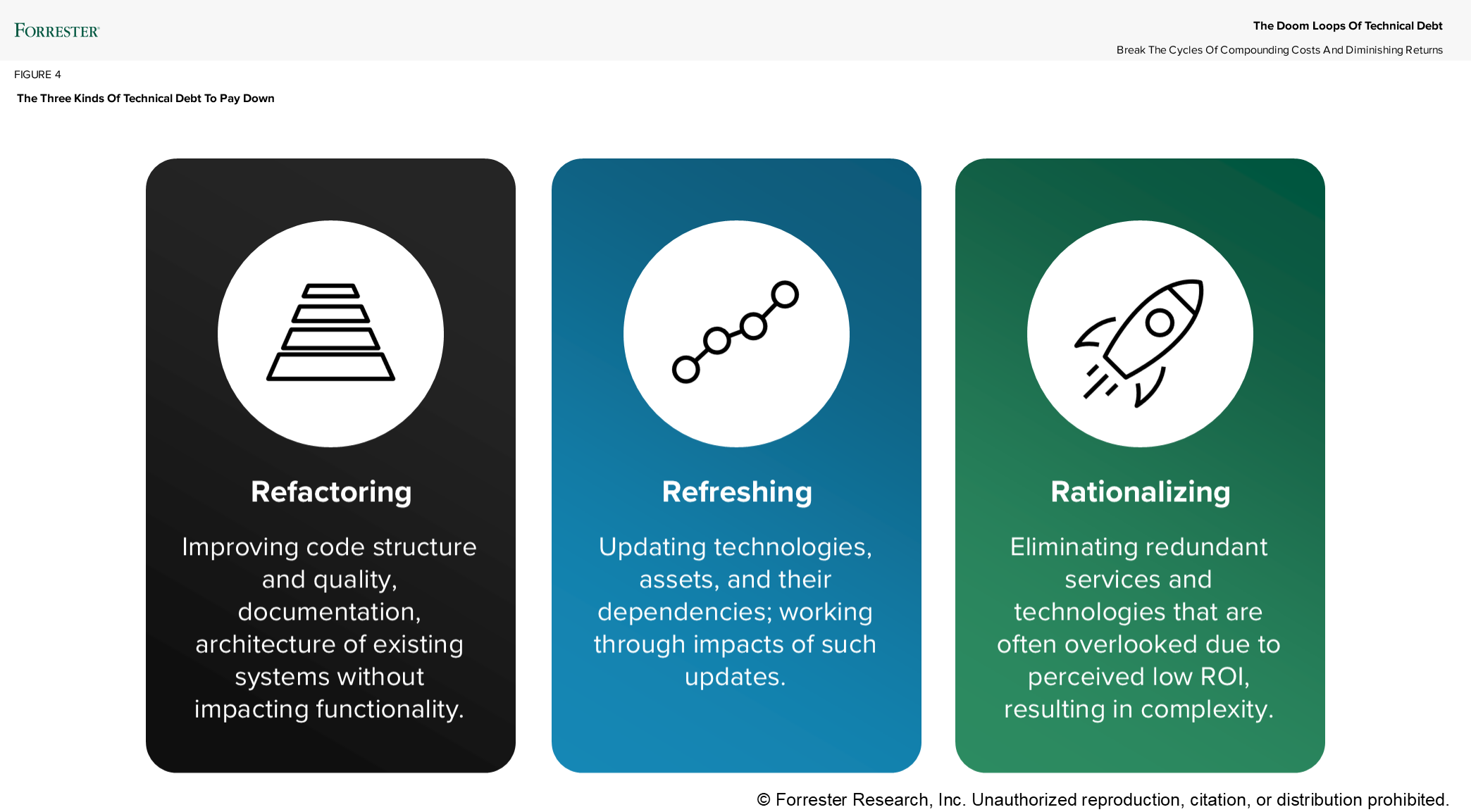
For organizations, the path forward is clear. Stop letting terminology debates distract from the real issue. You have a portfolio of deferred technical investment that requires active management and ongoing investment (emerging best practice is that 20-25% of ongoing spend be devoted to modernization). Some involves code, much doesn’t, all of it compounds over time. The question isn’t what to call these different types of deferred work—practitioners have already decided. The question is how to manage them effectively as the interconnected portfolio of non-optional spending they’ve always represented. We propose three major levers: refactoring, rationalization, and refreshing.

Practitioners know exactly what their technical debt encompasses in their complex digital operations. The most successful organizations will be those that embrace this broader understanding and develop portfolio management strategies that address technical debt in all its forms — from the knowledge walking out the door, to systems that can’t adapt, to sprawl and obsolescence, to the code that yes, could be cleaner.

In an era where IT underpins every aspect of business success, managing technical debt as a comprehensive portfolio isn’t just good practice. It’s essential for survival. The 593 professionals surveyed by Forrester aren’t confused about terminology. They’re dealing with reality. It’s time the purists and academics catch up.

Let’s continue the conversation:  request a guidance session.



Source link

Tags: debtmeansprofessionalstechnical
ShareTweetShare
Previous Post

Cisco (CSCO) reports higher Q1 revenue and earnings; results beat estimates

Next Post

How advisors are responding to falling client risk tolerance

Related Posts

edit post
Five Findings About Today’s Market And Competitive Intelligence Programs

Five Findings About Today’s Market And Competitive Intelligence Programs

by TheAdviserMagazine
January 23, 2026
0

Our recent survey of 21 organizations reveals a familiar tension: Intelligence teams remain lean, yet their remit spans an expanding...

edit post
How HCLTech Won A Forrester B2B Programs Of The Year Award — And How Your Team Could Be Next

How HCLTech Won A Forrester B2B Programs Of The Year Award — And How Your Team Could Be Next

by TheAdviserMagazine
January 23, 2026
0

B2B marketers face growing pressure to produce personalized content that truly connects and resonates with buyers, and their organizations need...

edit post
TikTok Seals The Deal With New US Joint Venture

TikTok Seals The Deal With New US Joint Venture

by TheAdviserMagazine
January 23, 2026
0

On January 22, the primarily American‑owned TikTok USDS Joint Venture LLC finalized a deal with ByteDance to create a new...

edit post
Why Bitcoin’s Digital Gold Narrative Is Failing in the Current Risk-Off Cycle

Why Bitcoin’s Digital Gold Narrative Is Failing in the Current Risk-Off Cycle

by TheAdviserMagazine
January 23, 2026
0

The theme of risk aversion has once again taken center stage in crypto markets this week. Geopolitical tensions, the resurgence...

edit post
4 Tech Titans Face the Earnings Spotlight in High-Stakes Week

4 Tech Titans Face the Earnings Spotlight in High-Stakes Week

by TheAdviserMagazine
January 23, 2026
0

Four of the ‘Magnificent 7’ tech stocks prepare to report quarterly results next week. AI-driven momentum is powering most of...

edit post
Geospatial Imagery Analytics Market: Investment Trends & Analysis

Geospatial Imagery Analytics Market: Investment Trends & Analysis

by TheAdviserMagazine
January 23, 2026
0

The Geospatial Imagery Analytics Market transforms Earth-observation data into actionable insights for defense, urban planning, agriculture, disaster response, and sustainability...

Next Post
edit post
How advisors are responding to falling client risk tolerance

How advisors are responding to falling client risk tolerance

edit post
How OBBBA changes the educators tax deduction in 2026

How OBBBA changes the educators tax deduction in 2026

  • Trending
  • Comments
  • Latest
edit post
Most People Buy Mansions But This Virginia Lottery Winner Took the Lump Sum From a 8 Million Jackpot and Bought a Zero-Turn Lawn Mower Instead

Most People Buy Mansions But This Virginia Lottery Winner Took the Lump Sum From a $348 Million Jackpot and Bought a Zero-Turn Lawn Mower Instead

January 10, 2026
edit post
Utility Shutoff Policies Are Changing in Several Midwestern States

Utility Shutoff Policies Are Changing in Several Midwestern States

January 9, 2026
edit post
80-year-old Home Depot rival shuts down location, no bankruptcy

80-year-old Home Depot rival shuts down location, no bankruptcy

January 4, 2026
edit post
Tennessee theater professor reinstated, with 0,000 settlement, after losing his job over a Charlie Kirk-related social media post

Tennessee theater professor reinstated, with $500,000 settlement, after losing his job over a Charlie Kirk-related social media post

January 8, 2026
edit post
Warren Buffett retires on December 31 and leaves behind a manual for a life in investing

Warren Buffett retires on December 31 and leaves behind a manual for a life in investing

December 27, 2025
edit post
Elon Musk Left DOGE… But He Hasn’t Left Washington

Elon Musk Left DOGE… But He Hasn’t Left Washington

January 2, 2026
edit post
Trump urges Congress to enact 10% credit card interest rate cap

Trump urges Congress to enact 10% credit card interest rate cap

0
edit post
Barclays Updates First American Financial (FAF) in Broader Coverage Reset

Barclays Updates First American Financial (FAF) in Broader Coverage Reset

0
edit post
Monthly Dividend Stock In Focus: Canadian Net Real Estate Investment Trust

Monthly Dividend Stock In Focus: Canadian Net Real Estate Investment Trust

0
edit post
Virtuous Market Distribution vs. Nefarious State Redistribution

Virtuous Market Distribution vs. Nefarious State Redistribution

0
edit post
Explosive truth behind crypto bots that front-run thieves to “save” funds — but they decide who gets paid back

Explosive truth behind crypto bots that front-run thieves to “save” funds — but they decide who gets paid back

0
edit post
Winter Savings Very Few People Use, But Everyone Qualifies For

Winter Savings Very Few People Use, But Everyone Qualifies For

0
edit post
Winter Savings Very Few People Use, But Everyone Qualifies For

Winter Savings Very Few People Use, But Everyone Qualifies For

January 25, 2026
edit post
Explosive truth behind crypto bots that front-run thieves to “save” funds — but they decide who gets paid back

Explosive truth behind crypto bots that front-run thieves to “save” funds — but they decide who gets paid back

January 25, 2026
edit post
Psychology says if you instantly sense tension in a room, you may have these 8 signs of high emotional intelligence

Psychology says if you instantly sense tension in a room, you may have these 8 signs of high emotional intelligence

January 25, 2026
edit post
Q3 earnings, Fed rate decision, Budget to steer Dalal Street this week

Q3 earnings, Fed rate decision, Budget to steer Dalal Street this week

January 25, 2026
edit post
Random Walk Theory Is Impossible

Random Walk Theory Is Impossible

January 25, 2026
edit post
14 penny stocks crash up to 80% in three months. Check full list here – Deep Cuts

14 penny stocks crash up to 80% in three months. Check full list here – Deep Cuts

January 24, 2026
The Adviser Magazine

The first and only national digital and print magazine that connects individuals, families, and businesses to Fee-Only financial advisers, accountants, attorneys and college guidance counselors.

CATEGORIES

  • 401k Plans
  • Business
  • College
  • Cryptocurrency
  • Economy
  • Estate Plans
  • Financial Planning
  • Investing
  • IRS & Taxes
  • Legal
  • Market Analysis
  • Markets
  • Medicare
  • Money
  • Personal Finance
  • Social Security
  • Startups
  • Stock Market
  • Trading

LATEST UPDATES

  • Winter Savings Very Few People Use, But Everyone Qualifies For
  • Explosive truth behind crypto bots that front-run thieves to “save” funds — but they decide who gets paid back
  • Psychology says if you instantly sense tension in a room, you may have these 8 signs of high emotional intelligence
  • Our Great Privacy Policy
  • Terms of Use, Legal Notices & Disclosures
  • Contact us
  • About Us

© Copyright 2024 All Rights Reserved
See articles for original source and related links to external sites.

Welcome Back!

Login to your account below

Forgotten Password?

Retrieve your password

Please enter your username or email address to reset your password.

Log In
No Result
View All Result
  • Home
  • Financial Planning
    • Financial Planning
    • Personal Finance
  • Market Research
    • Business
    • Investing
    • Money
    • Economy
    • Markets
    • Stocks
    • Trading
  • 401k Plans
  • College
  • IRS & Taxes
  • Estate Plans
  • Social Security
  • Medicare
  • Legal

© Copyright 2024 All Rights Reserved
See articles for original source and related links to external sites.