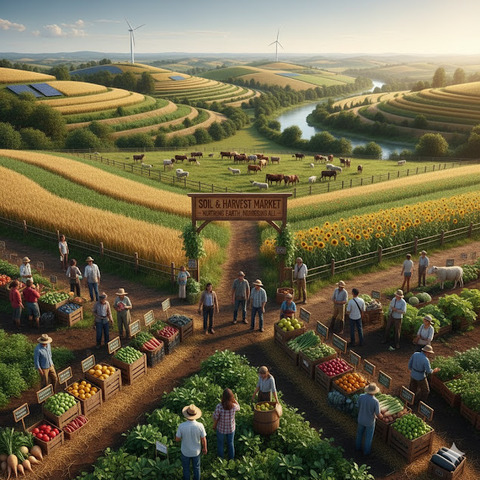
The Soil Health and Regenerative Agriculture Market is gaining momentum as global agriculture shifts toward sustainable, climate-resilient practices. Increasing awareness of soil degradation, rising corporate sustainability commitments, and supportive government policies are accelerating adoption. Businesses, investors, and agribusiness leaders are increasingly choosing to Invest in Soil Health and Regenerative Agriculture Market to align long-term profitability with environmental stewardship and food security goals.
What Are the Key Drivers Fueling Market Expansion?
Sustainability & Net-Zero Targets: Corporations worldwide are integrating regenerative practices across supply chains to fulfill environmental, social, and governance (ESG) goals, directly fueling demand for soil health solutions.
Carbon Credit Opportunities: Soil carbon sequestration practices generate tradable credits, offering farmers and companies a new revenue stream and making regenerative agriculture financially attractive.
Policy & Incentives: Government subsidies, tax credits, and climate-smart agriculture initiatives—especially in North America, Europe, and Australia—are reducing barriers to adoption.
Ag-Tech Innovation: Digital MRV (measurement, reporting, verification) tools, AI, and remote sensing are making soil health monitoring scalable and more reliable.
What Major Trends Are Shaping the Soil Health and Regenerative Agriculture Market?
Wider Adoption of Regenerative Practices: Farmers are increasingly using cover cropping, no-till systems, crop rotations, and agroforestry to enhance soil structure and resilience.
Emergence of Digital Platforms: Satellite and AI-based tools are transforming soil carbon monitoring, providing actionable data and enabling participation in carbon markets.
Partnerships Across Value Chains: Collaborations between agribusinesses, food companies, and tech startups are strengthening implementation pathways and expanding market reach.
Request A Sample for Soil Health and Regenerative Agriculture Market – Focus on Market Opportunities, Business Strategies, Application, Product, and Regional Analysis – Analysis and Forecast, 2025-2035
What Challenges and Opportunities Exist in the Market?
Challenges:
Transition Barriers: Shifting from conventional to regenerative methods requires time, training, and new equipment, posing short-term economic hurdles for many growers.
Measurement Complexity: Standardizing soil carbon measurement and verification remains technically demanding, affecting the credibility of carbon markets.
Awareness Gaps: Smallholder farmers often lack access to financing, technical knowledge, and data needed to implement regenerative practices effectively.
Opportunities:
Soil Health Financing Models: Innovative funding, including green finance and blended public-private investment, could accelerate adoption.
High-ROI Practices: Scaling technologies and practices with strong returns—like precision agriculture tools—can attract more capital and broaden adoption.
Which Regions Are Leading the Soil Health and Regenerative Agriculture Market?
North America is projected to lead the global soil health and regenerative agriculture market with a CAGR of 14.73% from 2025 to 2035. Strong corporate sustainability programs, federal incentives for climate-smart farming, and a mature ag-tech ecosystem drive this growth. Collaboration among agribusinesses, food companies, and carbon marketplaces accelerates the adoption of regenerative practices across millions of acres in the U.S. and Canada.
Future Outlook
The future of the Soil Health and Regenerative Agriculture Market appears highly promising as sustainability becomes central to global food systems. Continued policy support, rising corporate participation, and advancements in digital soil assessment are expected to strengthen market adoption. As awareness of soil resilience and climate impact grows, stakeholders across agriculture, finance, and technology are likely to increase efforts to Invest in Soil Health and Regenerative Agriculture Market.
Click Here to Download the ToC
Conclusion
The Soil Health and Regenerative Agriculture Market represents a convergence of environmental necessity and commercial opportunity. Robust growth drivers, coupled with emerging technologies and policy support, are accelerating adoption of regenerative practices worldwide. While challenges around transition costs and measurement persist, the potential for soil carbon credits, enhanced farm resilience, and sustainable food systems create a strong investment rationale. Stakeholders seeking to support sustainability and profitability should seriously consider strategic moves to Invest in Soil Health and Regenerative Agriculture Market as part of their long-term growth and ESG strategies.
Trending FAQ for Soil Health and Regenerative Agriculture Market
What is the Soil Health and Regenerative Agriculture Market?
It refers to economic activities and technologies focused on improving soil fertility, biodiversity, and sustainability through regenerative practices like cover cropping, no-till farming, agroforestry, and soil carbon sequestration.
Why is regenerative agriculture gaining momentum?
Demand is driven by climate-smart agriculture goals, corporate net-zero targets, food supply chain sustainability, soil degradation challenges, and carbon credit opportunities.
How significant is the carbon credit market for soil health?
Soil carbon credits allow farmers to monetize carbon sequestration through verified MRV systems, and this segment is rapidly emerging as a major financial incentive.
Why are investors interested in this market?
Investors see regenerative agriculture as a growth sector aligned with ESG goals, resilient to climate risks and capable of generating new revenue streams via carbon markets.