No Result
View All Result
SUBMIT YOUR ARTICLES
  • Login
Wednesday, February 11, 2026
TheAdviserMagazine.com
  • Home
  • Financial Planning
    • Financial Planning
    • Personal Finance
  • Market Research
    • Business
    • Investing
    • Money
    • Economy
    • Markets
    • Stocks
    • Trading
  • 401k Plans
  • College
  • IRS & Taxes
  • Estate Plans
  • Social Security
  • Medicare
  • Legal
  • Home
  • Financial Planning
    • Financial Planning
    • Personal Finance
  • Market Research
    • Business
    • Investing
    • Money
    • Economy
    • Markets
    • Stocks
    • Trading
  • 401k Plans
  • College
  • IRS & Taxes
  • Estate Plans
  • Social Security
  • Medicare
  • Legal
No Result
View All Result
TheAdviserMagazine.com
No Result
View All Result
Home Market Research Investing

The Accounting Treatment of Dividends

by TheAdviserMagazine
6 months ago
in Investing
Reading Time: 7 mins read
A A
The Accounting Treatment of Dividends
Share on FacebookShare on TwitterShare on LInkedIn


Updated on August 26th, 2025

This article was originally a guest contribution from Jaren Nichols, the Chief Operating Officer at ZipBooks. Jaren was previously a Product Manager at Google and holds a Master of Accountancy degree from Brigham Young University and an MBA from Harvard Business School. The August 2025 update is by Bob Ciura.

Note:  This article corresponds to C-Corporations.  For sole proprietors and S-Corporations the accounting treatment of dividends may differ markedly.  Individuals may wish to consult an accountant or tax advisor for more.

Profitable companies have a choice of what to do with their earnings:

Reinvest the profits back into the company
Distribute profits to shareholders in the form of a dividend

Note: There are other capital allocation options as well such as share repurchases or acquisitions.

This isn’t an either/or decision. A percentage of profits can be paid as dividends, and a percentage can be reinvested back into the business.

Most of the time, businesses and business owners aren’t required to issue dividends. Preferred shareholders can be an exception.

Whether you issue dividends monthly or choose to only issue dividends following a strong fiscal period, you’ll need to record the transaction. This article will explain the accounting treatment of dividends.

And not all businesses are strong enough to issue dividends year-in and year-out. Even fewer can pay rising dividends every year.

That’s what makes the Dividend Champions so special.  To be a Dividend Champion, a stock must have paid rising dividends for 25+ consecutive years.

 

The Accounting Treatment of Dividends

Declaring a Dividend

The first step in recording the issuance of your dividends is dependent on the date of declaration, i.e., when your company’s Board of Directors officially authorizes the payment of the dividends.

Applying Generally Accepted Accounting Procedures (GAAP), which is required for any public company and a good practice for private companies, means recording the dividend when it is incurred.

GAAP is telling everyone that once dividends are declared, instantly the money is owed. The company is liable for the dividends and you recognize or record the liability.

The Board’s declaration includes the date a shareholder must own stock to qualify for the payment along with the date the payments will be issued.

Retained Earnings

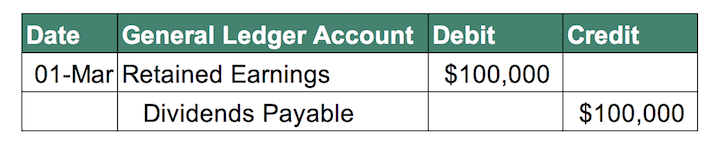
To record the declaration, you’ll debit the retained earnings account — the company’s undistributed accumulated profits for the year or period of several years. This entry will reflect the full amount of the dividends to be paid.

Debiting the account will act as a decrease because the money that is being paid out would otherwise have been held as retained earnings.  

Dividends Payable

The Dividends Payable account records the amount your company owes to its shareholders. It’s the liability. In the general ledger hierarchy, it usually nestles under current liabilities.

On the date of declaration, credit the dividend payable account.

And as with debiting the retained earnings account, you’ll credit the total declared dividend value. These two lines make the balance journal entry.

Here’s an example of declaring a dividend with Your Co.:  

The Board of Directors for Your Co. declares a cash dividend on March 1st.
Shareholders will be paid on April 10th.
The date of record will be March 15th.
Your Co. has 100,000 shares outstanding.
The dividend total will be $1-per-share or $100,000.

Date of Declaration Journal Entry
Journal Entry 1Journal Entry 1

In this situation, the date the liability will be recorded in Your Co.’s books is  March 1 — the date of the Board’s original declaration.

Date of Record

This is where GAAP accountants catch a break. The date of record is when the business identifies the shareholders to be paid.

Since shares of some companies can change hands quickly, the date of record marks a point in time to determine which individuals will receive the dividends.

Since accountants at Your Co. have already created the liability (Dividends Payable) and have not yet paid the cash dividend, no accounting financial statement is changed.

Date of Payment

The final entry required to record issuing a cash dividend is to document the entry on the date the company pays out the cash dividend.

This transaction signifies money that is leaving your company, so we’ll credit or reduce your company’s cash account and debit your dividends payable account. Use the date of the actual payment for the total value of all dividends paid.  

Let’s go back to our initial example with Your Co.:

The Board of Directors for Your Co. declares a cash dividend on March 1st.
Shareholders will be paid on April 10th.
The date of record will be March 15th.
Your Co. has 100,000 shares outstanding.
The dividend total will be $1-per-share or $100,000.

Date of Payment
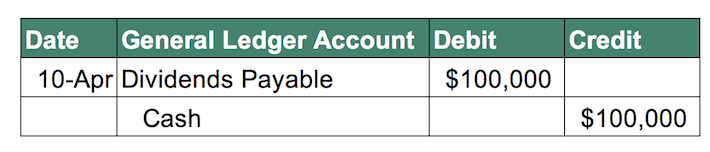
Journal Entry 2Journal Entry 2

Impacts to your financial statements

As you would expect, dividends shouldn’t impact the operating activities of your company. That means declaring, paying, and recording dividends won’t change anything on your income statement or profit and loss statement.

Declaring and paying dividends will change your company’s balance sheet. Don’t worry, your balance sheet will still balance since there will be offsetting changes.

After your date or record, your liabilities will increase and your retained earnings will decrease. Then after the payment, both your cash account and your liability will be reduced.

The end result across both entries will be an overall reduction in retained earnings and cash for the amount of the dividend.

Simplified for non-GAAP or Cash Basis

If you don’t need to report in GAAP, you probably have a simpler business structure and fewer shareholders. This also corresponds to a less-than-formal dividend announcement.

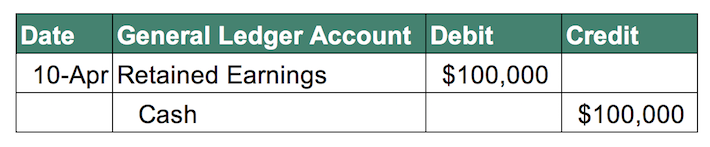
However, the principle is the same, you are just able to skip the temporary dividends payable portions of the entry.

Here’s an example of cash-basis reporting with Your LLC.:

Your LLC has 100,000 shares outstanding.
Your LLC directors determine to pay a dividend of $1-per-share or $100,000 in total.
Payment is made on April 10th.
Journal Entry 3Journal Entry 3

Deciding when to start paying dividends, how much to pay, and how frequently to pay them can be difficult. These can be key signals in the maturity of your business and optimism of the business owners or directors.

However, recording dividends should be simple (especially if you have your bookkeeper do it). Whether you follow GAAP or use cash-basis accounting, you can make sure your financial reports are accurate with proper dividend reporting.

the following Sure Dividend resources contain many of the most reliable dividend growers in our investment universe:

Thanks for reading this article. Please send any feedback, corrections, or questions to [email protected].



Source link

Tags: Accountingdividendstreatment
ShareTweetShare
Previous Post

All 252 Consumer Discretionary Stocks List From Major Sector ETFs Now

Next Post

6 Financial Conversations to Avoid During the Holidays With Family

Related Posts

edit post
3 Reasons Why You Haven’t Bought Your First Rental Property (Yet)

3 Reasons Why You Haven’t Bought Your First Rental Property (Yet)

by TheAdviserMagazine
February 11, 2026
0

After all, there are too many things working against you: high mortgage rates, fewer deals, and concerns about the housing...

edit post
Monthly Dividend Stock In Focus: Killam Apartment REIT

Monthly Dividend Stock In Focus: Killam Apartment REIT

by TheAdviserMagazine
February 10, 2026
0

Published on February 10th, 2026 by Bob Ciura Monthly dividend stocks have instant appeal for many income investors. Stocks that...

edit post
6 Ways I’ve Diversified My Passive Portfolio in Search of “Perfection”

6 Ways I’ve Diversified My Passive Portfolio in Search of “Perfection”

by TheAdviserMagazine
February 10, 2026
0

In This Article Every time I’ve tried to get “clever” and pick “the next hot investment,” life crammed some humble...

edit post
What Makes an Ideal Leveraged Buyout Candidate?

What Makes an Ideal Leveraged Buyout Candidate?

by TheAdviserMagazine
February 10, 2026
0

With more than $4.6 trillion of capital committed across private markets (30 June 2025), fund managers face growing pressure to...

edit post
10 Red Flag Monthly Dividend Stocks With Unsafe Payouts

10 Red Flag Monthly Dividend Stocks With Unsafe Payouts

by TheAdviserMagazine
February 9, 2026
0

Published on February 9th, 2026 by Bob Ciura Monthly dividend stocks have instant appeal for many income investors. Stocks that...

edit post
Rethinking Household Asset Allocation Under Capital Constraints

Rethinking Household Asset Allocation Under Capital Constraints

by TheAdviserMagazine
February 9, 2026
0

The 60/40 equity–bond portfolio remains a widely used benchmark for long-term asset allocation, despite ongoing debate about its optimality (Pham...

Next Post
edit post
6 Financial Conversations to Avoid During the Holidays With Family

6 Financial Conversations to Avoid During the Holidays With Family

edit post
StanChart says Ethereum treasury companies are undervalued, revises ETH forecast to ,500 by year-end

StanChart says Ethereum treasury companies are undervalued, revises ETH forecast to $7,500 by year-end

  • Trending
  • Comments
  • Latest
edit post
Medicare Fraud In California – 2.5% Of The Population Accounts For 18% Of NATIONWIDE Healthcare Spending

Medicare Fraud In California – 2.5% Of The Population Accounts For 18% Of NATIONWIDE Healthcare Spending

February 3, 2026
edit post
Key Nevada legislator says lawmakers will push for independent audit of altered public record in Nevada OSHA’s Boring Company inspection 

Key Nevada legislator says lawmakers will push for independent audit of altered public record in Nevada OSHA’s Boring Company inspection 

February 4, 2026
edit post
North Carolina Updates How Wills Can Be Stored

North Carolina Updates How Wills Can Be Stored

February 10, 2026
edit post
Where Is My South Carolina Tax Refund

Where Is My South Carolina Tax Refund

January 30, 2026
edit post
Washington Launches B Rare Earth Minerals Reserve

Washington Launches $12B Rare Earth Minerals Reserve

February 4, 2026
edit post
Wells Fargo moving wealth HQ to Florida

Wells Fargo moving wealth HQ to Florida

January 20, 2026
edit post
Palo Alto Networks to list on TASE

Palo Alto Networks to list on TASE

0
edit post
There’s an AI Market Selloff Everywhere Except Here

There’s an AI Market Selloff Everywhere Except Here

0
edit post
Signia Capital Management’s Views on Ramaco Resources (METC)

Signia Capital Management’s Views on Ramaco Resources (METC)

0
edit post
Why Politicians Hate Productivity (and Robots)

Why Politicians Hate Productivity (and Robots)

0
edit post
Crypto Dream Turns Nightmare As SafeMoon CEO Gets 100 Months In Jail

Crypto Dream Turns Nightmare As SafeMoon CEO Gets 100 Months In Jail

0
edit post
10 Medicaid Extras That Reduce Out-of-Pocket Costs for Seniors in 2026

10 Medicaid Extras That Reduce Out-of-Pocket Costs for Seniors in 2026

0
edit post
There’s an AI Market Selloff Everywhere Except Here

There’s an AI Market Selloff Everywhere Except Here

February 11, 2026
edit post
10 Medicaid Extras That Reduce Out-of-Pocket Costs for Seniors in 2026

10 Medicaid Extras That Reduce Out-of-Pocket Costs for Seniors in 2026

February 11, 2026
edit post
Signia Capital Management’s Views on Ramaco Resources (METC)

Signia Capital Management’s Views on Ramaco Resources (METC)

February 11, 2026
edit post
Crypto Dream Turns Nightmare As SafeMoon CEO Gets 100 Months In Jail

Crypto Dream Turns Nightmare As SafeMoon CEO Gets 100 Months In Jail

February 11, 2026
edit post
*HOT* Bath & Body Works:  Hand Sanitizers,  Bar Soaps, and  Lip Care!

*HOT* Bath & Body Works: $2 Hand Sanitizers, $3 Bar Soaps, and $4 Lip Care!

February 11, 2026
edit post
8 traits of people who never feel lonely, especially in the second half of life

8 traits of people who never feel lonely, especially in the second half of life

February 11, 2026
The Adviser Magazine

The first and only national digital and print magazine that connects individuals, families, and businesses to Fee-Only financial advisers, accountants, attorneys and college guidance counselors.

CATEGORIES

  • 401k Plans
  • Business
  • College
  • Cryptocurrency
  • Economy
  • Estate Plans
  • Financial Planning
  • Investing
  • IRS & Taxes
  • Legal
  • Market Analysis
  • Markets
  • Medicare
  • Money
  • Personal Finance
  • Social Security
  • Startups
  • Stock Market
  • Trading

LATEST UPDATES

  • There’s an AI Market Selloff Everywhere Except Here
  • 10 Medicaid Extras That Reduce Out-of-Pocket Costs for Seniors in 2026
  • Signia Capital Management’s Views on Ramaco Resources (METC)
  • Our Great Privacy Policy
  • Terms of Use, Legal Notices & Disclosures
  • Contact us
  • About Us

© Copyright 2024 All Rights Reserved
See articles for original source and related links to external sites.

Welcome Back!

Login to your account below

Forgotten Password?

Retrieve your password

Please enter your username or email address to reset your password.

Log In
No Result
View All Result
  • Home
  • Financial Planning
    • Financial Planning
    • Personal Finance
  • Market Research
    • Business
    • Investing
    • Money
    • Economy
    • Markets
    • Stocks
    • Trading
  • 401k Plans
  • College
  • IRS & Taxes
  • Estate Plans
  • Social Security
  • Medicare
  • Legal

© Copyright 2024 All Rights Reserved
See articles for original source and related links to external sites.