Updated on April 1st, 2026 by Felix Martinez
The real estate industry is a great place for investors seeking yield. Intuitively, this is not surprising. Real estate owners collect predictable income from their tenants. Thus, the real estate business is geared toward owners seeking periodic income.
One of the best ways for investors to gain exposure to the real estate industry is through Real Estate Investment Trusts (REITs).
STAG Industrial (STAG) is a commercial REIT that leases single-tenant industrial properties throughout the US. The stock’s current dividend yield of 4.3% is more than triple the 1.3% average yield in the S&P 500.
Moreover, STAG Industrial pays monthly dividends (rather than quarterly). This is highly beneficial for retirees and other investors who rely on dividend income to cover their living expenses. There are currently 117 monthly dividend stocks.
You can download our full Excel spreadsheet of all monthly dividend stocks (along with metrics that matter, like dividend yield and payout ratio) by clicking on the link below:

Thanks to its high yield and monthly dividend payments, STAG Industrial has the potential to be a great investment for income investors, particularly since the trust has a long runway for growth.
Business Overview
STAG Industrial is a Real Estate Investment Trust (REIT). It owns and operates industrial real estate. It focuses on single-tenant industrial properties and has nearly 600 buildings across 41 U.S. states. This REIT’s focus on single-tenant properties may entail higher risk than multi-tenant properties, as the former are either fully occupied or completely vacant.
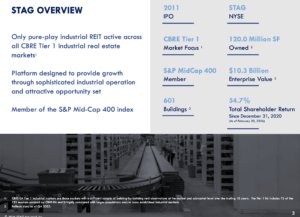
Source: Investor Presentation
STAG Industrial conducts in-depth quantitative and qualitative analyses of its tenants. As a result, it has incurred credit losses of less than 0.1% of its revenues since its IPO.
The trust typically does business with established tenants to reduce risk. Moreover, STAG Industrial has limited exposure to any specific tenant. STAG has an added advantage thanks to its exposure to e-commerce properties, which gives it access to a key growth segment in real estate.
The penetration rate of e-commerce is expected to grow from 14% in 2021 to 30% by 2030. This secular shift in consumer behavior will provide a strong tailwind to STAG’s business for the next several years.
STAG is currently facing a headwind due to rising interest rates. However, the effect of higher interest rates on the REIT has been limited so far, thanks to the strong credit profiles of its tenants.
Some REITs view single-tenant properties as risky because they are binary: either fully leased or empty. However, focusing on single-tenant properties creates mispriced assets, which STAG can add to its portfolio at attractive valuations. This is central to STAG’s strategy and is a key differentiator among competitors.
STAG’s addressable market exceeds $1 trillion, a significant portion of which consists of single-tenant properties. The sector is highly fragmented, meaning that no particular entity would have a considerable scale advantage. This is why STAG believes it can purchase mispriced assets.
STAG finds this to be an attractive mix of assets. Combined with relatively low capex and high retention rates, it has created a strong portfolio of industrial real estate.
STAG’s tenant profile reflects the vast diversification it has built into its portfolio. This diversification greatly mitigates the risk of owning single-tenant properties. STAG has done a nice job of taking a relatively risky sector of real estate—single-tenant properties—and building a portfolio that greatly reduces that risk.
Growth Prospects
STAG Industrial’s growth since its IPO in 2011 has been impressive from both fundamental and investor-return perspectives. Fortunately, this real estate trust still has ample room for future growth.
The trust reported strong fourth-quarter 2025 results, with net income of $83.4 million ($0.44 per share), up significantly from the prior year. Core FFO rose to $0.66 per share (+8.2%), while revenue reached $220.9 million, reflecting solid growth driven by increased leasing activity and higher rental rates. Same-store cash NOI grew 5.4%, and occupancy remained high at 96.4%, highlighting continued strength in its industrial real estate portfolio.
For the full year 2025, net income totaled $273.4 million ($1.46 per share), while Core FFO increased to $2.55 per share (+6.3%).
Same-store cash NOI rose 4.3% to $579.4 million, supported by strong leasing spreads and consistent demand for warehouse and distribution space. The company maintained disciplined capital allocation, contributing to steady earnings growth and improved operating performance.
Operationally, STAG expanded its portfolio through $449 million in acquisitions (3.8 million square feet) while disposing of $171 million in assets.
Leasing activity remained robust, with significant rent increases on new and renewal leases and solid tenant retention. Overall, the company demonstrated stable growth, high occupancy, and effective portfolio management heading into 2026.
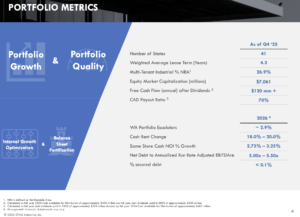
Source: Investor Presentation
Dividend Analysis
STAG is a high-dividend REIT. Its dividend is obviously very important, as investors generally own REITs for their payouts. STAG’s payout has grown year over year since its IPO and is currently $1.55 per share. However, dividend growth since 2015 has been minimal, averaging only 1.0% yearly.
We do not see material growth in the dividend moving forward. Still, STAG’s payout ratio, which currently stands at 59% of expected FFO-per-share for 2026, provides a meaningful margin of safety for the dividend. We expect STAG to continue raising its dividend very slowly for the foreseeable future to avoid ending up in a tight spot as it did in the earlier half of the trailing decade.
The payout ratio is down significantly from its 2016 level of nearly 100%, as STAG has made a concerted effort to reduce its dividend’s vulnerability. However, that effort is still underway, and hence, we see meaningful payout growth as unlikely in the near term.
The current payout ratio, combined with our expectations for mid-single-digit FFO-per-share growth in the coming years, should gradually improve the safety of STAG’s dividend. The trust has also made divestitures when pricing is favorable, an option it could use to temporarily cover dividend shortfalls. In short, we view the REIT’s 4.3% dividend yield as safe for the foreseeable future.
Final Thoughts
STAG Industrial has two characteristics that immediately appeal to income investors: a 4.3% dividend yield and regular monthly dividend payments. In addition, REITs have promising growth prospects and are reasonably valued. As a result, it can offer a total average annual return of about 10% over the next five years.
We like the trust’s strategy for long-term growth in the real estate sector, which investors sometimes overlook due to its perceived risk. Thus, STAG Industrial is a good potential addition to a high-yield portfolio, thanks to its high dividend yield, monthly dividend payments, and leadership in the single-tenant industrial real estate market. Overall, STAG Industrial seems an attractive candidate for income-oriented investors, especially in the highly inflationary investing environment prevailing right now.
Don’t miss the resources below for more monthly dividend stock investing research.
And see the resources below for more compelling investment ideas for dividend growth stocks and/or high-yield investment securities.
Thanks for reading this article. Please send any feedback, corrections, or questions to [email protected].