Updated on March 6th, 2026 by Felix Martinez
We review each of the Dividend Aristocrats, the group of companies in the S&P 500 Index with 25+ consecutive years of dividend increases, every year.
To become a Dividend Aristocrat, a company must possess durable competitive advantages and a steady business model that generates yearly profits, even during recessions.
But it must also have a shareholder-friendly management team dedicated to maintaining consistent dividend increases each year.
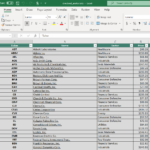
We have compiled a list of all 69 Dividend Aristocrats, along with key financial metrics such as price-to-earnings ratios and dividend yields. You can download the full list by clicking on the link below:
Disclaimer: Sure Dividend is not affiliated with S&P Global in any way. S&P Global owns and maintains The Dividend Aristocrats Index. The information in this article and downloadable spreadsheet is based on Sure Dividend’s own review, summary, and analysis of the S&P 500 Dividend Aristocrats ETF (NOBL) and other sources, and is meant to help individual investors better understand this ETF and the index upon which it is based. None of the information in this article or spreadsheet is official data from S&P Global. Consult S&P Global for official information.
Next up in the Dividend Aristocrats In Focus series is International Business Machines (IBM). IBM has increased its dividends 30 years in a row.
In the past few years, IBM has turned itself around by investing in new areas such as artificial intelligence, data, and cloud services, which have returned the company to growth.
In turn, IBM shares have rallied 60% over the past 12 months, far outpacing the S&P 500 Index. This article will discuss IBM’s current business model, future growth prospects, and whether we see the stock as a buy right now.
Business Overview
IBM focuses on running mission-critical systems for large, multinational customers and governments. It typically provides end-to-end solutions. IBM spun off Kyndryl, its managed infrastructure business, in 2021, but is still one of the largest IT services companies in the world.
IBM now has four business segments: Software, Consulting, Infrastructure, and Financing. In 2025, its annual revenue was $66.7B.
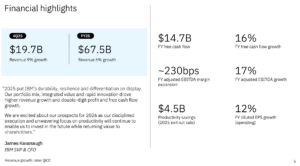
IBM reported fourth-quarter and full-year results on January 28th, 2026. IBM reported strong fourth-quarter 2026 results, with adjusted EPS of $4.52, beating estimates, and revenue of $19.7 billion, up 12% year-over-year.
Growth was driven by the Software segment, which increased 14% to $9.0 billion, and Infrastructure revenue, which surged 21% to $5.1 billion, supported by strong demand for the company’s next-generation IBM Z mainframe platform. Consulting revenue rose 3% to $5.3 billion, while operating gross margin improved to 61.8%.
For the full year 2025, IBM generated $67.5 billion in revenue, up 8% year-over-year, with operating EPS of $11.59 and expanding profitability. Software revenue increased 11%, Infrastructure grew 12%, and Consulting rose 2%.
The company also produced $13.2 billion in operating cash flow and $14.7 billion in free cash flow, reflecting double-digit growth in profit and cash generation.
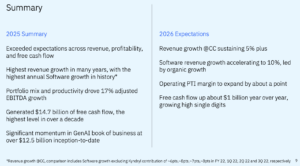
Looking ahead, IBM expects more than 5% constant-currency revenue growth in 2026 and forecasts free cash flow to increase by about $1 billion year-over-year. Management highlighted strong demand for hybrid cloud, automation, and data platforms, along with a generative AI book of business exceeding $12.5 billion, positioning the company for continued growth.
Source: Investor Presentation
Growth Prospects
IBM has engineered a successful turnaround over the past few years, and signs are emerging that it is gaining traction.
Its priority is to become a leader in artificial intelligence and hybrid cloud solutions. It has invested aggressively in these areas, such as the $34 billion acquisition of Red Hat in 2019.
IBM sees the hybrid cloud as a $1 trillion market and its most significant opportunity to return to growth in the future.
In 2023, IBM continued its habit of frequently tuck-in acquisitions. It acquired software company Apptio for $4.6 billion, expanding its AI offerings. The company followed that up with the acquisitions of StreamSets and webMethods. Under the present CEO, IBM has acquired 30+ companies.
IBM forecasts revenue growth in the mid-single-digits and free cash flow. We expect 5% EPS growth over the next five years.
Source: Investor Presentation
Competitive Advantages & Recession Performance
IBM enjoys meaningful competitive advantages, primarily its industry leadership position and scale. Its competitive strength lies in its brand, entrenched customer relationships, and extensive patent portfolio. IBM is also the market leader in mainframe computers, with 90% market share and little competition.
IBM receives mixed reviews on its performance during the recession. As a global technology company, it is exposed to the fluctuations of the broader economy.
For example, in 2020, the company’s revenue and earnings per share declined as the global economy fell into a recession due to the coronavirus pandemic.
That said, IBM performed relatively well in the Great Recession of 2008-2009. IBM’s performance during that recession is listed below:
2008 earnings-per-share: $8.93
2009 earnings-per-share: $10.01 (12% increase)
2010 earnings-per-share: $11.52 (15% increase)
2011 earnings-per-share: $13.06 (13% increase)
It is impressive that IBM grew its earnings-per-share each year during the Great Recession. Moreover, the dividend kept increasing.
While the company’s performance during the recession was weaker in 2020, it remained highly profitable, allowing it to keep its dividend increase streak alive.
Valuation & Expected Returns
Based on our 2026 earnings-per-share estimate of $12.40 And the current stock price of $256, IBM shares trade at a price-to-earnings ratio of 20.6x.
The stock trades above our fair value P/E estimate of 18.0. A declining valuation multiple could reduce annual returns by 4% over the next five years, suggesting the stock is overvalued right now.
These negative returns could be offset by earnings-per-share growth and dividends. As previously mentioned, we expect 5% annual EPS growth through 2031.
In addition, the stock has a current dividend yield of 2.6%. Over the next five years, we estimate total returns at 3.6% per year.
The stock price has risen quickly due to better performance and AI optimism, and it is now nearly a decade high. The low rate of return is due to the current overvaluation of the shares.
Final Thoughts
In 2021, IBM was inducted into the prestigious Dividend Aristocrats list. Due to its steady growth and strong free cash flow, IBM has continued to raise its dividend each year.
IBM’s financial performance is improving, and the company is deleveraging. It should be able to continue raising its dividend each year.
Given its share price rally over the past year, the stock appears overvalued. The low expected returns make it a hold, in our view.
If you are interested in finding high-quality dividend growth stocks suitable for long-term investment, the following Sure Dividend databases will be useful:
The major domestic stock market indices are another solid resource for finding investment ideas. Sure Dividend compiles the following stock market databases and updates them monthly:
Thanks for reading this article. Please send any feedback, corrections, or questions to [email protected].