Updated on March 13th, 2026 by Nathan Parsh
Essex Property Trust (ESS) isn’t necessarily a household name when it comes to dividend stocks, but the real estate investment trust, or REIT, has produced very impressive growth in the past two decades.
The trust has managed to produce increasing dividends since its IPO in 1994. In all, Essex has increased its dividend for 32 consecutive years.
It is now a member of the Dividend Aristocrats, a group of S&P 500 stocks with at least 25 consecutive years of dividend increases.
That list is now up to 69 companies that have proven to investors they can pay – and increase – their dividends in any economic climate.
You can download an Excel spreadsheet of all 69 Dividend Aristocrats, including important financial metrics such as P/E ratios and dividend yields, by clicking the link below:
Disclaimer: Sure Dividend is not affiliated with S&P Global in any way. S&P Global owns and maintains The Dividend Aristocrats Index. The information in this article and downloadable spreadsheet is based on Sure Dividend’s own review, summary, and analysis of the S&P 500 Dividend Aristocrats ETF (NOBL) and other sources, and is meant to help individual investors better understand this ETF and the index upon which it is based. None of the information in this article or spreadsheet is official data from S&P Global. Consult S&P Global for official information.
Essex faced some headwinds during the coronavirus pandemic of 2020, but the company has made big strides in its ongoing recovery.
Meanwhile, the stock has a 4.1% yield, a leadership position in its core markets, and potential for growth up ahead.
Business Overview
Essex is a Real Estate Investment Trust, or REIT. It started in 1971 as a small real estate company and eventually went public in 1994.
At that time, Essex had grown to 16 multifamily communities as a fully integrated REIT that acquires, develops, redevelops, and manages multifamily apartment communities located in supply-constrained markets.
Today, Essex is concentrated on the West Coast of the U.S., including cities like Seattle, Los Angeles, and San Francisco.
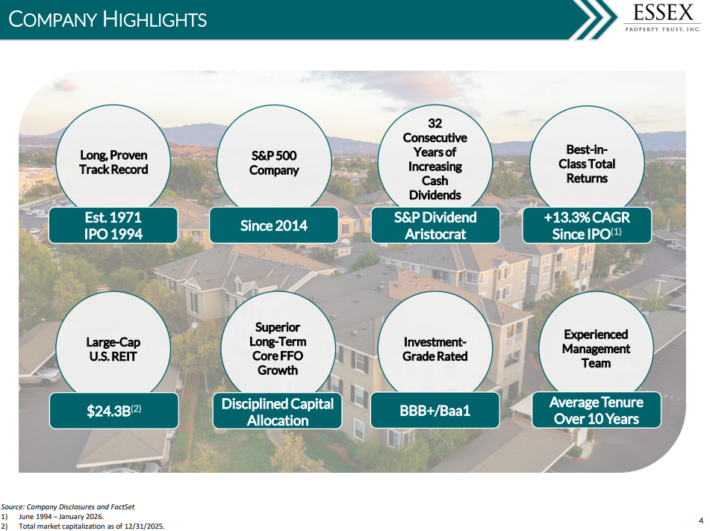
Source: Investor Presentation
The company reported its earnings results for the fourth quarter of 2025 on February 4th, 2026. Essex reported solid results that showed operational execution despite a challenging earnings environment. For the quarter, revenue grew 5.6% to $477 million and was $3.3 million better than expected. Core FFO of $3.98 per share compared favorably to $3.92 in the prior year, but this was $0.01 below estimates.
For the year, revenue grew 6.4% to $1.89 billion while Core FFO of $15.94 was up from $15.60 in 2024.
Same-property revenue growth of 3.8% for the quarter. Same-property revenue growth was 3.3% for the year and landed at the high end of guidance and roughly 30 basis points above initial projections, underscoring healthy demand across Essex’s West Coast portfolio.
Regional performance was broad-based, with Northern California same-property revenue up 4.2%, Southern California up 3.8%, and Seattle up 3.1%, while portfolio occupancy improved to 96.3% in Q4 and delinquency levels reverted to near pre-COVID norms, signaling strong underlying tenant quality. The company also maintained a robust balance sheet with over $1.7 billion of liquidity, providing financial flexibility.
On the other hand, the Seattle market showed softness in Q4 related to corporate layoff announcements, while Los Angeles continued to face elevated delinquency challenges that could hinder near-term growth. In addition, the structured finance portfolio created a 1.8% headwind to Core FFO growth.
Management provided guidance for 2026 as well, with the company expecting revenue from its same-property portfolio to be in a range of 1.7% to 3.1%. Core FFO is projected to be $15.94, which would match last year’s result. We are slightly more bullish and expect Core FFO of $16.08 for 2026.
Growth Prospects
We see Essex producing 3.5% annual FFO-per-share growth for the next five years. Essex has reached the point where it is a huge player in the markets where it is present, so growth could be more difficult to come by.
Essex concentrates on the markets on the West Coast because of favorable long-term rental prospects. That area has very high economic productivity and strong rates of job growth, both of which fuel the demand for housing supply.
In addition, single-family residences are very expensive in these markets, making renting more attractive.
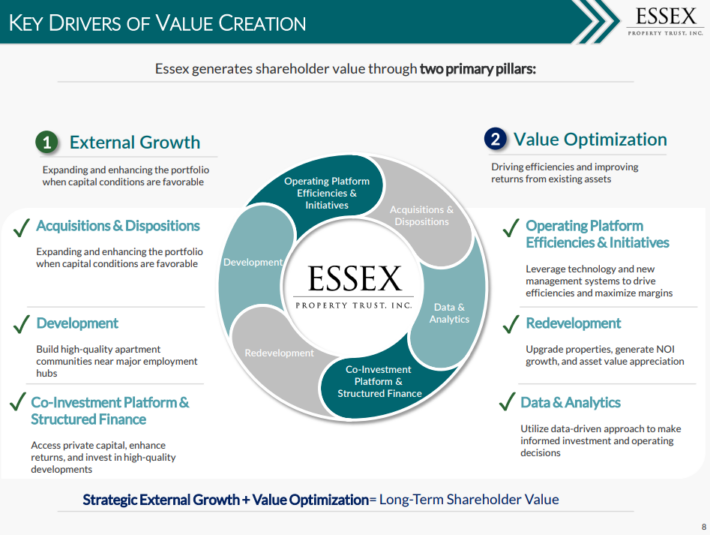
Source: Investor Presentation
These markets have a strong demand for rental units and a limited supply of new ones as undeveloped land is limited, and construction is lengthy and expensive.
Essex is present in two markets with chronic housing shortage problems, which drives demand for its rental units over time. We think this tailwind will be modest but steady, adding to the trust’s FFO-per-share in the years to come via higher same-property revenue and NOI growth.
Competitive Advantages & Recession Performance
Competitive advantages are difficult to come by for a REIT, given that so many competitors employ essentially identical business models.
However, Essex has scale and size, unlike other apartment REITs, and a management team that is highly skilled in creating shareholder value through various methods.
The company also has a strong financial position, providing it a competitive advantage over its peers, who may be in worse financial shape. Essex has a solid BBB+ credit rating from Standard & Poor’s.
At the same time, net debt to adjusted EBITDA has been coming down since 2020.
Interestingly, Essex performed very well during and after the Great Recession:
2007 FFO-per-share: $5.57
2008 FFO-per-share: $6.14
2009 FFO-per-share: $6.74
2010 FFO-per-share: $5.02
This speaks to the resilience of the markets where it is present, as 2020 and 2021 were the only years in the past decade where FFO-per-share declined. We see this recession resilience as highly favorable and adds to the stock’s attractiveness.
Valuation & Expected Returns
Shares are trading at ~$251 and our expectation for Essex’s FFO to be $16.08 this year, resulting in a price-to-FFO ratio of 15.6. We see fair value at 16 times FFO-per-share, which means shares are trading below our fair value estimate.
As such, Essex is undervalued at the present time in our view. Reaching our target valuation by 2031 would add 0.5% to annual returns over this period.
In addition, future returns will be aided by FFO growth and dividends as well. Along with the current dividend yield of 4.1%, 3.5% forecasted FFO-per-share growth, and a small tailwind from multiple expansion, we project annual returns to be 7.6% through 2031.
Essex has paid increasing dividends for 32 consecutive years. Dividend growth investors likely find this an attractive quality, and we expect Essex to continue to raise the payout each year for the foreseeable future as the projected payout ratio for 2026 is just 64%.
Final Thoughts
Essex has undoubtedly been a world-class REIT since it went public and began paying dividends more than three decades ago. The trust has favorable long-term demographics working in its favor, and a management team is keen to unlock shareholder value.
ESS stock is appealing to investors looking for dividend safety and steady dividend growth over time. With total returns expected at 7.6% annually, we rate ESS stock as a hold.
If you are interested in finding more high-quality dividend growth stocks suitable for long-term investment, the following Sure Dividend databases will be useful:
The major domestic stock market indices are another solid resource for finding investment ideas. Sure Dividend compiles the following stock market databases and updates them monthly:
Thanks for reading this article. Please send any feedback, corrections, or questions to [email protected].