As President Trump wrestles to deliver on his campaign promise to end the war on Ukraine by helping to bring about a negotiated peace deal, the effort has, in part, been undermined by an escalating exchange of kamikaze drones by both sides.
The last week especially saw a sharp escalation, with Ukraine launching thousands of drones deep into Russia—most of which the Russians claim to have intercepted—and Russia, in turn, stepping up its drone attacks in Ukraine. The Russian strikes over the weekend got a lot of coverage in the American media, especially an aerial assault on Saturday night where parts of some of the largest drone swarms launched in the war so far hit residential buildings around the Ukrainian armament factories Russia claimed to be targeting.
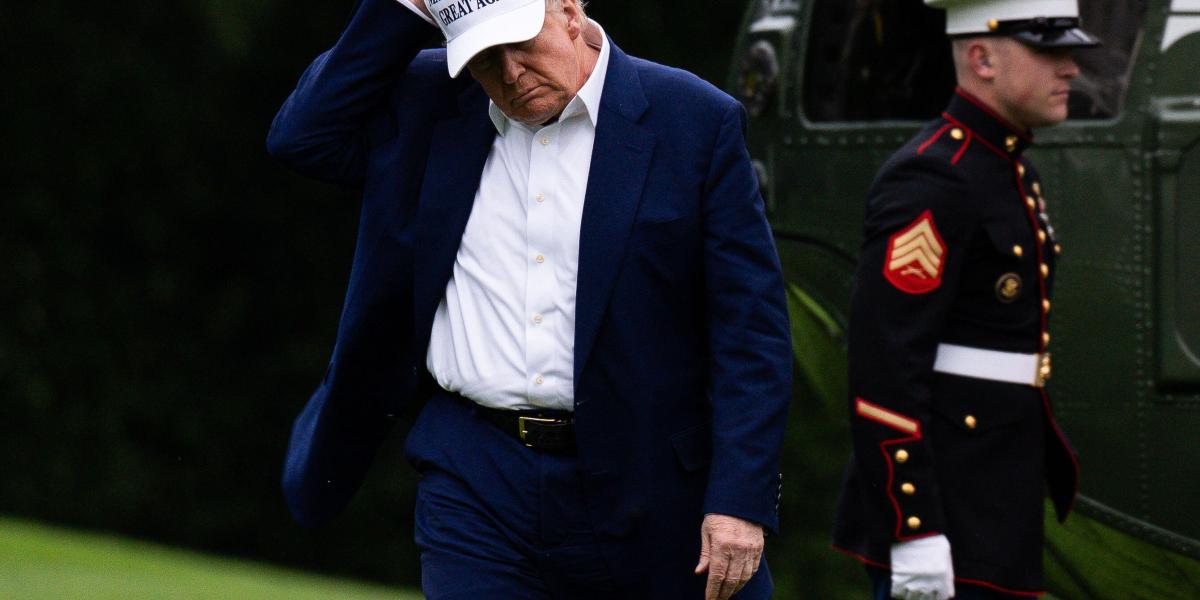
That series of strikes led Trump to issue his sharpest rebuke of Vladamir Putin to date. He called the Russian president crazy and voiced frustration with how Putin has changed since their phone call together—after which Trump had characterized Putin as reasonable and interested in a ceasefire.
The establishment press gleefully seized on Trump’s comments to argue that even he is now waking up to what they’ve been saying this whole time: that Putin is an unhinged maniac who cannot be reasoned with because he is motivated solely by bloodlust and delusions of conquering Europe. They then, predictably, bring it back to their broader argument that Trump’s “naïve” effort to “appease” Putin with a peace agreement and then “retreat from Europe” to usher in a new age of American isolationism is futile and dangerous and that he ought to instead recommit to the establishment’s preferred strategy of heavy-handed interventionism.
It is true that the Trump administration’s attempt to kickstart negotiations to end the war in Ukraine has run into difficulties that make it unlikely a ceasefire will be reached soon. But that is not an argument in favor of the political establishment’s interventionism, as that is the very thing that brought about this difficult situation in the first place.
Much has been written on the decades between the collapse of the USSR and the rise of the Western-friendly Russian Federation and the eventual return of Cold War conditions encapsulated by Russia’s invasion of Ukraine. There is plenty of debate about the details and consequences of decisions made along the way. But nobody with any real credibility is even trying to argue that this period was characterized by a lack of US meddling in Eastern Europe.
Washington was heavily involved in the region from the beginning. At first, it was all under the friendly guise of helping with the transition from communism to capitalism. But as that process was botched by a combination of statist Western economists—who thought free markets had to be organized and managed in a top-down fashion—and outright corruption by officials on all sides, the respect, admiration, and trust the American government enjoyed in much of the region began to fade away.
That was accelerated when US presidents began working to expand NATO, the anti-Soviet military alliance, up to Russia’s border. For Russia’s entire history, the lack of natural barriers between Moscow and the rest of Europe has been a source of tremendous anxiety for Russian leaders. No mountains or major waterways blocked the armies of Napoleon and, later, Hitler from marching directly into the Russian heartland. The only factor that doomed both of those invasions was distance.
Even in the age of nuclear weapons, when long infantry supply chains are less relevant, the greater the distance a ballistic missile needs to travel to reach Russian cities, the more time the Russian regime has to detect, assess, and respond. Distance is still a factor in their defense strategy.
US officials knew this and still chose to help NATO expand closer and closer to Moscow. They were even told explicitly by the US ambassador to Russia that working to bring Ukraine, specifically, into NATO would almost certainly cause Russia to invade Ukraine.
Virtually every major American Cold War strategist was vocally against NATO expansion because they saw it as a surefire way to unnecessarily restart the US-Russia conflict that had just miraculously ended without nuclear annihilation. But they were out-lobbied and out-maneuvered by the weapons companies that produce all the military hardware that new NATO countries are required to buy.
So NATO expanded, American military hardware moved east, and anti-government protests in countries aligned with Russia received funding and support from the American government.
Even if we accept the establishment’s argument that Putin doesn’t actually care if the US pours weapons into and arranges security guarantees with the countries right on his border and is only using those actions as an excuse to further his imperial ambitions, US officials still handed Putin an easy way to get the Russian public onboard with an invasion of Ukraine for no real reason whatsoever.
Then, tragically, after the invasion happened, US officials and their allies in Western European governments like the UK convinced the Ukrainians to abandon an early peace agreement that would have resulted in Russian forces pulling back to pre-invasion boundaries. In the years since, Russia has laid permanent claim to much of the eastern Ukrainian territory they had earlier agreed to relinquish. And the Ukrainian government has continuously lost leverage over its Russian occupiers as they tried and failed to drive them out by force.
Last summer, Ukraine made the surprising decision to draw soldiers and resources away from the front lines to conduct a small invasion in Russia’s Kursk region on Ukraine’s northern border. That operation may have been an attempt to regain some leverage in future negotiations. But it did not accomplish much, and Russia has since retaken virtually all the territory they lost. The transfer of Ukrainian troops and resources has now given the Russians momentum on the rest of the front.
That is why it is unlikely that a peace agreement will be reached in the near future. Because it appears that Russia can achieve more if it continues fighting than through negotiations. And, importantly, that is not because the US and its European allies have held back and avoided giving the Ukrainians what they needed to fight the Russians. It’s because the officials who recognized the West’s leverage in future negotiations would only get worse lost out to those who thought the war should be prolonged anyway because it was a good way to “weaken Russia” without risking American lives.
There is no easy path out of this mess. It’s not as if NATO governments have some special weapons system they haven’t sent to Ukraine yet that could begin to turn the tide of the war. If they had, they would have sent it already. Short of sending American troops into combat with the Russians, there is little more that can be done to prop up Ukrainian forces. And, as Scott Horton noted in his recent talk here at the Mises Institute, even if Trump genuinely tried to reverse course and repair relations between Washington and Moscow, the Russians would probably just assume, understandably, that any progress he made would be undone by the next Democrat to win the presidency.
That’s why, if we’re ever going to see a true end to this unnecessary second Cold War with Russia, it requires that more Americans understand how it truly came about in the first place. It needs to be widely understood that if our government’s priority were really keeping us safe, they would have done everything in their power to avoid kickstarting a new conflict with the most heavily nuclear-armed government in the world. And yet, they seemed to have done the precise opposite.
What the path out certainly does not involve is doubling down on the same exact policies that both created this mess in the first place and that are being championed by those who want to see this war drag on indefinitely in a vile attempt to use Ukrainians to weaken Russia a little bit more.