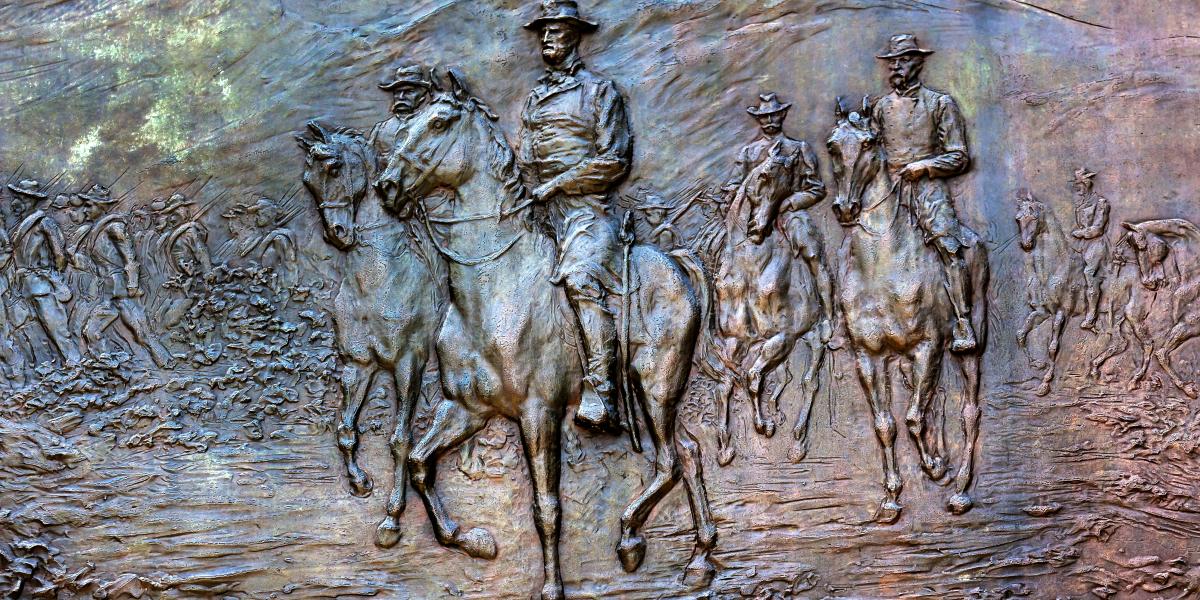
When a just war of defense turns into a war of revenge, it ceases to be a just war and becomes an unjust war of aggression. That explains why Robert E. Lee—who followed the conventions of civilized warfare agreed upon in the eighteenth and nineteenth centuries—saw his role as defense of the South, and not as aggression against the North. In 1863, he said:
It must be remembered that we make war only upon armed men, and that we cannot take vengeance for the wrongs our people have suffered without lowering ourselves in the eyes of all whose abhorrence has been excited by the atrocities of our enemies, and offending against Him to whom vengeance belongeth, without whose favor and support our efforts must all prove in vain.
In “The War Against the South and Its Consequences” Murray Rothbard points out that Union General William Tecumseh Sherman, by contrast with Lee, abandoned all such conventions and launched a total war against civilians. Rothbard explains:
Let us trace the leading consequences of the War Against the South: there is, first, the enormous toll of death, injury, and destruction. There is the complete setting aside of the civilized “rules of war” that Western civilization had laboriously been erecting for centuries: instead, a total war against the civilian population was launched against the South. The symbol of this barbaric and savage oppression was, of course, Sherman’s march through Georgia and the rest of the South, the burning of Atlanta, etc. (For the military significance of this reversion to barbarism, see F.J.P. Veale, Advance to Barbarism).
Veale attributes the blame for Sherman’s war strategy, particularly the attacks on civilians, to Lincoln:
Sherman only executed the most dramatic and devastating example of the strategy which was laid down by President Lincoln himself and followed faithfully by General Ulysses S. Grant as commander-in-chief of the Northern armies.
It was the deliberate policy of the Union army to view Southern civilians as no different from combatants. As reported in “War of the Rebellion: A Compilation of the Official Records of the Union and Confederate Armies” published in 1880–1901, Sherman stated, “We will remove and destroy every obstacle—if need be, take every life, every acre of land, every particle of property, everything that to us seems proper.” Sherman’s apologists do not deny his total war tactics; on the contrary, they argue that these tactics were justified for various reasons including the claim that his war crimes were necessary in order to win the war.
In his book War Crimes Against Southern Civilians, Walter Brian Cisco examines the evidence in the Official Records concerning the Union war strategy. Cisco recounts civilian homes in Athens, Alabama being invaded, looted, and burned to “retaliate” against Confederates who were attacking Federal troops, and to discourage the civilian population from supporting the “rebels.” Federal troops also broke into businesses and looted the premises. Significantly, none of these actions were condemned by Union officers—they were seen as just punishment against the South. Cisco gives many examples of this:
“Everything of value was carried out of dry goods stores, jewelry stores and drug stores,” remembered Indiana sergeant George H. Puntenney. “The sacking of Athens has often been condemned,” he concluded, but “was about what those Athenian rebels deserved.”
In another example, Major James Austin Connolly said,
We’ll burn every house, barn, church, and everything else we come to; we’ll leave their families houseless and without food; their towns will all be destroyed, and nothing but the most complete desolation will be found in our track.
In Tennessee, Sherman destroyed an entire town, Randolph, to retaliate against an attack by Confederate guerillas on a steamboat docked in the town. Sherman wrote, “Immediately I sent a regiment up with orders to destroy the place. The regiment has returned and Randolph is gone.” His approach to Atlanta was the same, as he declared, “Let us destroy Atlanta and make it a desolation. One thing is certain, whether we get inside Atlanta or not, it will be a used up community by the time we are done with it.” Cisco recounts that, “As many as five thousand rounds of shot and shell fell on Atlanta that one day… It went on day and night for another three weeks.” It was obvious that civilian casualties would be a direct result of this shelling, and such casualties were not merely “collateral damage.” Deliberately destroying civilian homes to avenge Confederate attacks was not unusual. Major General Hunter, when he heard that Confederates had attacked one of his supply trains in the Shenandoah Valley, “was furious, ordering the torching of houses in the neighborhood where his loss had occurred.”
Many people suppose that the burning of the South may have been some sort of accident. They presume that a fire somehow started, the winds picked up, and the rest is history. The truth is that Sherman considered burning civilian property to be a justified form of retaliation against Confederate soldiers. He said “everything is right which prevents anything. If bridges are burned [by the Confederate armies], I have a right to burn all houses near it.” Explosive charges were buried throughout Atlanta before the fires were lit. Sherman wrote, “commence the destruction [of Atlanta] at once, but don’t use fire until the last moment.” Ohio captain George W. Pepper commented, as the city lay in smoking ruins, “This is the penalty of rebellion.” There is plenty of evidence that the fires were deliberately lit. For example,
The Medical College was spared when Dr. Peter D’Alvigny confronted soldiers igniting straw and broken furniture they had piled in the entrance hall. The doctor shouted that sick and wounded soldiers were still inside, throwing open the door to prove it.
Nor was there any attempt to ensure that only property belonging to slave owners was burned which, although also illegal, may have been regarded by some people as morally justified. However, the burning was indiscriminate. No attempt was made to ascertain who owned the burned homes, nor to ensure that slaves would not also be punished along with slave owners. Cisco recounts many examples of plantation homes that were deliberately burned by Union troops:
Troops fired the gin house, granary, and a large quantity of cloth. “The Negroes went out and begged for the cloth,” wrote Mrs Canning, “saying that it was to make their winter clothes. The cruel destroyers refused to let the Negroes have a single piece.” “Well, madam,” sneered one of the soldiers, “how do you like the looks of our little fire. We have seen a great many such, within the last few weeks.”
Rage and fury in the heat of battle, undisciplined soldiers behaving badly, and the urge to retaliate for losses, are often shrugged off as understandable human reactions in the chaos of wartime. However, Robert E. Lee insisted that his army should not fight for vengeance, following a well-established convention that armies should not retaliate against soldiers by attacking civilians or burning their property. Throughout the first and second world wars—when the allies were accused of indiscriminately bombing German towns, killing civilians, and destroying their property—their response was to (emphatically, albeit dishonestly) deny it. The point here is not to endorse dishonesty in brazenly denying war crimes—the point is that, by bothering to deny war crimes, the combatants at least exhibit awareness that war crimes are abhorrent and nothing of which to be proud. Unlike Sherman’s apologists, they did not attempt to argue that bombing civilians is justified, nor are there annual celebrations of the bombing of Dresden the way some American academics annually celebrate the burning of Georgia and South Carolina.
The convention in Europe, as noted by Veale, was that “hostilities between civilized peoples must be limited to the armed forces actually engaged.” As Veale notes, any European state that broke this convention did not attempt to claim that there are circumstances where breaking the convention is justified: “for two hundred years it was acknowledged by all the European States. In the main it was complied with and, when infringed, was paid the tribute of indignant denials.” As David Gordon observes in “The Historical Origins of Modern American War Crimes,” the conventions described by Veale have now wrongly been abandoned, in favor of the horrendous view that “shock and awe” attacks on civilians are acceptable in the name of bringing a “quick end” to the war:
In the American context, a great deal of horrendous conduct stems from the Civil War, and one thing Moyn brings out is the role of the “Lieber code”, a guide to conduct for the American armed forces written by the German immigrant Francis Lieber, in this matter. Moyn says, “Lieber refused to pity victims of war. Lieber’s code went in a different direction, legalizing shock and awe, with humanity a fringe benefit rather than a true goal…. Erected as one of its founding fathers later, Lieber was not really part of the tradition of making war humane. He condoned horrendous acts such as punishing civilians and denying quarter—which meant that, when enemies surrendered in hopes of avoiding death, you could kill them anyway.” (pp. 19–20)
As Samuel Moyn points out, “For Lieber, anything necessary in war, more or less, ought to be legal; if there was such a thing as excess violence and suffering, it was because it was necessary to achieve victory, which hastened peace.” Those who rightly desire peace have wrongly adopted Lieber’s opinion that the end justifies the means, and that to hasten a peaceful future any and all war crimes are justified. After the war is won, the atrocities are memory holed. As Veale puts it, “As the war had been won, it did not seem to matter very much how it had been won.” Thus, further steps are taken in the “advance to barbarism.”