In 1918, the Austrian political scientist Joseph Schumpeter delivered a now-famous lecture titled “The Crisis of the Tax State.” The question he addressed was whether or not the First World War would bring about a destructive fiscal crisis for European states. Would the burdens of post-war debt and taxation threaten to destroy these states? Many at the time believed that it would be difficult or impossible to fiscally recover from the enormous debts and tax liabilities incurred by states during the war.
Schumpeter, however, concluded that the states of Europe would easily survive whatever fiscal strains might be caused by the war. After all, he noted, the states of Europe were well developed “tax states” by the early twentieth century. In the short and medium term, at least, the ruling regimes of Europe could essentially raise revenue at will, and the state organizations themselves thus faced no existential crisis. If the states of Europe did fail, he noted, it would be for some reason other than fiscal collapse, such as conquest or revolution. Nonetheless, “the hour will come,” he noted, that the drive to endlessly increase state revenues would eventually consume and destroy the private sector. But, in 1918, he predicted (correctly) that the day of reckoning was not yet at hand.
Now more than 100 years later, it’s clear that Schumpeter was right. No states collapsed due to an inability to raise taxes. As fiscal demands increased on states, it was not the states who suffered. The taxpayers, on the other hand, fared less well.
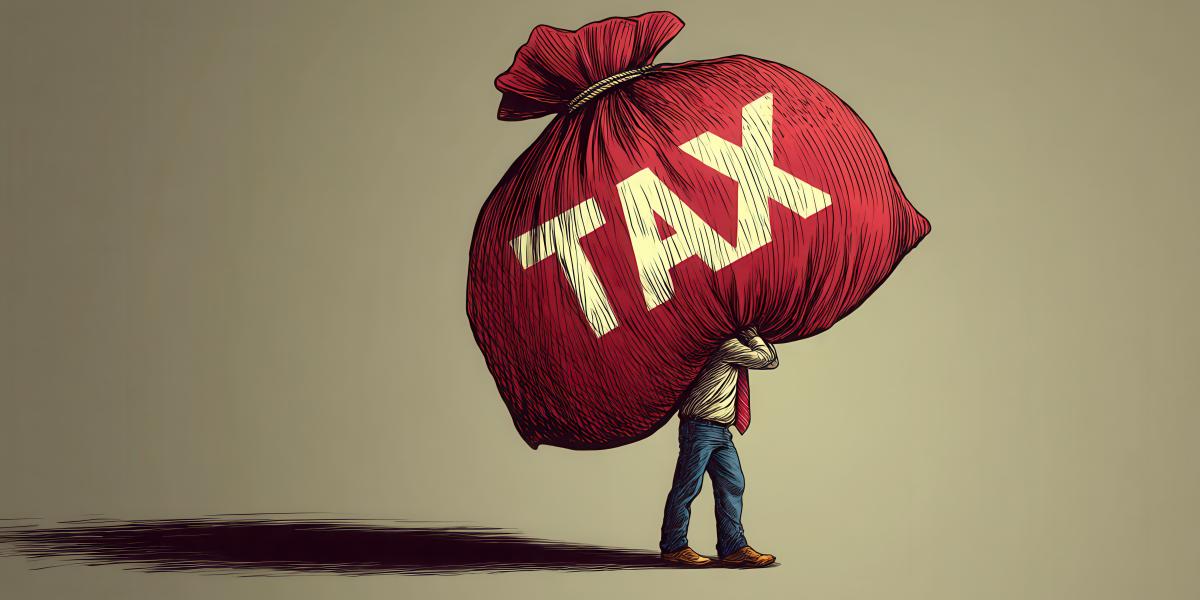
Unfortunately, Schumpeter’s conclusions apply to the modern-day United States as well. Like the states of Europe, the United States is now a full-blown “tax state” in that lawmakers of the central government can raise taxes with minimal political or institutional effort without meaningful legal resistance from any other domestic institution. Consequently, as the burdens of debt and upward-spiraling welfare costs continue to put pressure on the Treasury, the answer will be to simply raise taxes—and the taxpayers will absorb it.
Moreover, the history of modern democratic regimes confirms that interest group politics will ensure that spending continues unabated. In other words, given the lack of meaningful obstacles to accelerated taxation, there is no institutional or legal way out of this. The only way that the power of the tax state will be meaningfully challenged is through the dismemberment of the state through secession, or through outright dissolution of the existing state and the founding of an entirely new successor state.
The US Is a Tax State
But first: what is a tax state exactly?
Schumpeter emphasizes that the reason tax states so easily endure fiscal pressures is the fact that tax states can so efficiently, with minimal friction, extract revenues from the domestic population. This is made possible by these characteristics of tax states, which are also characteristics of modern states in general:
Centralization: taxes are directly imposed by the central government. The central government does not rely on regional or local governments to collect taxes or enforce tax laws. (This does not preclude regional or local governments from imposing their own taxes.)Unilateral power: The central government can raise taxes unilaterally. The central government’s legislature or executive has the prerogative to raise taxes on its own authority without the permission of any other sovereign within the state’s territory. Put another way, no regional or local government has the ability to veto a tax increase or legally prevent its implementation.The central government freely decides how revenues are spent. Once tax revenues are collected, the central government spends the revenues in whatever manner is preferred by the central state’s legislative power.Taxes are not fees or a payment for a service. Strictly speaking, a fee is a payment that is designed to fund a specific service, and only those who “benefit” from the service pay the fee. Tax “benefits,” on the other hand, are not tied to any particular service. Tax states are not legally held to any sort of reciprocal duty to spend tax revenues in a manner that benefits those who pay the tax.
The United States government fulfills all these requirements of tax states. In the United States, the Congress can raise direct taxes on the population at any time by simply increasing the income tax. Recent experience has also shown that the US president can unilaterally raise import taxes to any level he prefers. This doesn’t even require a vote of any kind. And, should these taxes prove insufficient to meet the needs and preferences of the central government, the central government can borrow legally unlimited amounts of money.
Moreover, when more debt is needed, the central bank will often purchase some portion of the central government’s bonds to subsidize and push down interest rates on government debt. This process is made possible through monetary inflation, allowing the central government to extract revenue via monetization of debt and an “inflation tax.”
Throughout this process, no state or local government can legally prevent these tax increases, and no institution outside the central government has any say over how the dollars are spent. Nostalgic sentimentalists may try to console themselves with feel-good stories about the United States being a decentralized, federalist state under some alleged “rule of law.” But, when it comes to taxation, the United States is clearly a de facto unitary state.
The Rising Tax Burden
This is good news for the American state itself. As federal spending continues upward unabated, the federal government will continue to have untrammeled access to more revenue. Where a tax increase in Congress cannot be had, the central government can simply turn to monetary inflation or to new tariffs, implemented via a “stroke of the pen” at the central bank or in the Oval Office.
For the taxpayer, however, it’s all bad news. Fiscal pressures on the central government will continue to mount, but there will be no discussion of austerity, spending cuts, or anything else that would actually lessen the spending obligations of the central government.
The exigencies of democratic coalition politics will ensure cuts will not happen. To cut spending on any major program would mean political suicide for many members of Congress and endanger critical fundraising needs for candidates and party organizations. Thus, there will be no substantial cuts, least of all to the largest federal programs that put the most pressure on federal revenues: Social Security, Medicare, military, and interest on the debt. There certainly will be no cuts to spending on interest on the debt—now topping a trillion dollars per year. To do that would be to prompt a sovereign debt crisis.
Instead, the central government will just keep going back to the well of taxation over and over, either through more ordinary taxes, or through an ever growing inflation tax. We’re already seeing this at work in how the central bank has already effectively abandoned its so-called two-percent target for price inflation. The official price-inflation rate sits at 2.9 percent, and the central bank is easing monetary policy. (If price inflation does go down at this point, it will be thanks to declining economic conditions, not to restrained monetary policy.)
What the Future Holds—and the Battle of Ideas
In the short term, economic booms and busts will come and go, but over the medium and long term, the true tax burden on taxpayers will continue to grow and grow. So long as most of the American population considers the US government to be a legitimate state, there will be no impediment to the state continuing to extract ever larger amounts of revenue from the domestic population.
Over time, this will lead to more and more impoverishment for the productive population, but what alternative will the taxpayer have? It is clear that democratic elections will not reverse the trend. If elections were any threat to this trend, we would have seen some evidence of it by now. Even with rising price inflation, rising import taxes, and historic deficits, taxpayers have shown little interest in cutting federal spending. Even among those voters who claim to be for fiscal austerity, most draw the line at any cuts that endanger their favorite federal programs. For example, “hands off my Medicare” is a favored refrain for those who pretend to care about cutting government spending.
There is no legal or institutional mechanism that will bring this to an end. Even as interest on the national debt soars, and as the requirements of federal social benefits continue to rise, the “answer” will simply be more debt and more taxes. If interest rates get “too high” the central bank will intervene with monetary inflation. This will lead to higher inflation, but this will allow the state to meet its political “obligations” with cheaper dollars.
Most of the taxpayers—few of whom understand why federal debts and federal spending increase price inflation—will be fine with this, and they’ll blame price inflation on greed or global oil prices. In short, the end game will likely look like something we witnessed in Latin America during the 1980s: ever increasing government spending coupled with runaway inflation. The state, however, will remain intact through it all.
The only way out will be through the dismemberment of the state through secession, or through the dissolution of the state—hopefully in a peaceful manner similar to that of the dissolution of the Soviet Union. Unfortunately, no true opposition is likely to materialize until the middle classes and working classes have endured years of downward mobility. It will be only then that a critical mass of the population abandons its faith in the regime—a misplaced faith formed by decades of state propaganda and public “education.”
For those who actually value freedom, prosperity, and reining in the state, the best thing we can do right now is this: work to speed up the process of state disintegration by exposing the evils of the spending-inflation scam to a portion of the public large enough to force true reforms. As we say at the Mises Institute, “we learn economics to know how we are being ripped off.” Countless millions of taxpayers are being ripped off. But they still don’t understand how or why.
On top of this work, it is critical to ceaselessly work to undermine the public’s view of the American state’s legitimacy. No state that steals, inflates, and impoverishes on such a massive scale could possibly be considered moral or legitimate, or beneficial. As the collapse of the enormous and militarily powerful Soviet state showed us, the key to winning against the state is to increasingly expose how the state mercilessly exploits the taxpayers.
Ultimately, this is a battle of ideas. As Ludwig von Mises knew, we can only win against state power if we first win in the battle of ideas.