
No Result
View All Result
SUBMIT YOUR ARTICLES
  • Login
Tuesday, March 17, 2026
TheAdviserMagazine.com
  • Home
  • Financial Planning
    • Financial Planning
    • Personal Finance
  • Market Research
    • Business
    • Investing
    • Money
    • Economy
    • Markets
    • Stocks
    • Trading
  • 401k Plans
  • College
  • IRS & Taxes
  • Estate Plans
  • Social Security
  • Medicare
  • Legal
  • Home
  • Financial Planning
    • Financial Planning
    • Personal Finance
  • Market Research
    • Business
    • Investing
    • Money
    • Economy
    • Markets
    • Stocks
    • Trading
  • 401k Plans
  • College
  • IRS & Taxes
  • Estate Plans
  • Social Security
  • Medicare
  • Legal
No Result
View All Result
TheAdviserMagazine.com
No Result
View All Result
Home Market Research Economy

No, Tariffs Did Not Cause September’s Budget Surplus

by TheAdviserMagazine
5 months ago
in Economy
Reading Time: 5 mins read
A A
No, Tariffs Did Not Cause September’s Budget Surplus
Share on FacebookShare on TwitterShare on LInkedIn


According to the Treasury Department’s monthly report for September, the budget deficit turned positive last month, with tax receipts coming in at $197 billion above federal outlays. This sizable one-month surplus was due to a large month-to-month drop in federal spending for the month. Contrary to what some protectionists and Trump advocates have claimed, however, the surplus was not significantly driven by tariff revenues. 

According to the report, total tax receipts for September amounted to $543 billion, a month-to-month increase of 57 percent, or $199 billion. In increase in receipts from August to September is an expected seasonal change, and tax revenue has increased from August to September in every year for more than a decade. Indeed, last months’ increase in revenue was not even particularly large. Over the past decade, the August-September increase in tax revenue has been larger in every year—except 2017 and 2018—compared to this year’s increase:

In other words, there’s nothing about recent revenue growth that’s remarkable. 

In recent months, however, Trump and administration spokesmen have repeatedly made grandiose claims about tariff revenue. Early in his administration, for example, Trump claimed that tariff revenue would replace the income tax. It is now abundantly clear that the income tax is not going anywhere. As I showed earlier this year here on mises.org, tariff revenue is only a tiny part of total federal revenue. There is virtually no way to increase tariff revenue to a point that Trump would even be able to fund his military spending, let alone the popular welfare programs—like Social Security and Medicare—that Trump has pledged to not cut. 

Nonetheless, the administration has been crowing about how tariff revenue increased to $31 billion during August and September, as if this would put any sort of significant dent in fiscal policy. For example, September’s tariff “haul” of $31 billion amounts to a mere 5.7 percent of all revenue ($543 bln) for the month. Looking at the Treasury’s revenue report, we can see that the true sources of the increase in September revenue were individual income taxes and corporate income taxes. Tariff revenues are so insignificant in the graph that they have been included under “other.”
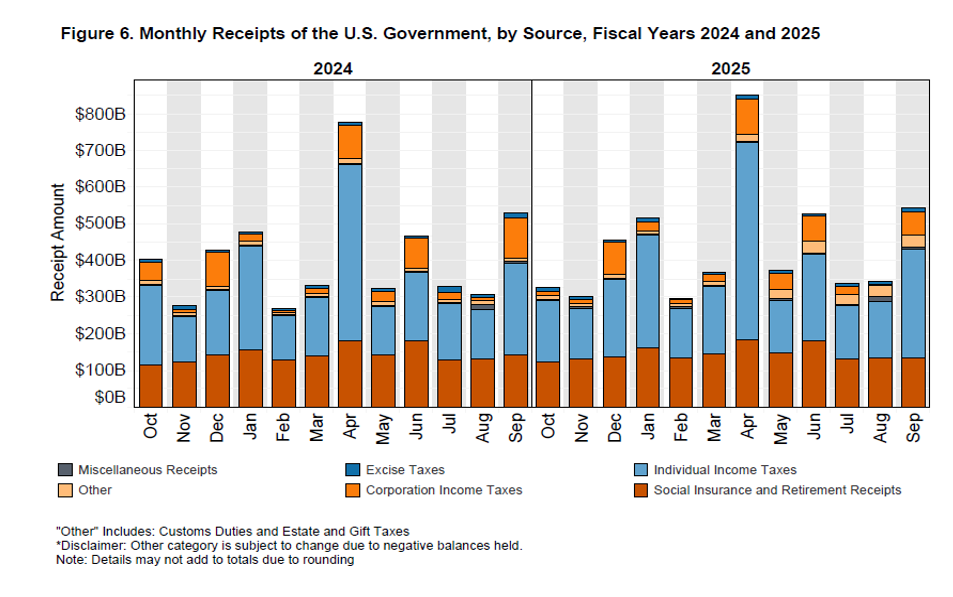
Source: Treasury Dept. 

Of course, an ordinary person could be forgiven for thinking that tariff revenue is enormous. In August, for example, Trump repeatedly claimed that tariff revenue totaled trillions of dollars. Forbes reports: 

“Without tariffs, and all of the TRILLIONS OF DOLLARS we have already taken in, our Country would be completely destroyed, and our military power would be instantly obliterated,” Trump wrote on Truth Social.

Trump claimed earlier this month that “trillions of dollars are being taken in on tariffs” and his levies have “not caused inflation, or any other problems for America, other than massive amounts of CASH pouring into our Treasury’s coffers.”

In truth, since Trump took office, total tariff revenues have totaled about $120 billion or only 12 percent of a single trillion. It’s a long way from “TRILLIONS.”

So, when bragging about increased tax revenue in September and August, trump is really bragging about fleecing Americans of hundreds of billions of dollars collected through income taxes. 

It’s not true that only foreigners pay tariffs, but, for the sake of argument, let’s say it is true. Even then, the overwhelming majority of tax revenue would still be coming from corporate and individual income taxes—assuming that Trump continues with his current policy of making no sustained spending cuts.  Some Trump supporters may claim that tariffs are increasing and so will soon “replace” income taxes, but even if tariff revenue quadruples into fiscal year 2026, tariffs will still come up more than $3 trillion short of replacing income taxes. So, given everything we know about Trump’s big-spending fiscal policy, there is virtually no chance of the income tax going away. Trump needs that revenue to pander to Medicare recipients, to fund corporate welfare queens like Raytheon, and to lavish Israeli war criminals with American tax dollars. 

Nor will tariff revenues do much to eliminate federal deficits. A monthly tariff revenue total of $30 billion—or even $50 billion—is a long way from erasing monthly deficits.

While it’s true that September’s surplus was unusually large, this can be attributed to a surprisingly big drop in federal outlays for the month. According to the Treasury report, total outlays dropped from $689 billion in August to $345 billion in September. Total outlays usually fall from August to September, with spending falling during the period during seven of the past ten years. Nonetheless, this September’s drop was a big one, with federal spending falling by 49.8 percent dung the period. The only comparable year in the past decade was 2018 when spending fell by 48.2 percent from August to September. 

This is a good thing, of course, although it’s unlikely to be the start of any significant change in trend. Unfortunately, federal spending tends to increase from September to October, and September’s drop off in spending is likely to be an outlier. (I’d be happy to be proven wrong on this.) 

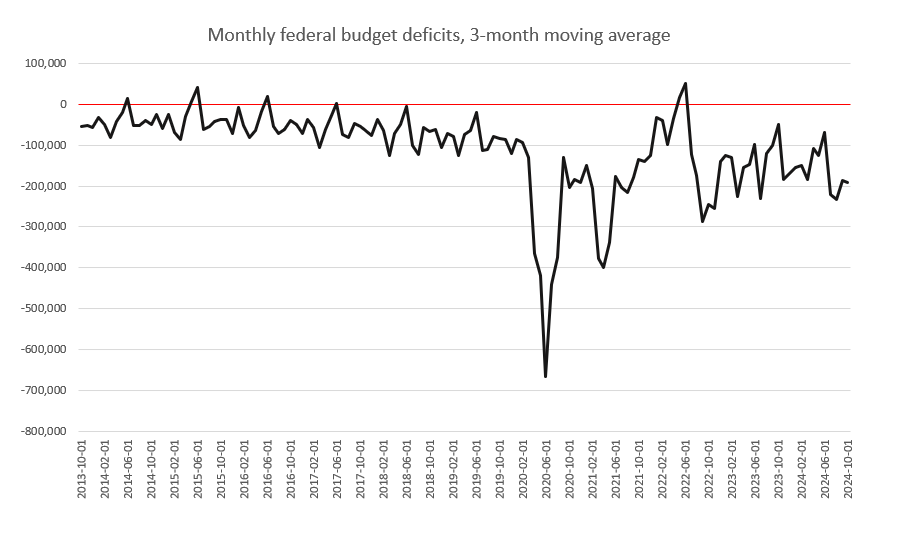
Moreover, tax revenue tends to fall from September to October, so we’re likely looking at another sizable deficit for October. If that happens, Septembers surplus will be nothing more than blip in the trend in deficits. After all, the three-month moving average in monthly deficits shows the trend is getting worse, not better: 
These deficits will continue to drive ever larger amounts of federal debt, and this itself will drive more federal spending on interest. For example, the September Treasury report also shows that more than $91 billion of the month’s $543 billion in revenue was spent on “interest on Treasury debt securities.” In other words, nearly one dollar for every six dollars collected in taxes goes just to pay debt service. That’s the largest single category of federal spending outside the major welfare programs like Social Security. 
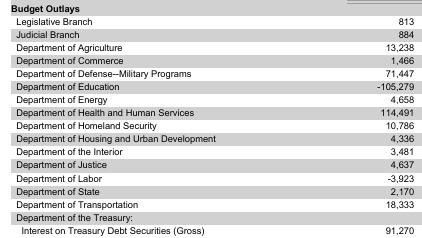
Year-to-date, total federal spending on interest on the national debt exceeded $1.22 trillion. That’s up from $1.13 trillion during the same period of last year. Debt service is rapidly consuming ever larger amounts of the federal budget. Contrary to what Americans have long told themselves, the federal debt does come with a cost. 

The only good news in this monthly Treasury report is the fact that spending went down last month. Meanwhile, federal revenue went up substantially—with most of it coming from income taxes. But, unless something changes significantly in terms of military spending and big programs like Medicare, etc., the Treasury will quickly return to running big deficits. 



Source link

Tags: budgetSeptemberssurplusTariffs
ShareTweetShare
Previous Post

As Pentagon Takes Secretive Donation for Military Salaries, AFL-CIO Says Pay All Workers Impacted by Shutdown

Next Post

How to File a Claim Against an Insurance Company for Emotional Distress

Related Posts

edit post
Rothbard Never Abandoned His Principles

Rothbard Never Abandoned His Principles

by TheAdviserMagazine
March 17, 2026
0

It is often observed that Rothbard’s political opinions were controversial, especially in his later years when he forged an alliance...

edit post
The Canals Behind the War

The Canals Behind the War

by TheAdviserMagazine
March 17, 2026
0

Many people are looking at the conflicts in Gaza and Iran strictly through the lens of religion, terrorism, or regional...

edit post
Market Talk – March 16, 2026

Market Talk – March 16, 2026

by TheAdviserMagazine
March 16, 2026
0

ASIA: The major Asian stock markets had a mixed day today: • NIKKEI 225 decreased 68.46 points or -0.13% to...

edit post
Bessent says Treasury is not intervening in oil commodities markets and has no authority to do so

Bessent says Treasury is not intervening in oil commodities markets and has no authority to do so

by TheAdviserMagazine
March 16, 2026
0

Treasury Secretary Scott Bessent said Monday that the administration has no plans to intervene in financial markets and may not...

edit post
Is Another Stone Age in the Making?

Is Another Stone Age in the Making?

by TheAdviserMagazine
March 16, 2026
0

When a monster military like the US circles its prey for possible attack, very little can go wrong. Painful lessons...

edit post
Popular Interest Rate Theory Describes but Fails to Explain

Popular Interest Rate Theory Describes but Fails to Explain

by TheAdviserMagazine
March 16, 2026
0

According to much popular economic thinking, there are three factors determining the market interest rates. The first is liquidity, the...

Next Post
edit post
How to File a Claim Against an Insurance Company for Emotional Distress

How to File a Claim Against an Insurance Company for Emotional Distress

edit post
When Does a Claim Fall Under Strict Liability?

When Does a Claim Fall Under Strict Liability?

  • Trending
  • Comments
  • Latest
edit post
Foreclosure Starts are Up 19%—These Counties are Seeing the Highest Distress

Foreclosure Starts are Up 19%—These Counties are Seeing the Highest Distress

February 24, 2026
edit post
7 States Reporting a Surge in Norovirus Cases

7 States Reporting a Surge in Norovirus Cases

February 22, 2026
edit post
2025 Delaware State Tax Refund – DE Tax Brackets

2025 Delaware State Tax Refund – DE Tax Brackets

February 16, 2026
edit post
The Growing Movement to End Property Taxes Continues in Kentucky, And What It Means For Investors

The Growing Movement to End Property Taxes Continues in Kentucky, And What It Means For Investors

March 2, 2026
edit post
Who Is Legally Next of Kin in North Carolina?

Who Is Legally Next of Kin in North Carolina?

February 28, 2026
edit post
Gasoline-starved California is turning to fuel from the Bahamas

Gasoline-starved California is turning to fuel from the Bahamas

February 15, 2026
edit post
Rebecca Mason, Study Group

Rebecca Mason, Study Group

0
edit post
What is capital gains tax? Here’s when you owe, plus strategies to reduce your bill.

What is capital gains tax? Here’s when you owe, plus strategies to reduce your bill.

0
edit post
She Started Investing in Her 50s, Now She’ll Retire with Rentals!

She Started Investing in Her 50s, Now She’ll Retire with Rentals!

0
edit post
The 30-Second Phone Hack: How AI is Using Your Own Voice to Drain Your Savings Account

The 30-Second Phone Hack: How AI is Using Your Own Voice to Drain Your Savings Account

0
edit post
Alphabet (GOOGL): Zündet nach der Konsolidierung die nächste KI-Stufe?

Alphabet (GOOGL): Zündet nach der Konsolidierung die nächste KI-Stufe?

0
edit post
When Analytical Tools Scale, First-Order Information Differentiates

When Analytical Tools Scale, First-Order Information Differentiates

0
edit post
What is capital gains tax? Here’s when you owe, plus strategies to reduce your bill.

What is capital gains tax? Here’s when you owe, plus strategies to reduce your bill.

March 17, 2026
edit post
Rebecca Mason, Study Group

Rebecca Mason, Study Group

March 17, 2026
edit post
Alphabet (GOOGL): Zündet nach der Konsolidierung die nächste KI-Stufe?

Alphabet (GOOGL): Zündet nach der Konsolidierung die nächste KI-Stufe?

March 17, 2026
edit post
The 30-Second Phone Hack: How AI is Using Your Own Voice to Drain Your Savings Account

The 30-Second Phone Hack: How AI is Using Your Own Voice to Drain Your Savings Account

March 17, 2026
edit post
Rothbard Never Abandoned His Principles

Rothbard Never Abandoned His Principles

March 17, 2026
edit post
Episode 252. “I’m 35, in debt, and spend everything I make”

Episode 252. “I’m 35, in debt, and spend everything I make”

March 17, 2026
The Adviser Magazine

The first and only national digital and print magazine that connects individuals, families, and businesses to Fee-Only financial advisers, accountants, attorneys and college guidance counselors.

CATEGORIES

  • 401k Plans
  • Business
  • College
  • Cryptocurrency
  • Economy
  • Estate Plans
  • Financial Planning
  • Investing
  • IRS & Taxes
  • Legal
  • Market Analysis
  • Markets
  • Medicare
  • Money
  • Personal Finance
  • Social Security
  • Startups
  • Stock Market
  • Trading

LATEST UPDATES

  • What is capital gains tax? Here’s when you owe, plus strategies to reduce your bill.
  • Rebecca Mason, Study Group
  • Alphabet (GOOGL): Zündet nach der Konsolidierung die nächste KI-Stufe?
  • Our Great Privacy Policy
  • Terms of Use, Legal Notices & Disclosures
  • Contact us
  • About Us

© Copyright 2024 All Rights Reserved
See articles for original source and related links to external sites.

Welcome Back!

Login to your account below

Forgotten Password?

Retrieve your password

Please enter your username or email address to reset your password.

Log In
No Result
View All Result
  • Home
  • Financial Planning
    • Financial Planning
    • Personal Finance
  • Market Research
    • Business
    • Investing
    • Money
    • Economy
    • Markets
    • Stocks
    • Trading
  • 401k Plans
  • College
  • IRS & Taxes
  • Estate Plans
  • Social Security
  • Medicare
  • Legal

© Copyright 2024 All Rights Reserved
See articles for original source and related links to external sites.