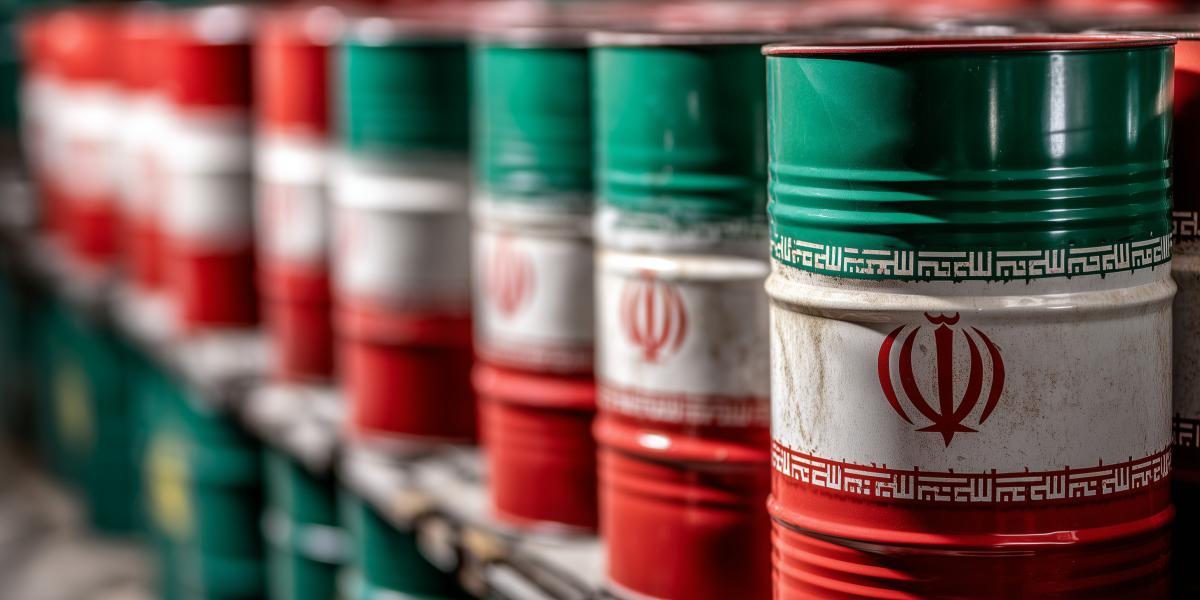
Incorrigible war-monger, Donald Trump, just can’t help but say the quiet part out loud. When interviewed on March 29 by the Financial Times, he confessed:
To be honest with you, my favorite thing is to take the oil in Iran, but some stupid people back in the US say: “why are you doing that?” But they’re stupid people.
Trump is very consistent about wanting to take other people’s hydrocarbons and minerals, first having brought up the idea of seizing Iran’s principal oil terminal on Kharg Island way back in 1987 in an interview by Barbara Walters. As I noted in previous articles, Trump’s lust for stealing natural resources has also been prominent in his thinking about Greenland and Venezuela. Grabbing a share of Ukrainian minerals has been a priority for Trump too.
To be sure, there are strong indications of Trump having other motives for starting a major war whose opening phase featured the gruesome slaughter of 168 Iranian schoolgirls. Joe Kent—who resigned from his post as Director of the National Counterterrorism Center over the war—has offered eloquent testimony as to the malevolent influence of Israel and the Zionist lobby on Trump’s thinking. It has also been suggested that the war provides a convenient “Wag the Dog” distraction from the Epstein files scandal, or maybe even that Trump is being blackmailed by the Israelis over his past involvement with Epstein (the latter theory being featured in Iranian propaganda).
While we can’t know what exactly was going on inside Trump’s head when he agreed to joint American-Israeli aggression against Iran, it is still the case that a grab of natural resources never seems to be far from Trump’s mind. Even if one assumes that Netanyahu is dominating Trump and that the quest for a Greater Israel is the principal driver of the war, such a goal wouldn’t necessarily divert Trump from seeking control over Iran’s oil and natural gas as being the major objective he hopes to gain from the war.
It is also impossible to ignore the long-standing ambitions of America’s national security establishment, which in the aftermath of the Soviet Union’s collapse pivoted from a policy of containment towards a policy of unipolar domination of the world, with the progenitors of the neoconservative movement inside the Pentagon at the time pushing for endless wars in order to prevent the rise of any potential rival of the US in any region of the world. From such imperialistic principles, it was concluded that the US needs to be the “predominant outside power” in the Middle East to “preserve US and western access to the region’s oil” (which also implies that the US could deny such access to any state deemed hostile to the US). Taking the oil is not merely Trump’s favorite thing; endless wars to control access to oil has long been the Pentagon’s favorite thing too.
It is important in this context to recall that, between October 1973 and March 1974, Middle Eastern states actually did cut off the US and its Western allies from access to their oil, marking the first significant break from the traditional Western imperial domination of the region (including Iran prior to 1979). With the US becoming increasingly reliant upon imported oil in the early 1970s and lacking a sound dollar to pay for it thanks to President Nixon cutting the dollar off from gold in 1971, oil exporting countries, led by King Faisal bin Abdulaziz Al Saud, soon began to insist on much higher dollar prices for their chief export product, and fears began to grow that the Saudi-led OPEC cartel might unleash its “oil weapon”—an all-out oil embargo against uncooperative states—to extort even more.
These fears proved to be well-founded when King Faisal formed an alliance with Egyptian President Anwar Sadat in 1973. The Egyptian and Syrian governments were planning a war against Israel to reconquer land that had been taken from them by Israel in 1967. Faisal saw the forthcoming war as an opportunity to mobilize other Arab states, and even Iran (a staunch pro-American ally at the time), to employ their “oil weapon” against the Western powers.
On October 6, 1973, the Egyptian Army surprised the Israelis on the Yom Kippur holiday, driving them back from their defensive line. Over the first few days, it established two large bridgeheads on the east bank of the Suez Canal. The Israelis begged for more American weapons, but as soon as the weapons airlift started, an enraged King Faisal unleashed the oil embargo.
As the battlefield situation reversed, the Soviets then began to demand intervention by a joint US-Soviet peacekeeping force to save the Egyptian Army from encirclement. The Soviets put their airborne troops on alert and began shipping nuclear weapons to Egypt. With Nixon too drunk and too depressed by the Watergate scandal to even attend an emergency meeting in the Situation Room, National Security Advisor Henry Kissinger wound up taking the initiative to elevate American nuclear forces to a DEFCON III alert and to order the deployment of American troops and nuclear forces to the region.
While the world just barely avoided nuclear war, Kissinger’s diplomatic work wasn’t finished. He also had to deal with the ongoing Arab oil embargo. The dollar price of oil, which had already doubled before the war in the wake of Nixon’s default on the dollar’s gold backing, quintupled again as the embargo continued to squeeze the industrialized world. Kissinger embraced Defense Secretary James Schlesinger’s proposal to threaten an armed seizure of Persian Gulf oil fields by the US Marines to extort a change in Saudi behavior, a threat which proved to be successful.
The resulting US-Saudi agreement on June 8, 1974 required the Saudis to sell their oil for dollars and to use their dollar earnings to purchase US Treasury securities, and to cooperate with the US on economic, military, and technological matters which might involve things like massive arms purchases from America (these financial arrangements becoming known as “petrodollar recycling”). In a media interview at the beginning of 1975, Kissinger went public with a warning that the American government wouldn’t tolerate another “actual strangulation of the industrialized world” by oil exporters. King Faisal was conveniently assassinated by his nephew a few months later, and subsequent Saudi monarchs have tended to be much more compliant with Washington’s demands.
While the Soviet Union has long since been swept into the dustbin of history and America has achieved the sort of energy independence that 1970s politicians could only bloviate about, one thing that has remained constant since the 1970s is a global monetary system where America and countries that sell stuff to America get to use America’s constantly-depreciating dollars to buy critically important natural resource inputs like crude oil and liquefied natural gas. The petrodollar has remained important because the Saudis and other Gulf states (which made similar deals with Kissinger) continue to function as buyers-of-last-resort of dollars, helping to prop up the international demand for dollars in spite of its dodgy fiat nature.
Another constant since the 1970s has been the threat of nuclear war to keep the US’s military rivals out of the Persian Gulf, something which was formalized by President Carter in his 1980 State of the Union Speech (the “Carter Doctrine”). Since then, the Pentagon has moved its own forces into the Persian Gulf region in line with the post-Soviet unipolar doctrine of controlling access to its oil, not merely keeping the forces of other major powers out of the Gulf.
Iran is the one state that has consistently refused to go along with American domination of the region, instead militarily aligning itself with Russia and China and supporting the monetary initiative of the “BRICS” bloc to break free from the dollar. While Russia—like America—is self-sufficient in energy, China’s access to oil has been significantly impaired by the war and by Trump’s takeover of Venezuela, affecting about 40 percent of its supply. Not surprisingly, the neoconservatives made Iran a charter member of the “Axis of Evil.”
Trump’s recent National Security Strategy endorsed the Carter Doctrine and its unipolar corollary while denying any intention of repeating the costly military disasters of the neoconservatives:
We want to prevent an adversarial power from dominating the Middle East, its oil and gas supplies, and the chokepoints through which they pass while avoiding the “forever wars” that bogged us down in that region at great cost;. . .
As I noted in my criticism of the NSS, “endless wars” in the Middle East is precisely what such a goal implies. Apparently the Pentagon hasn’t gotten the memo about the lessons of the Russo-Ukrainian war regarding the nature of contemporary missile and drone combat or about the steady erosion of America’s industrial and financial dominance or about the vast number of “boots on the ground” that are likely to wind up in national cemeteries as “shock and awe” strikes continue to prove their ineffectiveness in bending Iran to Trump’s will.
Ron Paul has wisely urged “Just Get Out! Now!”—unipolarism remains neither feasible nor moral, and doesn’t make any sense whatsoever in a context where any serious quarrel between China and the US is going to be settled by mutual thermonuclear annihilation anyways, not by who happens to control the oil spigot on Kharg Island. The truth is that we are waist deep in the big muddy, and the big fool says to push on—it’s time to turn around and escape from the big muddy before it’s too late.
Postscript: In his April Fool’s Day speech, President Trump stated that he wants to take a couple more weeks to bomb Iran back into the Stone Ages, but apparently he has given up on his grabbing Iran’s oil. With Hormuz still closed and missiles and drones still raining down on Israel and on the Arab Gulf states, Trump seems content to let the Iranian regime block a large fraction of the world’s commerce in oil and liquefied natural gas indefinitely and leave the region in chaos, the only consolation being that the rest of the world can still buy American oil. Since he can’t get Iran’s oil, denying access to Gulf oil and thus leveraging American oil is apparently Trump’s second favorite thing. Meanwhile, Iranian President Masoud Pezeshkian issued his own Letter to the American People which the legacy American news media has totally ignored, asking whether “America First” is truly among the priorities of the Trump regime and inviting the American people to “look beyond the machinery of misinformation” in assessing Iranian intentions. Pezeshkian concluded by pointing out that Iran has outlasted many aggressors over thousands of years: “All that remains of them are tarnished names in history, while Iran endures–resilient, dignified, and proud.”