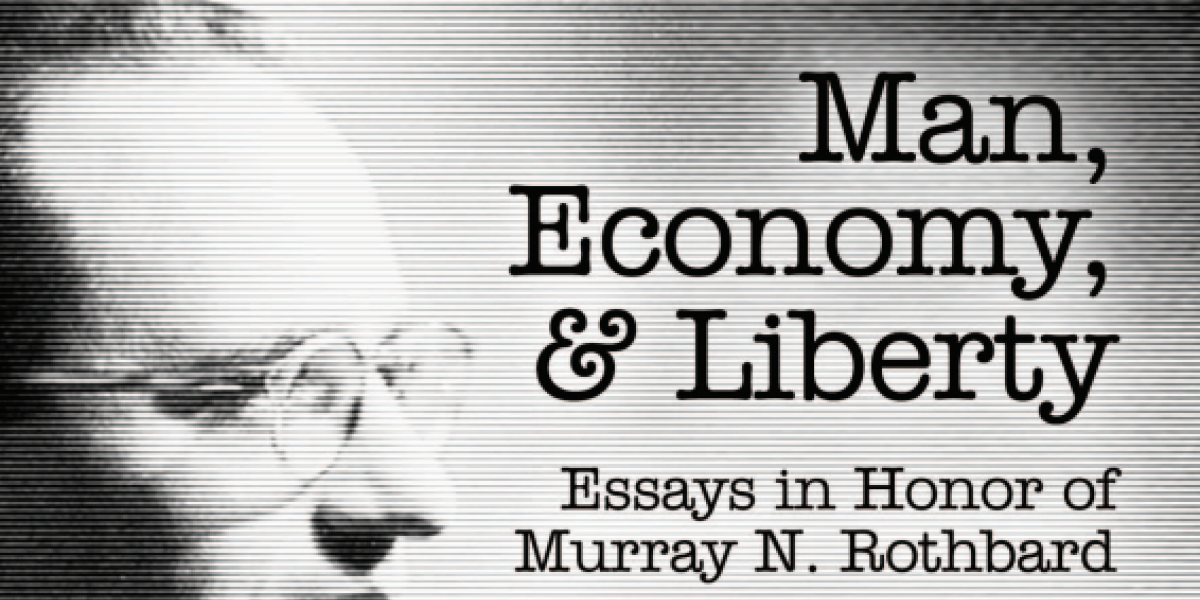
[This is the introduction to Man, Economy, and Liberty: Essays in Honor of Murray N. Rothbard, first published in 1988.]
Murray N. Rothbard is a scholar of unique, indeed monumental achievements: the founder of the first fully-integrated science of liberty.
Consider, first, his accomplishments in economics. His Ph.D. dissertation from Columbia University—The Panic of 1819—showed how the Bank of the United States, the Federal Reserve’s ancestor, caused the first American depression. It remains the only in-depth historical account of that particular monetary debacle.
In America’s Great Depression, still the most definitive work on the subject, Rothbard used Austrian trade cycle theory to show that the Federal Reserve caused that economic calamity, and that other government interventions prolonged and even deepened the Depression. In addition, the first two chapters present the most clear and convincing explanation of the Austrian theory of the trade cycle in existence.
Both books utilized tools drawn from the great tradition of Austrian economics—Carl Menger’s theory of the development of monetary institutions, Eugen von Böhm-Bawerk’s theory of capital and the time preference theory of interest, and Mises’s trade cycle theory and method —perfected each, and wove them together into a systematic praxeological model. He succeeded not only in explaining cyclical fluctuations caused by central bank intervention, but also proved the case for the gold coin standard, no central bank, 100% reserves, and laissez-faire.
After Rothbard’s masterful integration, economists can no longer dismiss recessions and depressions as an “inevitable” part of the market process. Instead, he showed, they are caused by central bank inflation and the corresponding distortion of interest rates, malinvestment of capital, theft of savings, and price increases that go with it. Government, of which the central bank is only one arm, is the real source of business cycles.
Rothbard was also the first to explode the fallacy of distinguishing between monopoly prices and competitive prices. This distinction makes sense only in neoclassical pricing models, where businessmen charge higher and higher prices in the inelastic portion of consumers’ demand curve. But these static models have nothing to do with the dynamic market process. In the real world, we can only distinguish between free market prices and those controlled by the government.
This discovery has momentous policy implications: in a free market, where we never see “monopoly (non-competitive) prices,” there can be no unjust monopoly profits. This destroys the entire neoclassical justification of anti-trust policy. Monopolies do exist, Rothbard shows, but only when government erects a barrier to entry into the market by granting some firm or industry a special privilege.
Rothbard also revolutionized the entire field of utility and welfare economics—and laid a foundation for other Austrian scholars to build upon—by showing that utility is something that we can know only by observing individual preferences revealed through human action. Utility, a strictly ordinal and subjective concept, cannot be aggregated among individuals, and thus there can be no social utility.
Because of Rothbard’s irrefutable theory of utility and demonstrated preference, neo-classical welfare economics can no longer be used to justify State planning. When individuals are free to trade without interference from government, we know that each party expects to benefit from the exchange, i.e. to maximize his own subjective utility, or the parties would not exchange in the first place. Rothbard’s conclusion: free markets maximize utility and welfare, whereas government intervention, by the very fact that it forces people to behave in ways in which they otherwise would not, only diminishes utility and welfare.
It was this foundation that allowed Rothbard to integrate a rigorous theory of property rights with a scientific theory of economics. Today, others within the profession are trying to do the same, but they will not succeed so long as they cling to theories of efficiency built around faulty utility and welfare concepts.
In his great work Man, Economy, and State, Rothbard provides a rigorous defense of economic science and the pure logic of action. In the bygone days of “real economics,” every scholar aspired to write a treatise covering the whole subject. Since the Keynesian and neo-classical warping of the profession, however, this has gone out of fashion, and Man, Economy, and State is the last such great work. In it, clearly and logically, Rothbard deduces the whole of economics from its first principles. It is a tour-de-force unmatched in modern economics.
If only his contribution to economics in general were considered, his refutations of neo-classical, socialist, interventionist, and Keynesian fallacies would put him head and shoulders above all other living economists. If only his accomplishments in the field of Austrian economics were taken into account, his place in the firmament would be secure. For it is an understatement to say that he is the most productive of the students and followers of Ludwig von Mises.
But his attainments in economics are only the tip of the iceberg. His productivity as a historian is more than sufficient to establish him as a leader in that field as well. In addition to many scholarly articles, his four-volume colonial history of the United States, Conceived in Liberty, shows that libertarian ideas have been an American staple since almost the earliest days, and that the American Revolution was very much a libertarian affair. He shows that the received wisdom in history is almost always wrong, since it usually reflects the State’s bias.
Permeating all of Rothbard’s historical writing is a brilliant and original revisionism, a unique and rigorous refusal to accept uncritically the official version. (He is also one of the few historians ever to place his presuppositions, his theory of history itself, on record. He does so properly in the introduction where it belongs, and not all throughout the book in the form of implicit presuppositions.) Whether discussing monetary history, the history of economic thought, the Progressive Era, the New Deal, World War I, or any of his other areas of expertise, Rothbard eruditely and unerringly turns the Statist worldview upside down, in search of a commodity unusual among modern historians—truth.
But his exploits in economics and history, extraordinary as they are, are matched by what he has done for the cause of liberty. If he is an eminent historian, and the world’s leading Austrian economist, he is no less than the father of libertarianism. He is, as even National Review has acknowledged, “Mr. Libertarian.”
In his Power and Market, Rothbard develops a comprehensive critique of government coercion. He vastly expanded the scope of the theory of intervention, and developed three useful categories: autistic, binary, and triangular. Autistic intervention prevents a person from exercising control over his own person or property, as with homicide or infringements on free speech. Binary intervention forces an exchange between two parties, as in highway robbery or income taxes. Finally there is the triangular mode, in which the government “compels a pair of people to make an exchange or prohibits them from doing so,” as in rent control or minimum wages. He carefully outlines the deleterious effects of every possible intervention in the economy, and is especially insightful in analyzing the harmful effects of taxation.
In For a New Liberty, Rothbard leaves the world of theory and gets down to brass tacks. How would a totally free society actually function? While it is always impossible to predict the future exactly, he shows how the challenges of education, poverty, private roads, courts, police, and pollution might be dealt with under a complete laissez-faire system. In his masterful The Ethics of Liberty, Rothbard deals with the hard questions: the criminal system, land redistribution, the vexing problem of children’s rights, bribery, boycotts, lifeboat situations; his critiques of other, less-pure advocates of the freedom philosophy such as Hayek, Nozick, and Berlin are alone worth the price of admission.
Nor must we lose sight of yet another of Rothbard’s particular excellences: his masterful ability to integrate intellectual thought, to see connections where others see only a bewildering complexity, to weave the threads from all of knowledge into a shield which can preserve human rights. He has long called for, and has indeed been the leading exponent of, what he calls the “interdisciplinary study of liberty.” From this perspective, the disciplines of economics, history, law, philosophy, sociology, etc., must all be harnessed together to comprise a “seamless web” of liberty. All must be utilized in the glorious struggle to promote the free society, with the teachings of none remaining inconsistent with any other.
Were Rothbard’s accomplishments limited merely to any one of the many disciplines he has so eloquently mastered, we could be very laudatory. But when we reflect on the fact that he has already made significant contributions to each of them, of the sort that any person would be justly proud to call an entire life’s work, we must simply stand in awe. And when we realize that Rothbard has not only spread himself over practically every social science, but also has integrated them into a moral and intellectual product never before known, that he has, in effect, created an entirely new academic discipline of liberty, then all we can say is that we are delighted, proud, and honored to be the editors of Man, Economy and Liberty: Essays in Honor of Murray N. Rothbard.
As to the content of this volume, the essays reflect Rothbard’s scholarly achievements in economics, ethics, libertarianism, philosophy, history, public policy, and methodology. They also reflect Rothbard’s success at integrating these disciplines while still maintaining the distinctions among them.
While Misesian-Rothbardian economics claims to be objectively true, neither Mises nor Rothbard made any secret of his belief in laissez-faire and the “free and prosperous commonwealth.” By coming to their conclusions, do Mises and Rothbard sacrifice scholarly objectivity? Can Rothbard be a scholar and, at the same time, the “State’s greatest living enemy”? “Given his strong commitment to the value of liberty,” asks Dr. David Gordon, “can the claim to objectivity be made good?”
Rothbard has defended Mises against similar charges. In his contribution to this volume, Gordon defends Rothbard against his opponents. The answer, as he shows, lies in Misesian methodological individualism and deductivist a priorism. Gordon also demonstrates the impressive range, and significance, of the polymathematic scholarship of Rothbard.
The charge of bias is seldom laid against Keynes and the Keynesians, despite their constant calls for state intervention. Mainstream economists object to Mises and Rothbard because liberty and logic are unpopular in the profession, says Dr. Gary North. And that’s “Why Rothbard Will Never Win the Nobel Prize.”
In support of this contention, North points to Rothbard’s unusual clarity, historical curiosity, opposition to strict mathematical economics, adherence to Misesian ideals, and commitment to liberty, as well as the nature of the “academic priesthood.” He then lists Rothbard’s fourteen “Nobel Prize-Losing Insights.”
In this era of growing government, Rothbard’s critique of statism is the most comprehensive. Professor Randall G. Holcombe’s essay argues in favor of the Rothbardian position that preemptive coercion exercised through taxation is unjust and immoral. Further, he agrees with Rothbard that the case against the State can also be made on grounds of economic efficiency.
Professor David Osterfeld analyzes Rothbard’s entire theoretical framework. He points out that Rothbard is not opposed to coercion as such, but only wants to limit it to defense and retaliation. Osterfeld also deals with the notion of markets and government, and the concept of ordinal vs. cardinal utility, and its implications (also examined in Yeager and Kirzner). He then explores the libertarian caste and class analysis of history and government, supports it with empirical studies, and shows how Rothbard unstintingly follows the implications of his analysis.
Professor Roger Arnold’s essays on the prisoner’s dilemma and transactions costs is relevant to Nobel Laureate James Buchanan’s work. As Arnold notes, these arguments are used by Buchananites to justify the government’s existence, and as a test of its proper role. Arnold analyzes the weaknesses of these arguments, and uses Rothbard’s analysis of intervention to show that government by its very nature lowers social welfare.
Utility and welfare are considered again in articles by Professor Leland Yeager and Professor Israel Kirzner. Both deal with the legitimacy and proper use of concepts such as welfare and social utility, but from very different angles. Yeager uses the writings of John Harsanyi as a springboard, and includes some of the works of David Gauthier (who shares with Rothbard an interest in anarchism).
Kirzner notes that “Utility is, for Austrians, not a quantity of psychological experience, it is merely an index of preferability as expressed in acts of choice. To attempt to aggregate utility is not merely to violate the tenets of methodological individualism and subjectivism … it is to engage in an entirely meaningless exercise.”
Though never explicitly arguing for one definition of utility over another, Yeager implies that utility is “human well-being.” He appeals for the reader to “be patient. . . with language . . . seeming to suggest that utilities are measurable and interpersonally comparable and that social welfare is a maximizable function of them,” which Kirzner calls a “meaningless exercise.” Rothbard, like Mises, would claim that there can be no such thing as “average” utility. Yeager disagrees.
From Menger to Rothbard, all Austrian economists have held that subjectivism is a cornerstone of good economic analysis. Professor E. C. Pasour elaborates on Rothbard’s application of subjectivism to the determination of efficiency. Because costs are subjective, as Rothbard shows, economists cannot pretend to know whether one particular course of action is more or less efficient than another. So “proper” resource allocation by the State is not an appropriate field of study for the economist to begin with.
Pasour also considers the role of public policy and finds common ground between the views of Buchanan and Rothbard in the notion that the “logical goal of public policy is to develop an institutional framework that maximizes the scope for mutually beneficial behavior.”
Consistent subjectivism is no hallmark of the profession, however, and to the extent it is, the implications of this doctrine for public policy are overlooked. In the field of anti-trust, Professor Dominick Armentano contrasts three groups: the traditionalists, the reformers, and the radicals. The traditionalists still adhere to perfect competition models, long ago shown to be fallacious and useless, and talk of “market failure.” The radicals, whose analysis emphasizes the market process and rivalry, want total repeal. (These are the Austrians, and Armentano discusses Rothbard’s improvements on the earlier representatives of this school of thought.) The reformers (Bork, Posner, Brozen) appear to differ strongly with the traditionalists in policy, but their analysis is still caught up in the “social welfare” implications of perfectly competitive models. Only Rothbardian Austrians, Armentano shows, demonstrate that all monopolies are based on grants of government privilege.
Professor Antony Flew dedicates his criticism of Jean-Jacques Rousseau to Rothbard for developing and expanding the individualist tradition of John Locke. Rousseau, in contrast to Locke and Rothbard, promoted a “peculiar, distinctive, and catastrophically collectivist concept of the general will,” which promoted statism. Rothbard has been a persistent critic of fractional-reserve banking as inflationary and fraudulent. He argues for the 100% reserve gold standard as the only free-market, non-inflationary alternative to government fiat money. Not surprisingly, he has been attacked by Keynesians. However, some libertarians take the same position, arguing that in a free society, banks should be allowed to loan out their customers’ demand deposits at interest.
Dr. Walter Block discusses note issuance in the free market and shows that permitting banks to inflate past their reserves is not consistent with Austrian economics, the free market, sound monetary policy, or libertarianism.
Another source of confusion among economists is the theory of interest, which often serves as a defining characteristic of a broader world-view. In fact, Professor Roger W. Garrison believes that “You tell me your theory of interest, and I’ll have a good guess about the rest of your economics.” The Austrian economists teach that interest rates exist only as a pure reflection of individuals’ preference for present goods over future goods. Garrison defends the pure time-preference theory of interest, expounded by Böhm-Bawerk, advanced by Mises, and perfected by Rothbard.
He also compares Austrian time-preference with the theory of “waiting” advanced by Knight, Cassel, and Yeager. While there are similarities, which Garrison details, and often complementary conclusions, Austrians “cannot fully embrace this alternative mode of analysis.”
W. H. Hutt introduced the concept of consumer sovereignty in the 1930s, and controversy has surrounded the idea ever since. Mises appreciated it as a positive description of economic arrangements in the free market, but Rothbard questioned the concept’s ultimate usefulness as a guide for policy, preferring instead the term “individual sovereignty.”
Professor Jeffrey Paul asks how we determine rights to natural resource ownership. He first criticizes the views of Robert Nozick and Hillel Steiner, and the application of the principle of distributive justice. Paul’s own view seeks to reconcile the problem of treating unowned vs. owned resources inconsistently.
Professor Ralph Raico discusses the late nineteenth-century champion of laissez-faire, John Prince Smith. Prince Smith, the leader of the German free trade movement and an activist for freedom, was attacked by his contemporaries for adherence to principle and opposition to statism.
Professor Douglas J. Den Uyl joins the long-running debate between libertarians and conservatives over which is more important, freedom or virtue. Rothbard agrees that “Virtue is the daughter, not the mother, of liberty.” Many conservatives disagree, saying it is government’s responsibility to foster virtue in “its” citizens. Order and virtue must take precedence over liberty. Recasting the debate in terms of liberty vs. violence, Den Uyl sides with Rothbard, and examines the meaning of virtue in a free society.
Professor Tibor Machan first attacks Rothbard’s views on the nature of government, and then defends his position on the necessity of freedom for real morality and virtue.
Professor Hans-Hermann Hoppe sets out to construct an irrefutable defense of property rights and liberty without reference to natural rights or natural law. The “libertarian ethic,” he says, “not only can be justified, and justified by means of aprioristic reasoning, but.. . no alternative ethic can be defended argumentatively.” He also criticizes the public goods justification of government intervention, clarifying Mises’s position on the role of government.
Much of the modern feminist movement views the State as the means to economic liberation, forgetting the secondary consequences of such programs as comparable worth. Professor Ellen Frankel Paul criticizes this interventionist program and shows how truly statist it is. She emphasizes the subjective valuations that ultimately determine wages in the free market, and how an exogenous government can never have the information necessary to set wage scales according to a laborer’s “worth.”
Rothbard, like Mises, Menger, and Böhm-Bawerk, is an advocate of the gold standard as the monetary system best able to preserve liberty and promote prosperity. Professor Gregory Christainsen argues that the U.S. Constitution explicitly mandates gold coinage, and surveys America’s experience with gold over two centuries.
Rothbard’s advocacy of gold has had many followers among Austrian economics-oriented investment letters, often called the “hardmoney movement.” Professor Mark Skousen has traced the history of this hard-money movement, showing Rothbard’s link with it since the early 1960s.
All economists outside the Austrian school hold that “Science is Prediction,” but praxeologists recognize that economies are made up of human actions and changing subjective valuations, and therefore cannot be made to fit into mechanistic computer models. In fact the attempt to make economics a predictive science has been an embarrassing failure.
Rothbard’s role in the hard-money movement has been to teach solid economic theory, illuminate historical examples like the Great Depression, and inspire with a vision of the free society.
Rothbard’s comprehensive vision of the free society is not the first, of course, and Professor Arthur Ekirch, Jr., discusses Austin Tappan Wright’s now-forgotten Islandia. This novel, written in 1942, describes an imaginary South Pacific isle with an isolationist foreign policy and high regard for individual liberty.
Continuity and consistency of thought have distinguished the great thinkers of every age. “Looking back through the telescope of 34 years,” Sheldon Richman concludes after surveying dozens of early book reviews by Rothbard, “one is impressed at how steady he is in so many ways, a Rock of Gibraltar—intellectually, philosophically, even stylistically. . . . On matters of bedrock principle, methodology, scholarly commitment, and above all human liberty, he is admirably—refreshingly—steady and uncompromising.”
Llewellyn H. Rockwell, Jr., writes about three “living national treasures” in economics: W. H. Hutt, Henry Hazlitt, and Murray N. Rothbard.
Former Congressman Ron Paul explains how he has been influenced by Rothbard’s works on money and banking, business cycles, and many other areas, and gives us an insight into his Rothbardian view of politics and strategy. Paul shows how Rothbard has affected public policy, not through compromise with the State, but through principled confrontation with the enemies of liberty.
The Appendix contains five personal tributes. Professor Justus Doenecke writes about “Mr. First Nighter,” Rothbard’s movie review column in the Libertarian Forum. Not surprisingly, Rothbard plugs movies that champion justice, natural rights, libertarian themes, and Old World orthodoxy. He disdains the psychologizing and relativistic ethics characteristic of many modern films, praising John Wayne and Clint Eastwood.
Neil McCaffrey, president and founder of the Conservative Book Club (and much else), discusses the cultural conservatism and love of jazz that he shares with Rothbard. (Note: McCaffrey and Rothbard are both scholars of the popular music of the 20s, 30s, and 40s.)
In the editors’ favorite essay, Rothbard as husband gets a warm and funny tribute from his wife and partner, Joey, whom he has called “the indispensable framework.” Robert Kephart, whose birthday dinner inspired this volume, and Dyanne Petersen present a charming poem for Rothbard’s 60th birthday, and Margit von Mises talks of the close personal and scholarly relationship that Mises and Rothbard enjoyed.
The essays in this Festschrift, which is proudly sponsored by the Ludwig von Mises Institute, show just some of the effects of Rothbard’s writing and teaching. His passionate commitment to individual liberty, Austrian economics, the free market, and the gold standard—his massive and original contributions to economics, history, political science, law, ethics, libertarianism, and philosophy—have made him a giant of liberty.
Rothbard is a writer of singular style, humor, and power. Like Mises, he has inspired millions with his vision of the free society. In the academic world, where devotion to principle is as popular as it is in Washington, D.C., he has carried the torch of Misesianism.
And also like Mises, he exhibits extraordinary personal gentleness along with his unbending adherence to principle. In an age when selling out is the norm among politicians—governmental and academic— Rothbard has held high the banner of truth and freedom. He has faced immense pressure to retreat, but never wavered. Today he is still at work extending the scholarship of freedom.
On Murray N. Rothbard’s 60th birthday, the Mises Institute sponsored a conference on his work. Out of that conference came this book.
The Institute, and the editors of this volume, are grateful to be associated with the joyous libertarian; this magnificent teacher, writer, scholar, activist; this great champion of liberty—whose achievements, integrity, courage, optimism, and humor, have made him the leader in the battle for freedom.