Murray Rothbard’s insights over the years:
The picture of the free market is necessarily one of harmony and mutual benefit; the picture of State intervention is one of caste conflict, coercion, and exploitation.Gold and silver are always in demand, regardless of clime, century, or government in power. But public confidence in and, hence, demand for paper money depends on the ultimate confidence – or lack thereof – of the public in the viability of the issuing government.It is in war that the State really comes into its own: swelling in power, in number, in pride, in absolute dominion over the economy and the society.Libertarians regard the state as the Supreme, the eternal, the best organized aggressor against the persons and property of the mass of the public. All states everywhere, whether democratic, dictatorial, or monarchical, whether red, white, blue or brown.
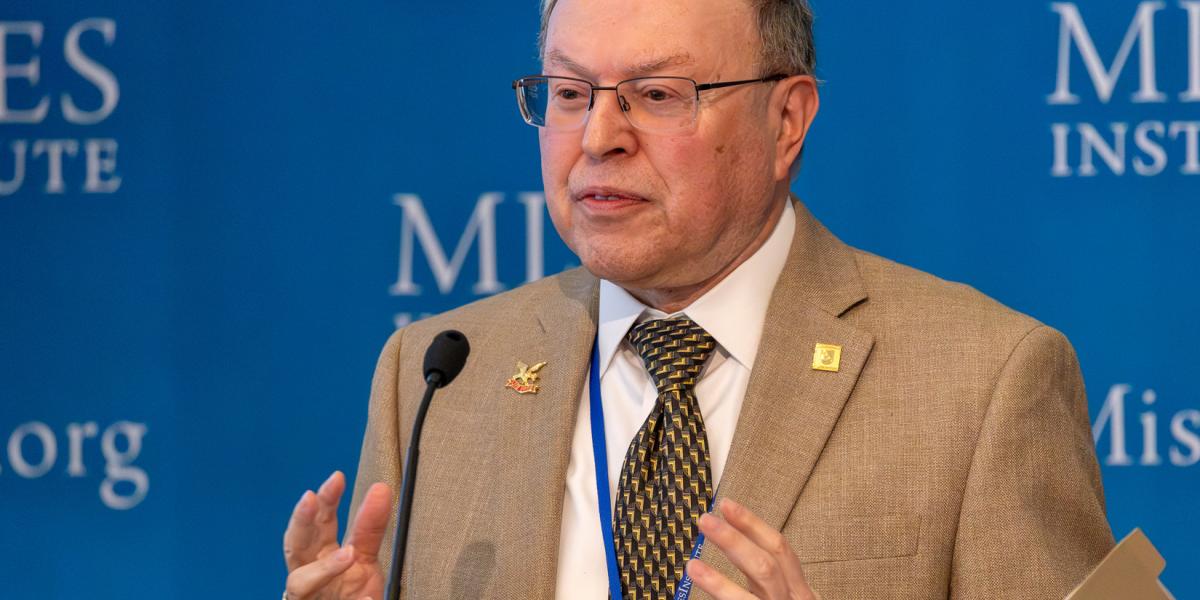
March 2 marks the 100th anniversary of Murray Rothbard—economist, libertarian philosopher, and historian—whose work reshaped each of those disciplines and inspired generations of scholars. For me, this centennial is deeply personal. Rothbard served on my dissertation committee, and since the 1970s his ideas have profoundly influenced my intellectual journey.
My dissertation on the geography of inflation, inspired by Rothbard’s explanation of the diffusion of new money, was hailed by a University of Chicago professor: “You are to be congratulated on the theoretical and critical depth of your thesis.”
As an economist, Rothbard extended and systematized the Austrian tradition of Ludwig von Mises. In Man, Economy, and State, he built upon economic theory from the foundation of human action, presenting a comprehensive treatise that combined rigorous logic with clarity and moral purpose. Rothbard emphasized methodological individualism, the centrality of property rights, and the distortions caused by state intervention, especially inflation and central banking. His analysis of money and banking anticipated many later critiques of fiat currency regimes and remains essential reading for anyone seeking to understand the political economy of monetary institutions.
In political philosophy, Rothbard’s For a New Liberty and The Ethics of Liberty articulated a systematic defense of natural rights and a free society grounded in the nonaggression principle. He did not merely argue for smaller government; he questioned the moral legitimacy of the state itself. By integrating economics with ethical theory, Rothbard offered a radical yet coherent vision of liberty that challenged both conservatives and progressives. His philosophical work gave moral force to economic insights, demonstrating that markets are not only efficient but just.
As a historian, Rothbard brought a revisionist lens to American political and economic development. In America’s Great Depression, he overturned the conventional view that capitalism caused the 1930s collapse, instead tracing the crisis to monetary expansion and policy errors. His multi-volume Conceived in Liberty revealed the libertarian currents in early American history, restoring to prominence neglected figures and ideas that championed decentralization and individual rights. Rothbard showed that history, like economics, must be grounded in sound theory and skepticism of power.
Since the 1970s, his integration of economics, philosophy, and history has guided my own work—reinforcing a commitment to methodological consistency, moral clarity, and historical honesty.
On this centennial, we celebrate not only a towering scholar but a teacher whose ideas continue to animate the cause of liberty.
Originally published at Murray Sabrin’s Substack.