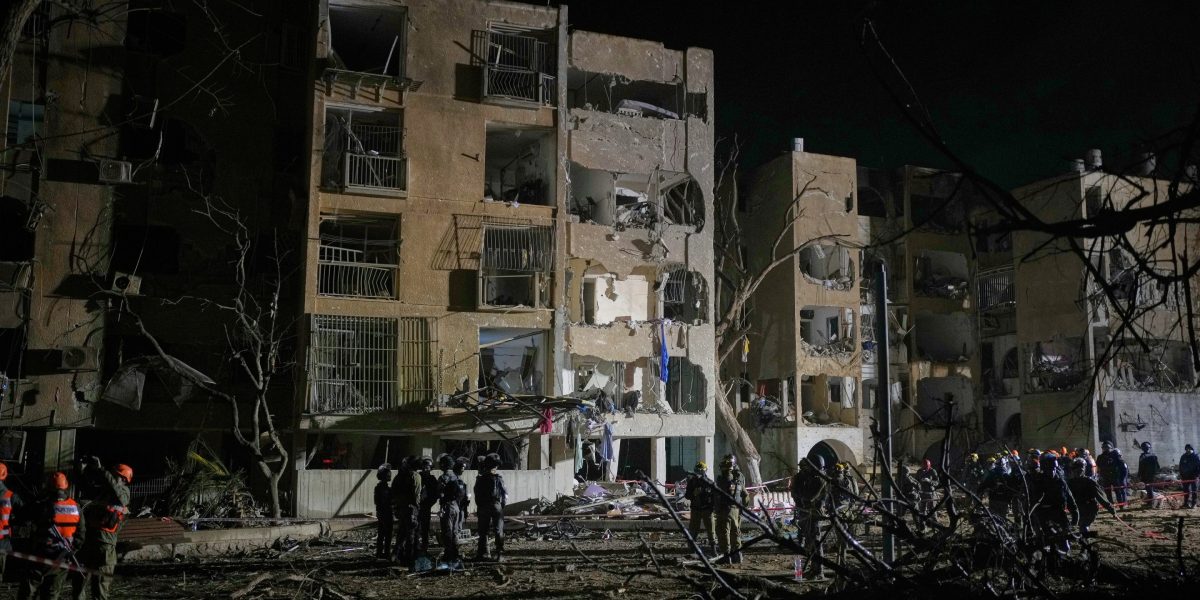
It’s a cruel irony that Qatar has been bombed twice in the last three months by two sworn enemies, first by Iran and then by Israel. Neither has received kinetic retaliation from the very power supposedly guaranteeing Qatar’s security: the U.S. This signals a shift in the world order that Israel has already understood, but which Gulf states are only now beginning to grasp.
Israel’s attack on Qatar has exposed the fragility of the Gulf states’ security system, based on U.S. protection as its power declines. As John Mearsheimer argues, Israel does not have territorial ambitions within the Gulf, but it certainly has hegemonic ones. Through the Abraham Accords, Israel aims to normalize relations, as it has done with the UAE, but under the rubric of its own superiority.
Hegemony in the Middle East is what Israel is after by establishing a “Greater Israel,” expelling Palestinians from it, and balkanizing its direct neighbors. This puts Jordan, Syria, Lebanon, and Egypt at risk. It is also why Israel will likely attack Iran again—perhaps, many analysts suggest, before the year’s end. Turkey is also on the horizon, and its government is taking note.
Israel wants to establish itself as the regional hegemon, and is already behaving like one, backed by the United States. The U.S. wants to disengage from the Middle East—to “end the endless wars”—while leaving it in the hands of a friendly power, and so far, that power is Israel. That is why Washington will not restrain Israel and will do nothing more than issue symbolic rebukes when it bombs its own allies.
The current boldness of Israel in pursuing its hegemonic ambitions shows that Israel has understood something the Gulf states seem to have not: the U.S. is a declining, overstretched empire forced to choose where it puts its resources. There are many arguments to justify this claim: from the defeat in Afghanistan to the one in Ukraine; from trade wars with China to levies imposed on Europe; from the breaking of its own international rules to the collapse of liberal philosophy’s universal claim—all are signs that the age of the hegemon is ending.
But it has not ended yet; this is a golden opportunity for Israel, and Netanyahu knows it. The U.S. is still heavily invested in the Middle East, and Israel has convinced Washington that helping it pursue its strategic goals is in America’s own interest—a fantasy sustained by the Israeli lobby.
To push its expansionist agenda, Israel needs the U.S. strong enough to offer support and political cover—fully aware that this entails committing genocide—while having no appetite to uphold the international rules-based order. There is plenty of evidence to suggest that the Hamas attacks on October 7 were, if not planned, at least allowed by the political and military elite of the country.
It’s arguable that Israel has been waiting for this moment since its creation in 1948, or at least since the Oslo Accords in 1993. The UN partition in 1947 was clearly carried out with a goal in mind—one has only to look at the map—and it was not a two-state solution. The Oslo Accords seem to have been nothing more than a way for Israel to buy time and strength to discard them entirely. Likud, Netanyahu’s political party, was founded in 1973 with the express intent of pursuing a “Greater Israel.”
That Israel was waiting for the most advantageous circumstances to fully unleash its expansion can also be deduced from recent history. Ariel Sharon, then Prime Minister, approved the disengagement plan to withdraw from Gaza in 2003. The E1 settlement in the West Bank—which Netanyahu himself has said would make a Palestinian state impossible—has been postponed since 1994. Both the reoccupation of Gaza and the E1 settlement are now moving ahead in full force.
Since the beginning of Israel’s attack on Gaza, it has also advanced occupation of the West Bank, Lebanon, and Syria. Despite the peace, Egyptian leaders have begun to voice their concern, fully aware that the Sinai is part of Israel’s project and that Israel already took it once. Israel has also pursued a policy of destabilization in the Middle East in general to prevent the emergence of any regional power capable of posing a threat. Hence it has attacked Iran and will do it again—and is already speaking about Turkey.
This is a marked change from the Israel of Trump’s first administration and the first iteration of the Abraham Accords. Back then, Israel was publicly promoting a desire for regional stability and normalizing relationships with its Arab neighbors. Now it speaks openly of annexing Gaza and the West Bank, and doesn’t hide its ambition of a hegemonic Greater Israel.
Israeli leadership has understood that the window of opportunity to pursue its expansionist agenda is now—or perhaps never. Despite good relations with Russia and friendly ones with China, at least until recently, neither of these powers would offer the support and political cover that the U.S. has done and continues to do. This also means that there will probably not be a better time to commit genocide than now, while the current international order is broken and a new one has not yet been enforced.
It took the U.N. almost three years and probably over 600,000 deaths to conclude that Israel is committing genocide. There has been no international organization—the U.N., the ICC, the E.U., BRICS, the OIC—or any nation, despite rhetoric, that has done anything to effectively stop the carnage in Gaza and to rein in Israel’s expansionist policy in the region and its continuous heinous attacks on civilians. This is a failure of the international system—not the first, but arguably the one that delivered the final blow.
That reality, which goes hand in hand with the decay of U.S. hegemony, is what Gulf states seem not to have understood—or, if they have, they are not willing to act on it as Israel does. The declaration at the recent Arab-Islamic emergency meeting in Doha, in light of Israel’s attack on the host country, is a testament to this: full of anger but lacking concrete action.
They call on the “international community,” the charter of the Arab League, and Article 2 of the U.N. Charter, which prohibits aggression that threatens territorial or political integrity. They invoke relevant resolutions of the OIC as well as the U.N. to condemn Israeli aggression on Qatar and its expansionist policies in the Middle East. They call for holding Israel accountable according to relevant “international law” and “human rights.” But there is not a single concrete item of actionable policy.
There is an argument for this, which is that they did not really want to do anything about it: that the emergency meeting was only a PR exercise to placate public opinion. This argument maintains that the U.S. and Qatar were aware and, since Qatar was not really the objective but Hamas, the Gulf state did not really feel threatened by Israel. Thus, their poetic but empty calls for Arab and Islamic unity, coupled with the lack of concrete action.
I don’t particularly agree with the idea that Qatar was in the loop, but if there is some truth to it, we must assume that it was forced to accept it as a fait accompli, since it doesn’t seem to benefit from it. Which only reinforces its status as a vassal state.
The Gulf states are, for all intents and purposes, vassals of the U.S. They owe their very modern existence to the international order championed by the U.S. after World War Two and its protection; that is why they invoke it when they feel threatened. The U.S. established a contractual relationship with them: security and recognition in exchange for oil and gas. But they have no real sovereignty. As Julian Macfarlane notes, their situation is very similar to that of the Indian Princely States under British imperial rule. The empire allowed local tribal families to rule while making sure they aligned completely with its interests. But the interests of the empire do not always align with theirs.
This is the case that most likely applies to Israel’s attack on Qatar. It is hardly believable that the U.S. had no prior knowledge. Axios reports that Netanyahu spoke to Trump previously. John Helmer argues that the attack might have been conducted with drones and not missiles and that, if so, it must have been launched from within Qatar, probably from an airstrip coming from the U.S. Al Udeid Air Base. This is speculative, but nonetheless, the argument of U.S. ignorance does not hold—just as it did not hold when Trump claimed not to be involved in Israel’s attack on Iran.
In the face of U.S. interests clashing with their own, what can Gulf states do? Not much. As Mearsheimer notes, they have almost no leverage. They have promoted an image of political and economic stability and neutrality, aiming to attract oligarchs and their finances, Western and non-Western, but all predicated on the U.S.-led order.
Now that order is breaking, they risk suffering the same fate as Antwerp in the 16th century. Under the Spanish Empire, this city became the world’s financial hub, handling 75% of Europe’s trade with Asia and receiving over 1,000 boats weekly from all over the world. But when in 1576, the Spanish Empire, burdened with debt, failed to pay the wages of its mercenary soldiers fighting in the Low Countries, the troops ransacked Antwerp, which was full of foreign merchants. In less than three days, this international merchant hub disappeared, with all traders and financiers relocating elsewhere.
To conclude, and because it does not seem appropriate to present only a victorious Israel, the genocide it is committing may ultimately cost the country its very existence. It is hard to imagine how any society could endure with such a deep moral wound, yet Netanyahu himself has warned that isolation is on the horizon. The real question is: how long can Israeli society hold together before part of it turns against itself? Difficult to predict—but not difficult to see coming.
PS: As I finished writing this, news broke about a security agreement between Saudi Arabia and Pakistan, which MoA has analyzed as consequence of the attack in Doha. This does not invalidate the hypothesis in this article, since Saudi Arabia already had its “Qatar moment” in 2019. And although it is a Gulf state, its size and importance place it in a different category from the others—closer to Türkiye and Iran.