During the recent government shutdown, the temporary interruption of benefits to 42 million food stamp recipients was hyped as practically the greatest human rights violation of our time. A Nation magazine headline howled: “The United States Is Letting Its People Starve.” But the delayed payments had scant impact in part because many states offered supplemental benefits, many recipients had leftover benefits on their Electronic Benefit Cards (EBTs), and because vast numbers of food pantries and other private charities provided relief.
Democrats accused Trump of “weaponizing hunger.” But the real problem is that politicians going back more than half a century have weaponized dependency to destroy limits on government power.
Most Americans support giving government assistance to people who are unable to feed themselves. But politicians profited by multiplying the number of people who relied on Washington for their next meal.
In 1969, President Richard Nixon was sharply expanding US bombing of southeast Asia. Nixon sought to bolster his humanitarian image by vastly increasing federal food handouts. He held a White House Summit and received glowing press coverage for proclaiming, “The moment is at hand to put an end to hunger in America itself for all time.” That year, 3 million Americans received food stamps, a burgeoning federal program that cost $228 million. Last year, the program cost $100 billion.
Why did food stamps become so expensive?
Government surveys in the 1960s showed that most of the poor did not need federal aid to have an adequate diet. But it was politically profitable to pretend that low-income Americans were helpless by definition. To further that goal, Washington launched a war on self-reliance.
Even though food stamp enrollment quadrupled between 1968 and 1971, Congress mandated an outreach program for states to recruit more recipients. A USDA magazine reported in 1972 that food stamp workers could often overcome people’s pride by saying, “‘This is for your children’. . .the problem is not with welfare recipients but with low-income workers: It is this group which recoils when anything even remotely resembling welfare is suggested.” The magazine triumphally announced: “With careful explanations. . .coupled with intensive outreach efforts, resistance from the ‘too prouds’ is bending. More and more are coming to the conclusion that taking needed assistance does not mean sacrificing dignity.”
In 1974, the Food Research and Action Center—a federally-funded activist group—successfully sued USDA to require the agency to further increase its food stamp outreach efforts. The USDA suggested sending food stamp workers to unemployment offices to distribute leaflets, and in Pennsylvania food stamp aides went to supermarkets to hustle shoppers. By 1976, twelve states had conducted door-to-door recruiting campaigns, and seventeen had conducted telephone campaigns. Door-to-door food stamp advertising became a favorite project for Comprehensive Employment and Training Act (CETA) workers.
In Wisconsin, 2,000 copies of the Food Stamp Nursery Rhyme Coloring Book were distributed. In Kentucky, a traveling puppet show told folks how and why to sign up for benefits. A typical 1975 USDA brochure announced, “You are in good company. Millions of Americans use food stamps.” A leaflet distributed in Maryland and paid for by the federal government showed a gaunt face on the cover with the question, “Did you know some people would rather STARVE than seek HELP. . .” On the inside, the brochure said,
PRIDE NEVER FILLS EMPTY STOMACHS . . . Are you one of thousands of Maryland residents who. . .have too much pride to consider applying for help? Then you need to know more about the Food Stamp program.Food Stamps should NOT be confused with CHARITY! In fact, food stamps are designed to help you help yourself.
The Community Services Administration funded scores of local and national food stamp advocacy organizations to increase enrollment in food programs. The federal Office of Economic Opportunity called in 1971 for community action agencies to “prick the public conscience” over the need for more food handouts, declaring, “food stamps are not used as often as they ought to be, particularly by the intermediate income families among the poor.”
During the Clinton administration, AmeriCorps played a leading role in food stamp recruiting. The Mississippi Action for Community Education (MACE) was one of the most prominent food stamp recruiters—at least on paper. Its 1999 grant application promised that its AmeriCorps members would “conduct door-to-door canvassing to identify potential food stamp recipients” and would also provide “assistance in completing necessary applications for food stamps.” The goal of the program was to enroll “75% of surveyed rural Mississippi residents who are eligible for food stamps, but are not receiving them.”
I dropped in on MACE headquarters in Greenville, Mississippi to ask a few questions for a Readers Digest article I was writing. MACE’s Fanny Woods was evasive about their AmeriCorps program and her answers contradicted MACE’s statements in its reports to AmeriCorps headquarters. I mentioned those evasions to the AmeriCorps Inspector General. They launched an investigation that was joined by the FBI and resulted in MACE’s executive director being sent to federal prison. Rather than doing food stamp recruiting, MACE simply had ghost employees on its AmeriCorps payroll.
Ironically, that was a better result for taxpayers than if the food stamp recruiting actually occurred.
At the end of the Clinton era, 17 million Americans received food stamps—a sharp decline from the 28 million recipients in 1994. A 1996 welfare reform act was decisive in curbing dependency. However, President George W. Bush took office in 2001 and sought to vigorously expand food stamp enrollment as part of his “compassionate conservatism” sideshow to his war on terrorism atrocities.
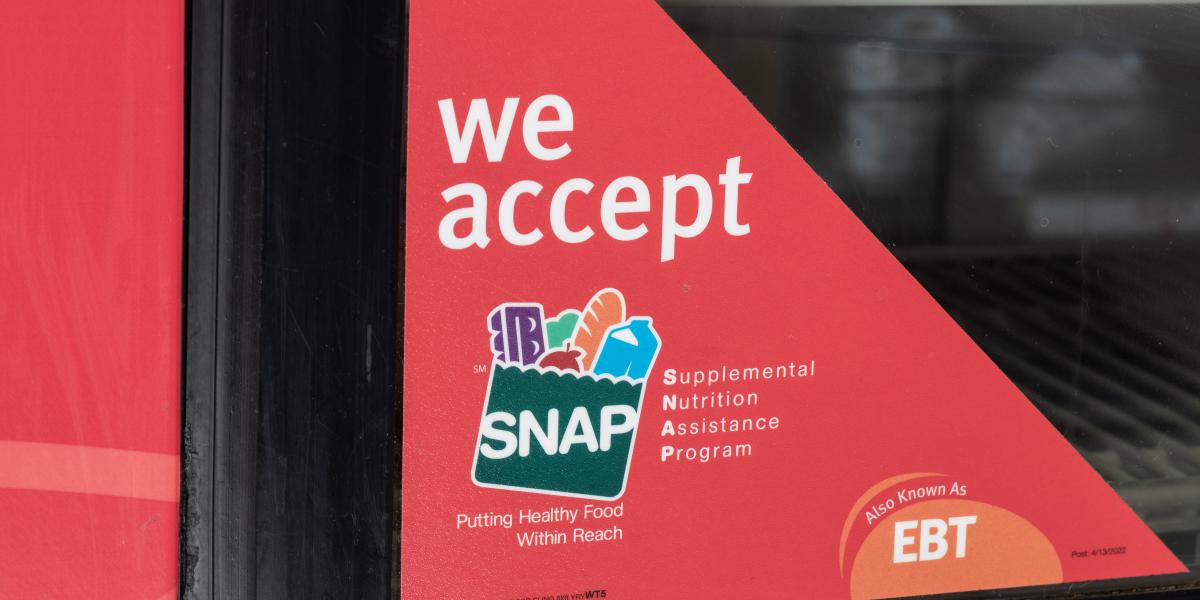
In 2008, food stamps were renamed the Supplemental Nutrition Assistance Program1SNAP—to sound more wholesome and attractive. But the program remained a junk food entitlement and food stamp recipients were twice as likely to be obese as eligible low-income people not receiving food stamps.
Food stamp recruiting went into overdrive with the Obama administration. USDA bankrolled state government propaganda campaigns. A North Carolina social services agency won a USDA “Hunger Champions Award” for its ad campaign attacking “mountain pride” as a reason for not accepting government handouts. In Alabama, people received fliers proclaiming: “Be a patriot. Bring your food stamp money home.” A USDA brochure advised its field offices to, “Throw a Great Party…. Putting SNAP information in a game format like BINGO, crossword puzzles. . .is fun and helps get your message across in a memorable way.” USDA promoted a 10-part Spanish-language radio “novella” to encourage immigrants to go on the dole. The Obama administration also made food stamps more inviting by banishing the requirement for able-bodied recipients to seek to get a job.
The Biden administration ramped up both welfare recruiting and benefits, helping maximize the number of dependents. In 2022, President Biden proclaimed a goal “to end hunger in this country by the year 2030.” Biden did not explain why a hundred-fold increase in federal food aid spending since Nixon’s 1969 proclamation had failed to end hunger.
Political demagogues have long invoked the number of food stamp recipients as proof of the failure of the market economy and the injustice of capitalism or neoliberalism or whatever they are calling the system that week. As long as more than 40 million people depend on food stamps, politicians can exploit push-button hysteria to claim that any interruption in their spending or power will result in vast suffering and (hint, hint) starvation, especially of children and minorities and women.
The Trump administration is taking some steps to curb food stamp abuses, reviving the work requirement, cracking down on fraud, and approving state-level reforms that end junk food purchases. Simply returning to the program standards of the late 1990s would radically decrease enrollment. As Mises Institute’s Ryan McMaken recently noted, “Nearly half of households headed by illegal-immigrants receive food stamps”—a benefit that was banned in the 1996 welfare reform bill.
Unfortunately, since the Reagan era, any high-profile proposal to curb food stamp spending is accepted as sufficient proof of mass hunger and imminent catastrophe. Reducing the number of dependents is a vital first step to curbing Leviathan. But how many politicians will have the savvy or the courage to resist the Hunger Hysteria Industrial Complex?