No Result
View All Result
SUBMIT YOUR ARTICLES
  • Login
Wednesday, January 7, 2026
TheAdviserMagazine.com
  • Home
  • Financial Planning
    • Financial Planning
    • Personal Finance
  • Market Research
    • Business
    • Investing
    • Money
    • Economy
    • Markets
    • Stocks
    • Trading
  • 401k Plans
  • College
  • IRS & Taxes
  • Estate Plans
  • Social Security
  • Medicare
  • Legal
  • Home
  • Financial Planning
    • Financial Planning
    • Personal Finance
  • Market Research
    • Business
    • Investing
    • Money
    • Economy
    • Markets
    • Stocks
    • Trading
  • 401k Plans
  • College
  • IRS & Taxes
  • Estate Plans
  • Social Security
  • Medicare
  • Legal
No Result
View All Result
TheAdviserMagazine.com
No Result
View All Result
Home Market Research Economy

Fed’s Standing Repo Facility (SRF) Drops to Zero, from $75 Billion on the Last Balance Sheet as Yearend Liquidity Turmoil Dissolves

by TheAdviserMagazine
1 day ago
in Economy
Reading Time: 5 mins read
A A
Fed’s Standing Repo Facility (SRF) Drops to Zero, from  Billion on the Last Balance Sheet as Yearend Liquidity Turmoil Dissolves
Share on FacebookShare on TwitterShare on LInkedIn


Yves here. I am of two minds in even now calling attention to the before-year-end action in the Fed’s repo facility. We’ve had repeated instances, most notably in the 2019 repo panic, of commentators getting whipped up over a nothingburger. This was another one.

Several readers e-mailed us, citing wild-eyed accounts from supposed experts over late-December spikes in repo facility usage, depicting them as representing stealth bank bailouts. We have the receipts via e-mailed responses at the time that this reaction was way overblown. We did not even want to dignify this line of thinking at the time by amplifying it through a refutation (cognitive bias research shows that trying to debunk is actually very hard to do effectively; it more often has the effect of reinforcing the message one is trying to counter).

Wolf presents the data. He points out, as we did, that year end is typically a time of low liquidity. Many institutional investors try to close their books as of December 15.

In addition, the Fed has changed the way it manages short-term liquidity which, as far as I can tell (expert opinion welcomed) has seemed to make matters worse in crunch times. After the crisis, it went from managing short-term liquidity mainly via daily open market operations to paying interest on reserves, which is a completely unwarranted gimmie to banks. That approach operationally works fine in loose monetary conditions but not in a tightening cycle. 3 months before the 2019 repo panic, the New York Fed “lost” the two top traders on its money desk, which leads me to think they were told the role of the unit was being curtailed. My perception, based on subsequent events, is that the Fed has been and still is inept in using the repo facility as an alternative to money desk interventions. There may also have been a loss of market intelligence by downgrading the role of the once-very-important New York Fed money desk.

In addition, around this year end, the CME raise margin requirements sharply for some metals. It is not hard to think some banks hoarded liquidity in case hedgies who were wrong-footed by the move in turn pulled down hard on their borrowing lines to meet margin calls.

We had pinged derivatives maven Satyajit Das for his reading at the time. From his reply:

1. Money market conditions are choppy primarily because of year-end and also the Treasury’s reliance on T-bills for funding. There is also deep uncertainty around the Fed and interest rates. I am aware that bank funding costs have increased for these reasons. An additional factor is the concern around credit ‘cockroaches’ (to use JP Morgan CEO Dimon’s expression) lurking in the system which may result in larger credit losses than provided for. There are concerns around exposure to hedge funds and commodity business due to rises in margin calls due to higher price volatility.

2. I am aware that the fed has stepped up its repo operations to ‘smooth’ short term fluctuations which is a normal part of its remit. The amounts mentioned in the article or not that large in the overall scheme.

By Wolf Richter, editor at Wolf Street. Originally published at Wolf Street

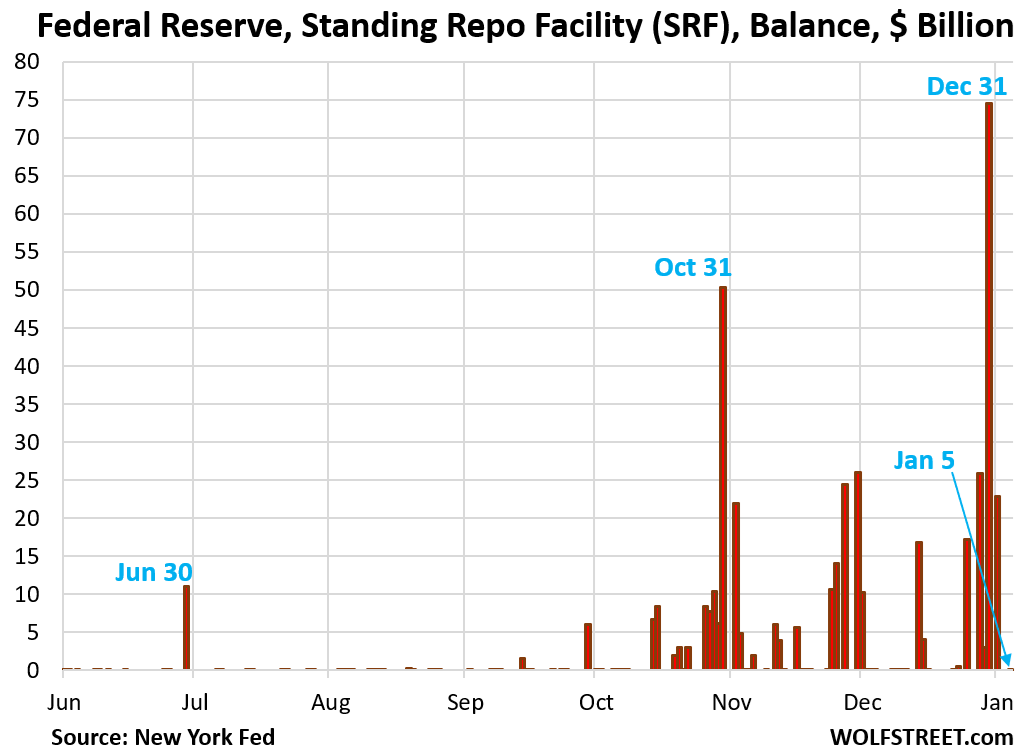
The balance at the Fed’s Standing Repo Facility (SRF), an asset on the Fed’s balance sheet, fell back to zero today, with all repos from Friday unwinding, and zero new repos being taken up at the two auctions today, as expected.

The SRF had spiked to $75 billion on December 31 as part of the year-end liquidity shifts, from zero before Christmas, and that $75 billion had been the largest factor in the $104 billion spike of the Fed’s weekly balance sheet as of the close of business on Wednesday, December 31.

But this spike has now completely reversed; and the Fed’s next weekly balance sheet, to be released on Thursday, will show a substantial drop in total assets.

At year-end, massive amounts of liquidity shifted around markets, causing tight spots in some places, as reflected in the spike of repo market rates, such as SOFR, and excesses in other places, as reflected in the spike at the Fed’s overnight reverse repos (ON RRPs) which drain liquidity from the markets.

The tight spots showed up in repo market rates, such as those tracked by SOFR, which surged at the end of December, with some transaction rates as high as 4.0% on December 31. On that day, SOFR – a calculated median for the day’s rates – jumped to 3.87%.

This spike in repo rates made it profitable for banks to borrow $75 billion at the SRF on December 31 at 3.75% and lend to the repo market at higher rates through the holiday until Friday morning.

On Friday, January 2, as repo market rates dropped – the high was down to 3.87%, and SOFR was down to 3.75% – that profit opportunity vanished, and banks unwound most of their repos at the SRF on Friday, and unwound the rest today, and the balance went back to zero today.

But the Fed’s weekly balance sheet, which shows balances as of the close of business on Wednesday, had booked that $75 billion one-day-wonder spike at the SRF that had occurred on Wednesday, and that had been the primary factor in the $104 billion spike of the Fed’s total assets on its balance sheet released on Friday.

But the Fed got its $75 billion back, and the counterparties got their collateral back, and that $75 billion has now been completely unwound and vanished from the Fed’s assets.

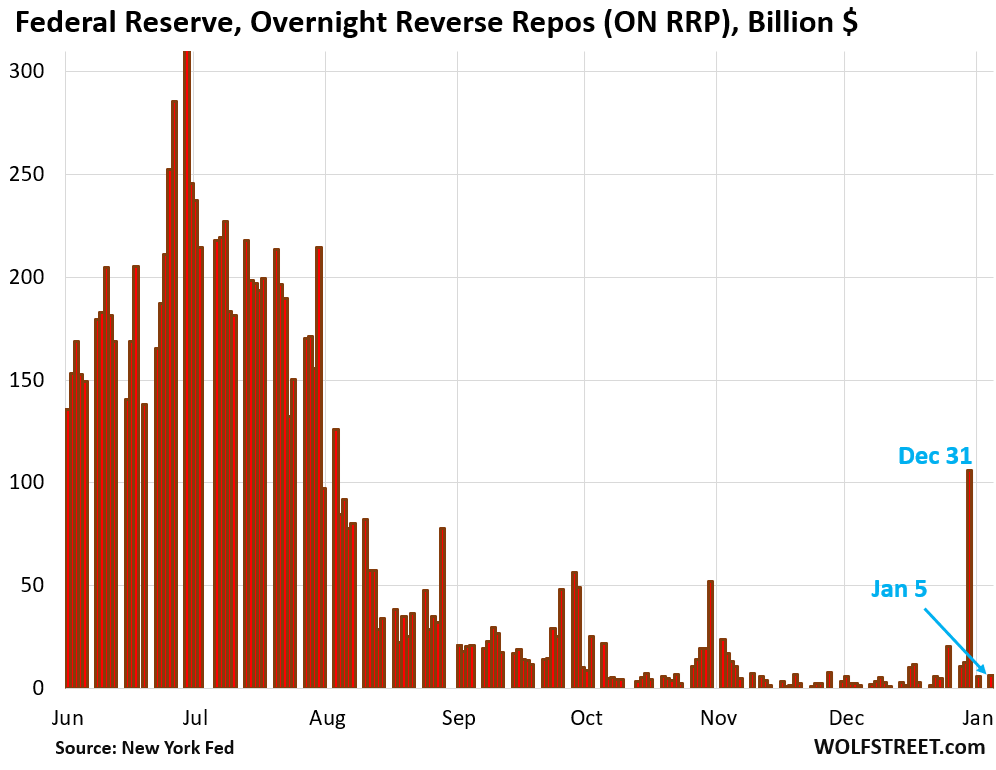
The excess liquidity that had occurred in other parts of the market on December 31 showed up at the Fed’s overnight reverse repo facility (ON RRPs). And it has been unwound nearly entirely.

That excess was reflected in the spike to $106 billion at the Fed’s ON RRP facility on Wednesday, December 31.

ON RRPs mostly reflect excess cash that money market funds have put on deposit at the Fed; they in essence lend their excess cash to the Fed and earn 3.5% on it. The Fed owes them this cash, and so ON RRPs are a liability on the Fed’s balance sheet.

On Friday January 2, the ON RRP balance plunged to $6 billion, from $106 billion on December 31. Today it remained at $6 billion. So this too has settled down, as expected.
These two facilities at the Fed – the SRF and ON RRPs – are part of the Fed’s system of control of short-term interest rates to keep them in the range of its monetary policy rates, currently 3.5% to 3.75%.

The SRF rate acts as a ceiling rate – one of the tools to keep overnight rates from surging too far above the Fed’s top end of the range (3.75%).

The ON RRP rate acts as a floor rate – one of the tools to keep short-term rates from dropping too far below the Fed’s bottom end of the range (3.5%).

And the counterparties of these two facilities are not the same, and so the rates affect different parts of the market: The counterparties of the SRF are 43 big banks, broker-dealers, and a credit union (I posted the updated list in the comments below). The counterparties of the ON RRPs are mostly money market funds.

After three years of QT removed $2.43 trillion in liquidity from the markets, these kinds of brief liquidity shifts are going to show up on key dates during the year, such as year-end, quarter-end, month-end, and particularly on Tax Days, such as around April 15.


The Tangled OpenAI and Microsoft Alliance Frayed Under Pressure


Source link

Tags: balanceBilliondissolvesdropsfacilityFedsLiquidityrepoSheetSRFStandingturmoilYearEnd
ShareTweetShare
Previous Post

NFT Paris Called Off – Organizers Cite Harsh Market Condition

Next Post

Turtlemint Fintech eyes Rs 2,000cr IPO; to file updated draft papers with Sebi in next 2-weeks

Related Posts

edit post
The Tangled OpenAI and Microsoft Alliance Frayed Under Pressure

The Tangled OpenAI and Microsoft Alliance Frayed Under Pressure

by TheAdviserMagazine
January 7, 2026
0

The partnership between Microsoft and OpenAI ignited the AI boom but frayed under pressure in 2025 as the halcyon early...

edit post
Socrates & War | Armstrong Economics

Socrates & War | Armstrong Economics

by TheAdviserMagazine
January 7, 2026
0

QUESTION: Marty, Socrates has been targeting the first week of January and the month of January as a panic cycle...

edit post
Private payrolls rose 41,000, slightly below expectations,

Private payrolls rose 41,000, slightly below expectations,

by TheAdviserMagazine
January 7, 2026
0

A "Join Our Team" flyer at the Appalachian State University internship and job fair in Boone, North Carolina, US, on...

edit post
Term Limits & Insider Trading

Term Limits & Insider Trading

by TheAdviserMagazine
January 6, 2026
0

I was invited to a briefing this morning on Term Limits and Congressional Insider Trading. Florida Governor Ron DeSantis and...

edit post
Coffee Break: Armed Madhouse – U.S. War Without Boundaries

Coffee Break: Armed Madhouse – U.S. War Without Boundaries

by TheAdviserMagazine
January 6, 2026
0

For much of the post-WWII era, the United States maintained a set of institutional boundaries designed to govern the use...

edit post
Regime Change and Nation-Building Are Back!

Regime Change and Nation-Building Are Back!

by TheAdviserMagazine
January 6, 2026
0

As was the case the morning after “Shock and Awe” signaled the start of the Iraq war, many are cheering...

Next Post
edit post
Turtlemint Fintech eyes Rs 2,000cr IPO; to file updated draft papers with Sebi in next 2-weeks

Turtlemint Fintech eyes Rs 2,000cr IPO; to file updated draft papers with Sebi in next 2-weeks

edit post
EUR/USD: 1.1660 Holds Firm – A Break Back Above 1.17 Signals Trend Continuation

EUR/USD: 1.1660 Holds Firm - A Break Back Above 1.17 Signals Trend Continuation

  • Trending
  • Comments
  • Latest
edit post
How Long is a Last Will and Testament Valid in North Carolina?

How Long is a Last Will and Testament Valid in North Carolina?

December 8, 2025
edit post
80-year-old Home Depot rival shuts down location, no bankruptcy

80-year-old Home Depot rival shuts down location, no bankruptcy

January 4, 2026
edit post
In an Ohio Suburb, Sprawl Is Being Transformed Into Walkable Neighborhoods

In an Ohio Suburb, Sprawl Is Being Transformed Into Walkable Neighborhoods

December 14, 2025
edit post
Democrats Insist On Taxing Tips        

Democrats Insist On Taxing Tips        

December 15, 2025
edit post
Detroit Seniors Are Facing Earlier Shutoff Notices This Season

Detroit Seniors Are Facing Earlier Shutoff Notices This Season

December 20, 2025
edit post
Warren Buffett retires on December 31 and leaves behind a manual for a life in investing

Warren Buffett retires on December 31 and leaves behind a manual for a life in investing

December 27, 2025
edit post
Does your credit score reset in the new year?

Does your credit score reset in the new year?

0
edit post
The Tangled OpenAI and Microsoft Alliance Frayed Under Pressure

The Tangled OpenAI and Microsoft Alliance Frayed Under Pressure

0
edit post
Polymarket Enters the Newsroom Through Dow Jones Alliance

Polymarket Enters the Newsroom Through Dow Jones Alliance

0
edit post
How automation can simplify your finances

How automation can simplify your finances

0
edit post
Jensen Huang’s CES Keynote Revealed Where AI Is Going Next

Jensen Huang’s CES Keynote Revealed Where AI Is Going Next

0
edit post
10 Best High Dividend Stocks For The Next 10 Years

10 Best High Dividend Stocks For The Next 10 Years

0
edit post
Polymarket Enters the Newsroom Through Dow Jones Alliance

Polymarket Enters the Newsroom Through Dow Jones Alliance

January 7, 2026
edit post
The Tangled OpenAI and Microsoft Alliance Frayed Under Pressure

The Tangled OpenAI and Microsoft Alliance Frayed Under Pressure

January 7, 2026
edit post
10 Best High Dividend Stocks For The Next 10 Years

10 Best High Dividend Stocks For The Next 10 Years

January 7, 2026
edit post
Jensen Huang’s CES Keynote Revealed Where AI Is Going Next

Jensen Huang’s CES Keynote Revealed Where AI Is Going Next

January 7, 2026
edit post
January Mortgage Outlook: New Year, Same Rates

January Mortgage Outlook: New Year, Same Rates

January 7, 2026
edit post
5 Best Money Habits for Boomers To Carry Into 2026

5 Best Money Habits for Boomers To Carry Into 2026

January 7, 2026
The Adviser Magazine

The first and only national digital and print magazine that connects individuals, families, and businesses to Fee-Only financial advisers, accountants, attorneys and college guidance counselors.

CATEGORIES

  • 401k Plans
  • Business
  • College
  • Cryptocurrency
  • Economy
  • Estate Plans
  • Financial Planning
  • Investing
  • IRS & Taxes
  • Legal
  • Market Analysis
  • Markets
  • Medicare
  • Money
  • Personal Finance
  • Social Security
  • Startups
  • Stock Market
  • Trading

LATEST UPDATES

  • Polymarket Enters the Newsroom Through Dow Jones Alliance
  • The Tangled OpenAI and Microsoft Alliance Frayed Under Pressure
  • 10 Best High Dividend Stocks For The Next 10 Years
  • Our Great Privacy Policy
  • Terms of Use, Legal Notices & Disclosures
  • Contact us
  • About Us

© Copyright 2024 All Rights Reserved
See articles for original source and related links to external sites.

Welcome Back!

Login to your account below

Forgotten Password?

Retrieve your password

Please enter your username or email address to reset your password.

Log In
No Result
View All Result
  • Home
  • Financial Planning
    • Financial Planning
    • Personal Finance
  • Market Research
    • Business
    • Investing
    • Money
    • Economy
    • Markets
    • Stocks
    • Trading
  • 401k Plans
  • College
  • IRS & Taxes
  • Estate Plans
  • Social Security
  • Medicare
  • Legal

© Copyright 2024 All Rights Reserved
See articles for original source and related links to external sites.