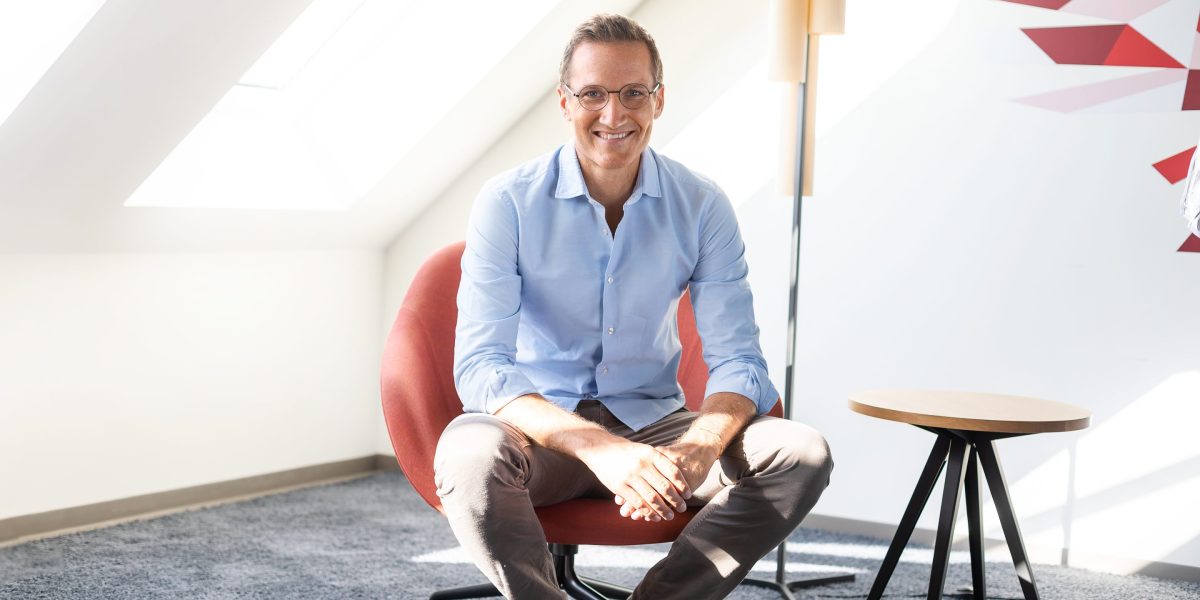
Niklas Östberg is a rare beast. A founder-CEO who took his company public and survived a shareholder backlash. Sam Altman might like to take his number as he considers floating OpenAI. Reporting on your results every three months is not for the faint-hearted.
Östberg is the entrepreneur behind Delivery Hero, the €7.65bn global food delivery business which IPO’d in 2017. It was the largest float of the year on the German stock exchange, and unlike other, rockier food delivery debuts (Deliveroo, Blue Apron), its share price rose strongly.
That was then. Roll forward to 2025 and it has been far from a good year on the markets for the owner of Talabat (Gulf, North Africa), Glovo (Europe, Africa) and Foodpanda (South-east Asia). Delivery Hero’s share price fell to a low of €16.05 ($18.94) in November, from a high of €31.39 ($37.05) nine months earlier, a nearly 50% drop. Competition from the Chinese giant, Meituan, and regulatory fines for poor employment practices in the cutthroat world of moped and cycle delivery weighed on share price performance.
Delivery Hero Chair, Kristin Skogen Lund, was obliged to write to shareholders announcing a strategy review, a streamlining of costs and continuing exits from underperforming regions. “Despite this significant progress and our relentless focus to always deliver the best possible customer proposition, we acknowledge that the share price performance has been disappointing for all of us,” she said. Östberg was the letter’s co-signatory.
We know how this movie is meant to end. ‘Founder-CEO struggles to scale on the public markets, shareholders become impatient for returns, founder-CEO departs.’
Östberg’s story arc is different and provides significant lessons on the value of long-term thinking, management style, and intense knowledge of the business. He has survived a number of storms around the company’s business model and valuations and has survived each of them. Delivery Hero’s share price is up 18% this year.
Read more: Oracle billionaire Larry Ellison’s next big bet: Redefining how long–and how well–we live
“Of course, in a private market, it’s much easier because you have to convince three to five board members and you can show them the exact economics and so on,” he tells me. “On the public market, you cannot give that same level of disclosure, and you have to convince a lot more than just a few so, of course, that’s a challenge.”
“The advantage of being a founder is that the business is your baby. You want the best for your baby and you are willing to go through fire and fury and anger to make sure that your baby is going to do well. That’s the difference between a manager and a founder, that we are stubborn and we want the best, sometimes we are wrong, but sometimes we are right.”
“I’m fine to look stupid for one or two or three years, as long as I know that in year four, I’ll prove it.”
Niklas Östberg
Delivery Hero’s vision is ‘deliver anything’—hot food, groceries, household goods. The quick commerce market is projected to grow from $184.6bn in 2025 to $337.6bn by 2032 according to Fortune Business Insights. But getting there costs money, which is where the pressure starts.
“[In the past] every shareholder on the planet hated home delivery. [They said] it’s never going to be profitable. Our largest competitor in America was saying how stupid this is. Everyone was saying ‘this is the dumbest thing ever’ and we took a lot of heat.”
“Until they realized maybe two, three, four years later, that the dumbest thing is not to do it.”
“Later on, we had a similar challenge when we went multi-vertical, where we deliver from grocery stores. Then we built our own warehouses. We built 1,000 warehouses—micro-fulfilment centers, or Dmarts, as we call them.”
“And, of course, that was seen as even dumber than delivery. It was like, ‘you can’t make money on delivering toothpaste and toilet paper.’ We lost a lot of money on it, and so did everyone else.”
“And then the capital ended in 2021 [the end of the low interest-rate cycle] and everyone went bankrupt, or close to bankrupt, and started to scale down and we decided, no, we’re still going to do it. Again, everyone said, ‘that’s the dumbest decision’ and we came under more heat for that. But now I’ve also made that business model profitable.”
Patient capital is rare on the public markets, and activist investors are increasingly apparent on share registers. Östberg says that the discipline demanded should be seen as a help, not a drag.
“It would clearly be less of a painful path, I’m sure, to not do it in the public sphere, especially in these transitions, or when things are a little bit rough, or you take a decision that’s good for five years, but not good for a quarter.”
“But we don’t do this because it’s easy or it’s the path of least resistance. We are fine to take the resistance, as long as I know that I’m going to be right over time. I’m fine to look stupid for one or two or three years, as long as I know that in year four, I’ll prove it.”
“I think driving efficiency is a good thing, because that means you have a better return on your capital and you can invest in things that really makes a difference for consumers. It has also made the company much stronger and better.”
“[In times of change] the public company will have to move the fastest, because they will be so exposed if they’re wrong or if they’re not on the ball, while I think sometimes the private company can be living in a bubble.”
‘Founder-CEO makes it through shareholder temper tantrum.’ Sam Altman, take note.