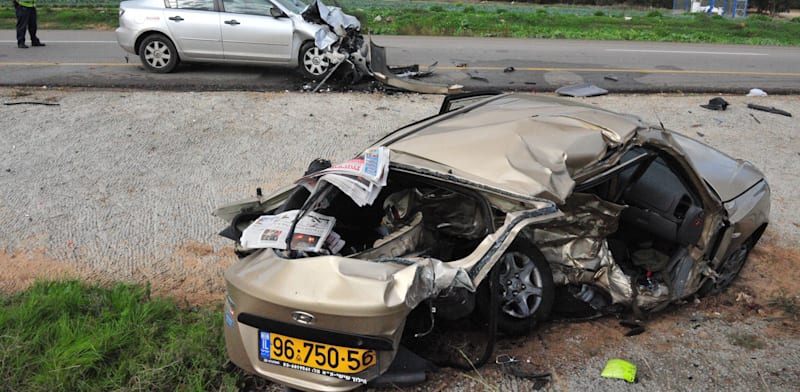
A new study by the National Road Safety Authority finds a clear connection between low socio-economic class and death on the roads. Unlike in other countries where policies have been developed to deal with the phenomenon, nothing has yet been done in Israel.
The study covers the period 2018-2022. It finds that residents in low socio-economic clusters (clusters 1-4, which include many Arab settlements) die in road accidents at a rate 1.4 times the rate for residents in settlements in high clusters (8-10). For children, the picture is even worse. In their case, the gap is 2.4 times. Road accidents are one of the most common causes of death and hospitalization among children, especially in weak sections of Israeli society.
The reasons for the these gaps are many. The study, which has reached “Globes”, states: “In Israel, there are gaps in infrastructure between the center and the periphery and Arab settlements, which have a high concentration of socio-economically weak people. In addition, the quality of the roads and of railway services in Israel score low on international rankings.”
Examination by the Authority in recent years of the infrastructure in the environs of schools reveals that 53% of the primary schools in socio-economic clusters 1-4 report severe deficiencies, which compares with 27% of schools in clusters 5-8, and just 4% in clusters 9-10. Volunteer road safety patrols for schoolchildren have hardly penetrated haredi and Arab society.
The problem continues with slow response to an accident, with the time that elapses between injury and admission to hospital varying by locality, although up-to-date statistics on this are unavailable in Israel.
Compliance with the law also varies. According to a survey by the Central Bureau of Statistics dating from 2021, 95% of high-income households report that they fasten safety belts in vehicles, which compares with 89% of middle-income households and 84.5% of low-income households.
A global phenomenon
The trend is a global one. According to the World Health Organization website, 93% of those killed in road accidents around the world are from countries with low and middle incomes, and within high-income countries, people of low socio-economic status are more involved in road accidents.
Socio-economic status is known as a predictor of health and life expectancy, and in recent years research into this aspect of road accidents has expanded, presenting a similar picture. One of the pioneers in this area is Canada, where it was demonstrated in the 1990s that children from poor neighborhoods in Montreal were injured in road accidents at a rate four times that of children from wealthier neighborhoods. A similar study during the same period in Nottingham in the UK found similar results.
A study published five years ago that analyzed data from around the world found an above-average road casualty rate among people with low education and income levels, among people living in rural communities, and among young drivers and minorities. Young drivers of low socio-economic status in Sweden are injured at a rate 1.8 times that of others, and in Australia it was found that the chances of being hospitalized for this group were double the general rate. In Canada, it was found that more people with low incomes were killed on the roads than people with high incomes, and research from Iran showed that drivers with less than twelve years of study were more involved in accidents.
In the light of the amount of research indicating similar situations around the world, various programs have begun focused on socio-economic gaps and the connection to fatalities in road accidents. The programs were surveyed in the Israeli National Road Safety Authority study which was written by Fadi Cabha and approved by the Authority’s chief scientist Prof. Hillel Bar-Gera.
The Australian national plan, for example, is based on a social road safety model that recognizes that, beyond the individual’s knowledge or qualifications, other factors are significant, such as social background, culture, and environment. Personal responsibility is therefore only part of the picture, and the cause of road safety can be helped by social and community organizations and personal ties alongside pubic policy expressed in regulation and laws.
This policy direction has influenced other programs around the world based on environmental and planning changes, removing blame from the victim and putting the emphasis on roads that are forgiving of human error, changes in the built environment, and promoting compact cities with less traffic that give priority to pedestrians, cyclists, and public transport users.
In the UK, a special program has been developed for young people from poor neighborhoods, out of the understanding that pupils who drop out of school or become involved in crime have a greater tendency to be involved in road accidents.
“We must act jointly”
Various studies have shown a connection between lack of safety and poverty and lack of access to services, education, and employment, and that the availability of public transport can reduce the risks. The study by the National Road Safety Authority, which is subordinate to the Ministry of Transport, states that “today, the Ministry of Transport is promoting the ‘transport justice’ reform with the aim of providing an answer to the needs of the population,” but the reform in question relates only to fares, and not to availability and reliability of public transport.
“The figures oblige us to work together – the government, local authorities, social organizations, and the public as a whole,” said National Road Safety Authority chairperson Yoram Halevy. “Only through strategic cooperation leading to systemic changes and adaptation of the solutions to the special needs of population groups will we be able to improve the safety of all citizens of Israel and reduce these life-endangering gaps.”
After years of lack of government action on the matter, the study recommends possible measures that have already been tried elsewhere in the world, such as a national plan for creating a safe road system, which has saved many lives in Sweden and the Netherlands. This approach recognizes that most pedestrians are not criminals, but they make mistakes. For example, if a road is suitable for travelling at 70 kilometers an hour, it’s no use putting up a 30 kilometers an hour speed limit sign and expecting that cars won’t drive faster. The approach requires holistic treatment of the geometry of the road and urban planning, digital enforcement, education, and more.
Such a program was drawn up in Israel years ago but was not promoted or budgeted. The National Road Safety Authority recommends that in this context cross-sector cooperation should be encouraged, and there should be focused investment in infrastructure, and in transport education, with an emphasis on poor settlements and areas, and that programs based on principles of equality should be promoted.
Meanwhile, programs are one thing, and reality is another. Since the beginning of this year, 195 people have been killed in road accidents in Israel, the same as in the corresponding period last year, which saw the most road accident fatalities in seventeen years. In international statistics measuring the number of fatalities in relation to size of population and distance travelled, Israel’s position is medium-to-good by comparison with the OECD countries, and bad in terms of the absolute change in the number of fatalities over the years. The report points to a significant point of weakness in Israel, and to the potential of saving lives in the country if it is understood that accidents are not a decree of fate.
Published by Globes, Israel business news – en.globes.co.il – on June 8, 2025.
© Copyright of Globes Publisher Itonut (1983) Ltd., 2025.