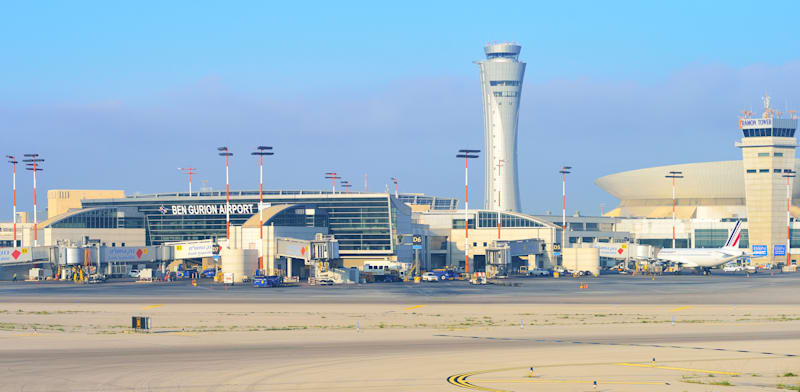
The first two rescue flights landed at Ben Gurion airport this morning – an El Al flight from Athens and an Israir flight from Rome. Later today Arkia and Air Haifa will join the airlift and until Shabbat tomorrow evening flights will continue. At the same time Israir and Arkia will carry on operating flights to Taba and Aqaba.
In the first phase of the opening of Israeli airspace introduced this morning, activity at Ben Gurion Airport is resuming in a very limited and gradual manner. Under the plan, rescue flights will be allowed at this stage only for Israeli airlines, using narrow-body aircraft from nearby destinations and at a rate of one flight per hour. During the next 24 hours, one narrow-body aircraft will be operated every hour, which can carry up to 200 passengers, meaning about 5,000 Israelis will return home. After that, the expansion of activity to two narrow-body aircraft per hour, or alternatively to one wide-body aircraft, is planned.
RELATED ARTICLES
More leaving than entering through Israel’s land borders
Ben Gurion airport set to reopen gradually
Wizz Air operating Sinai flights to rescue stranded Israelis
At this stage, only incoming flights will be allowed, as outgoing flights require a longer security check and a longer stay of the aircraft on the ground, and in the current situation with missiles still targeting Israel, the preference is to reduce the time spent by aircraft at the airport as much as possible.
What is expected next?
The Ministry of Transport decided this morning that from next week and subject to security developments, flights will also be allowed for passengers departing from the country, but only to a limited degree.
The return of foreign airlines to Israel depends, among other things, on the recommendations of the EU Aviation Safety Agency (EASA). If EASA decides to extend the validity of the flight warning (CZIB), foreign airlines, especially European ones, will refrain from resuming operations to and from Israel.
Currently, EASA has extended the validity of the warning until March 6 that applies to a wide range of airspaces in the Middle East, including Israel, Jordan, Iran, the UAE and other countries in the region. As part of the instruction, airlines are told not to operate in these airspaces, due to the risk arising from the military escalation in the region and the possibility of missile firing, interceptions or incorrect identification of aircraft.
Although the directive officially applies only to operators subject to European regulation, in practice many airlines around the world regard EASA’s instructions as an international safety standard. Therefore, EASA also influences decisions of companies that are not directly subject to EU regulation.
Published by Globes, Israel business news – en.globes.co.il – on March 5, 2026.
© Copyright of Globes Publisher Itonut (1983) Ltd., 2026.