No Result
View All Result
SUBMIT YOUR ARTICLES
  • Login
Thursday, January 8, 2026
TheAdviserMagazine.com
  • Home
  • Financial Planning
    • Financial Planning
    • Personal Finance
  • Market Research
    • Business
    • Investing
    • Money
    • Economy
    • Markets
    • Stocks
    • Trading
  • 401k Plans
  • College
  • IRS & Taxes
  • Estate Plans
  • Social Security
  • Medicare
  • Legal
  • Home
  • Financial Planning
    • Financial Planning
    • Personal Finance
  • Market Research
    • Business
    • Investing
    • Money
    • Economy
    • Markets
    • Stocks
    • Trading
  • 401k Plans
  • College
  • IRS & Taxes
  • Estate Plans
  • Social Security
  • Medicare
  • Legal
No Result
View All Result
TheAdviserMagazine.com
No Result
View All Result
Home Market Research Business

Could Venezuela be another Iraq or Afghanistan? Lessons from American statecraft in force and legitimacy

by TheAdviserMagazine
3 days ago
in Business
Reading Time: 6 mins read
A A
Could Venezuela be another Iraq or Afghanistan? Lessons from American statecraft in force and legitimacy
Share on FacebookShare on TwitterShare on LInkedIn


An image circulated over media the weekend of Jan. 3 and 4 was meant to convey dominance: Venezuela’s president, Nicolás Maduro, blindfolded and handcuffed aboard a U.S. naval vessel. Shortly after the operation that seized Maduro and his wife, Cilia Flores, President Donald Trump announced that the United States would now “run” Venezuela until a “safe, proper and judicious transition” could be arranged.

The Trump administration’s move is not an aberration; it reflects a broader trend in U.S. foreign policy I described here some six years ago as “America the Bully.”

Washington increasingly relies on coercion – military, economic and political – not only to deter adversaries but to compel compliance from weaker nations. This may deliver short-term obedience, but it is counterproductive as a strategy for building durable power, which depends on legitimacy and capacity. When coercion is applied to governance, it can harden resistance, narrow diplomatic options and transform local political failures into contests of national pride.

There is no dispute that Maduro’s dictatorship led to Venezuela’s catastrophic collapse. Under his rule, Venezuela’s economy imploded, democratic institutions were hollowed out, criminal networks fused with the state, and millions fled the country – many for the United States.

But removing a leader – even a brutal and incompetent one – is not the same as advancing a legitimate political order.

An image of Venezuelan President Nicolás Maduro after his capture, posted by President Donald Trump and reposted by the White House. White House X.com account

Force doesn’t equal legitimacy

By declaring its intent to govern Venezuela, the United States is creating a governance trap of its own making – one in which external force is mistakenly treated as a substitute for domestic legitimacy.

I write as a scholar of international security, civil wars and U.S. foreign policy, and as author of “Dying by the Sword,” which examines why states repeatedly reach for military solutions, and why such interventions rarely produce durable peace.

The core finding of that research is straightforward: Force can topple rulers, but it cannot generate political authority.

When violence and what I have described elsewhere as “kinetic diplomacy” become a substitute for full spectrum action – which includes diplomacy, economics and what the late political scientist Joseph Nye called “soft power” – it tends to deepen instability rather than resolve it.

More force, less statecraft

The Venezuela episode reflects this broader shift in how the United States uses its power. My co-author Sidita Kushi and I document this by analyzing detailed data from the new Military Intervention Project. We show that since the end of the Cold War, the United States has sharply increased the frequency of military interventions while systematically underinvesting in diplomacy and other tools of statecraft.

One striking feature of the trends we uncover is that if Americans tended to justify excessive military intervention during the Cold War between 1945–1989 due to the perception that the Soviet Union was an existential threat, what we would expect is far fewer military interventions following the Soviet Union’s 1991 collapse. That has not happened.

Even more striking, the mission profile has changed. Interventions that once aimed at short-term stabilization now routinely expand into prolonged governance and security management, as they did in both Iraq after 2003 and Afghanistan after 2001.

This pattern is reinforced by institutional imbalance. In 2026, for every single dollar the United States invests in the diplomatic “scalpel” of the State Department to prevent conflict, it allocates US$28 to the military “hammer” of the Department of Defense, effectively ensuring that force becomes a first rather than last resort.

“Kinetic diplomacy” – in the Venezuela case, regime change by force – becomes the default not because it is more effective, but because it is the only tool of statecraft immediately available. On Jan. 4, Trump told the Atlantic magazine that if Delcy Rodríguez, the acting leader of Venezuela, “doesn’t do what’s right, she is going to pay a very big price, probably bigger than Maduro.”

Lessons from Afghanistan, Iraq and Libya

The consequences of this imbalance are visible across the past quarter-century.

In Afghanistan, the U.S.-led attempt to engineer authority built on external force alone proved brittle by its very nature. The U.S. had invaded Afghanistan in 2001 to topple the Taliban regime, deemed responsible for the 9/11 terrorist attacks. But the subsequent two decades of foreign-backed state-building collapsed almost instantly once U.S. forces withdrew in 2021. No amount of reconstruction spending could compensate for the absence of a political order rooted in domestic consent.

Following the invasion by the U.S. and surrender of Iraq’s armed forces in 2003, both the U.S. Department of State and the Department of Defense proposed plans for Iraq’s transition to a stable democratic nation. President George W. Bush gave the nod to the Defense Department’s plan.

That plan, unlike the State Department’s, ignored key cultural, social and historical conditions. Instead, it proposed an approach that assumed a credible threat to use coercion, supplemented by private contractors, would prove sufficient to lead to a rapid and effective transition to a democratic Iraq. The United States became responsible not only for security, but also for electricity, water, jobs and political reconciliation – tasks no foreign power can perform without becoming, as the United States did, an object of resistance.

Libya demonstrated a different failure mode. There, intervention by a U.S.-backed NATO force in 2011 and removal of dictator Moammar Gadhafi and his regime were not followed by governance at all. The result was civil war, fragmentation, militia rule and a prolonged struggle over sovereignty and economic development that continues today.

The common thread across all three cases is hubris: the belief that American management – either limited or oppressive – could replace political legitimacy.

Venezuela’s infrastructure is already in ruins. If the United States assumes responsibility for governance, it will be blamed for every blackout, every food shortage and every bureaucratic failure. The liberator will quickly become the occupier.
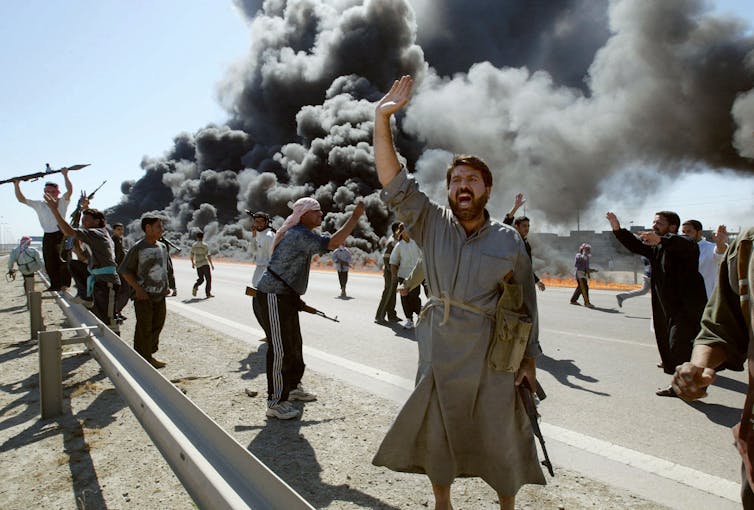
Men carrying guns and celebrating, with huge black clouds behind them.

Iraqi Sunni Muslim insurgents celebrate in front of a burning U.S. convoy they attacked earlier on April 8, 2004, on the outskirts of the flashpoint town of Fallujah. Karim Sahib, AFP/Getty Images

Costs of ‘running’ a country

Taking on governance in Venezuela would also carry broader strategic costs, even if those costs are not the primary reason the strategy would fail.

A military attack followed by foreign administration is a combination that undermines the principles of sovereignty and nonintervention that underpin the international order the United States claims to support. It complicates alliance diplomacy by forcing partners to reconcile U.S. actions with the very rules they are trying to defend elsewhere.

The United States has historically been strongest when it anchored an open sphere built on collaboration with allies, shared rules and voluntary alignment. Launching a military operation and then assuming responsibility for governance shifts Washington toward a closed, coercive model of power – one that relies on force to establish authority and is prohibitively costly to sustain over time.

These signals are read not only in Berlin, London and Paris. They are watched closely in Taipei, Tokyo and Seoul — and just as carefully in Beijing and Moscow.

When the United States attacks a sovereign state and then claims the right to administer it, it weakens its ability to contest rival arguments that force alone, rather than legitimacy, determines political authority.

Beijing needs only to point to U.S. behavior to argue that great powers rule as they please where they can – an argument that can justify the takeover of Taiwan. Moscow, likewise, can cite such precedent to justify the use of force in its near abroad and not just in Ukraine.

This matters in practice, not theory. The more the United States normalizes unilateral governance, the easier it becomes for rivals to dismiss American appeals to sovereignty as selective and self-serving, and the more difficult it becomes for allies to justify their ties to the U.S.

That erosion of credibility does not produce dramatic rupture, but it steadily narrows the space for cooperation over time and the advancement of U.S. interests and capabilities.

Force is fast. Legitimacy is slow. But legitimacy is the only currency that buys durable peace and stability – both of which remain enduring U.S. interests.

If Washington governs by force in Venezuela, it will repeat the failures of Afghanistan, Iraq and Libya: Power can topple regimes, but it cannot create political authority. Outside rule invites resistance, not stability.

Monica Duffy Toft, Professor of International Politics and Director of the Center for Strategic Studies, The Fletcher School, Tufts University

This article is republished from The Conversation under a Creative Commons license. Read the original article.

The Conversation

This story was originally featured on Fortune.com


Source link

Tags: AfghanistanAmericanforceIraqLegitimacyLessonsStatecraftVenezuela
ShareTweetShare
Previous Post

BoI Governor slams gov’t efforts to reduce cost of living

Next Post

The Great Wealth Transfer: Why Now Is the Time to Get Your Estate Plan in Order

Related Posts

edit post
Gurmeet Chadha warns of systemic market risks from ‘source-based news’. Suggests remedy to tackle ‘disinformation’

Gurmeet Chadha warns of systemic market risks from ‘source-based news’. Suggests remedy to tackle ‘disinformation’

by TheAdviserMagazine
January 8, 2026
0

Market veteran Gurmeet Chadha has raised concerns over the growing spread of unverified or source-based news, especially on expiry days,...

edit post
Tony Robbins went from being a janitor making  a week to a billionaire—now he’s sharing the 3 success skills Gen Z needs in today’s job market

Tony Robbins went from being a janitor making $40 a week to a billionaire—now he’s sharing the 3 success skills Gen Z needs in today’s job market

by TheAdviserMagazine
January 8, 2026
0

Tony Robbins knows that feeling well. Long before he became a self-made billionaire, best-selling author, and one of the world’s...

edit post
Taaleri SolarWind III Fund commitments reach 6m at final close

Taaleri SolarWind III Fund commitments reach $736m at final close

by TheAdviserMagazine
January 8, 2026
0

The Taaleri SolarWind III Fund commitments have reached a final close of €630m ($736.28m), including €74m in co-investment commitments, marking...

edit post
Hailo cuts 10% of workforce

Hailo cuts 10% of workforce

by TheAdviserMagazine
January 8, 2026
0

Israeli chip company Hailo, which develops dedicated processors for running AI applications on smart edge devices, is currently streamlining...

edit post
Crystal Ball: What 2026 holds for cybersecurity, healthcare, robotics, and more

Crystal Ball: What 2026 holds for cybersecurity, healthcare, robotics, and more

by TheAdviserMagazine
January 8, 2026
0

As our Crystal Ball series continues, it’s time to drill down into specific sectors.  Term Sheet readers, generally speaking, are...

edit post
Sebi notifies revamped stock brokers’ rules as part of ease of doing business

Sebi notifies revamped stock brokers’ rules as part of ease of doing business

by TheAdviserMagazine
January 8, 2026
0

Capital markets regulator Securities and Exchange Board of India (Sebi) on Thursday allowed stock brokers to undertake activities under the...

Next Post
edit post
The Great Wealth Transfer: Why Now Is the Time to Get Your Estate Plan in Order

The Great Wealth Transfer: Why Now Is the Time to Get Your Estate Plan in Order

edit post
Intel Stock Just Surged Through Its 50-, 20-Day Moving Averages. Should You Buy INTC Here?

Intel Stock Just Surged Through Its 50-, 20-Day Moving Averages. Should You Buy INTC Here?

  • Trending
  • Comments
  • Latest
edit post
80-year-old Home Depot rival shuts down location, no bankruptcy

80-year-old Home Depot rival shuts down location, no bankruptcy

January 4, 2026
edit post
In an Ohio Suburb, Sprawl Is Being Transformed Into Walkable Neighborhoods

In an Ohio Suburb, Sprawl Is Being Transformed Into Walkable Neighborhoods

December 14, 2025
edit post
Democrats Insist On Taxing Tips        

Democrats Insist On Taxing Tips        

December 15, 2025
edit post
How Long is a Last Will and Testament Valid in North Carolina?

How Long is a Last Will and Testament Valid in North Carolina?

December 8, 2025
edit post
Detroit Seniors Are Facing Earlier Shutoff Notices This Season

Detroit Seniors Are Facing Earlier Shutoff Notices This Season

December 20, 2025
edit post
Warren Buffett retires on December 31 and leaves behind a manual for a life in investing

Warren Buffett retires on December 31 and leaves behind a manual for a life in investing

December 27, 2025
edit post
New car payments just hit a record high. Here’s what you should be spending.

New car payments just hit a record high. Here’s what you should be spending.

0
edit post
Rental Investors Become the Most Bullish in Years

Rental Investors Become the Most Bullish in Years

0
edit post
Apple Cardholders: Here’s What to Know as Chase Aims to Take Over

Apple Cardholders: Here’s What to Know as Chase Aims to Take Over

0
edit post
Gurmeet Chadha warns of systemic market risks from ‘source-based news’. Suggests remedy to tackle ‘disinformation’

Gurmeet Chadha warns of systemic market risks from ‘source-based news’. Suggests remedy to tackle ‘disinformation’

0
edit post
Chart of the Week: The Market Has Split in Two

Chart of the Week: The Market Has Split in Two

0
edit post
Tony Robbins went from being a janitor making  a week to a billionaire—now he’s sharing the 3 success skills Gen Z needs in today’s job market

Tony Robbins went from being a janitor making $40 a week to a billionaire—now he’s sharing the 3 success skills Gen Z needs in today’s job market

0
edit post
Chart of the Week: The Market Has Split in Two

Chart of the Week: The Market Has Split in Two

January 8, 2026
edit post
Gurmeet Chadha warns of systemic market risks from ‘source-based news’. Suggests remedy to tackle ‘disinformation’

Gurmeet Chadha warns of systemic market risks from ‘source-based news’. Suggests remedy to tackle ‘disinformation’

January 8, 2026
edit post
Trade deficit in October hits smallest since 2009 after Trump’s tariff moves

Trade deficit in October hits smallest since 2009 after Trump’s tariff moves

January 8, 2026
edit post
Tony Robbins went from being a janitor making  a week to a billionaire—now he’s sharing the 3 success skills Gen Z needs in today’s job market

Tony Robbins went from being a janitor making $40 a week to a billionaire—now he’s sharing the 3 success skills Gen Z needs in today’s job market

January 8, 2026
edit post
Apple Cardholders: Here’s What to Know as Chase Aims to Take Over

Apple Cardholders: Here’s What to Know as Chase Aims to Take Over

January 8, 2026
edit post
9 Undervalued Dividend Aristocrats to Buy Now for Reliable Passive Income

9 Undervalued Dividend Aristocrats to Buy Now for Reliable Passive Income

January 8, 2026
The Adviser Magazine

The first and only national digital and print magazine that connects individuals, families, and businesses to Fee-Only financial advisers, accountants, attorneys and college guidance counselors.

CATEGORIES

  • 401k Plans
  • Business
  • College
  • Cryptocurrency
  • Economy
  • Estate Plans
  • Financial Planning
  • Investing
  • IRS & Taxes
  • Legal
  • Market Analysis
  • Markets
  • Medicare
  • Money
  • Personal Finance
  • Social Security
  • Startups
  • Stock Market
  • Trading

LATEST UPDATES

  • Chart of the Week: The Market Has Split in Two
  • Gurmeet Chadha warns of systemic market risks from ‘source-based news’. Suggests remedy to tackle ‘disinformation’
  • Trade deficit in October hits smallest since 2009 after Trump’s tariff moves
  • Our Great Privacy Policy
  • Terms of Use, Legal Notices & Disclosures
  • Contact us
  • About Us

© Copyright 2024 All Rights Reserved
See articles for original source and related links to external sites.

Welcome Back!

Login to your account below

Forgotten Password?

Retrieve your password

Please enter your username or email address to reset your password.

Log In
No Result
View All Result
  • Home
  • Financial Planning
    • Financial Planning
    • Personal Finance
  • Market Research
    • Business
    • Investing
    • Money
    • Economy
    • Markets
    • Stocks
    • Trading
  • 401k Plans
  • College
  • IRS & Taxes
  • Estate Plans
  • Social Security
  • Medicare
  • Legal

© Copyright 2024 All Rights Reserved
See articles for original source and related links to external sites.