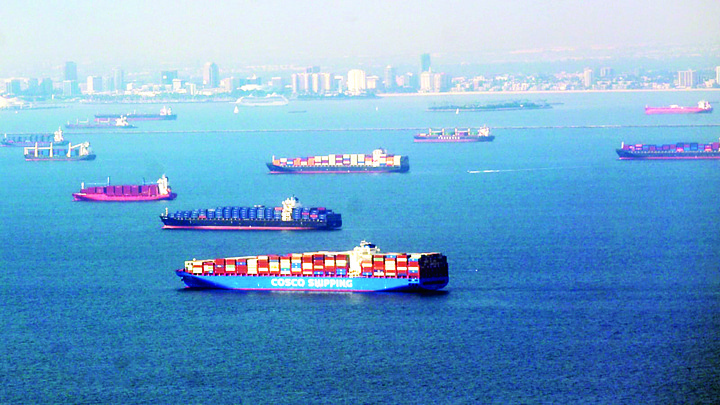
Almost every major capital spending boom during the past 200 years has ended in bankruptcies, consolidations, and tears—but also wins for the victors.
The late 1990s buildout of fiber-optic networks, in which companies spent billions to pull dark fiber across continents and under oceans, saw borrowers like WorldCom, Global Crossing, and others go under. The shale revolution that prompted U.S. oil and gas companies to issue $350 billion in debt to fund drilling led to hundreds of bankruptcies after oil prices swooned in 2014 and 2015. Going back even further to the early 1900s, the widespread adoption of electric power led to a buildout that saw roughly half of the 3,000 small utilities and power companies that existed either disappear or get sold during a brutal decade of consolidation. In each case, there were also long-term victors who inherited infrastructure and reaped the benefits of these expansions in the form of lower-cost bandwidth, cheaper consumer prices, and large manufacturers that consolidated the power grid.
Now, it’s AI’s turn.
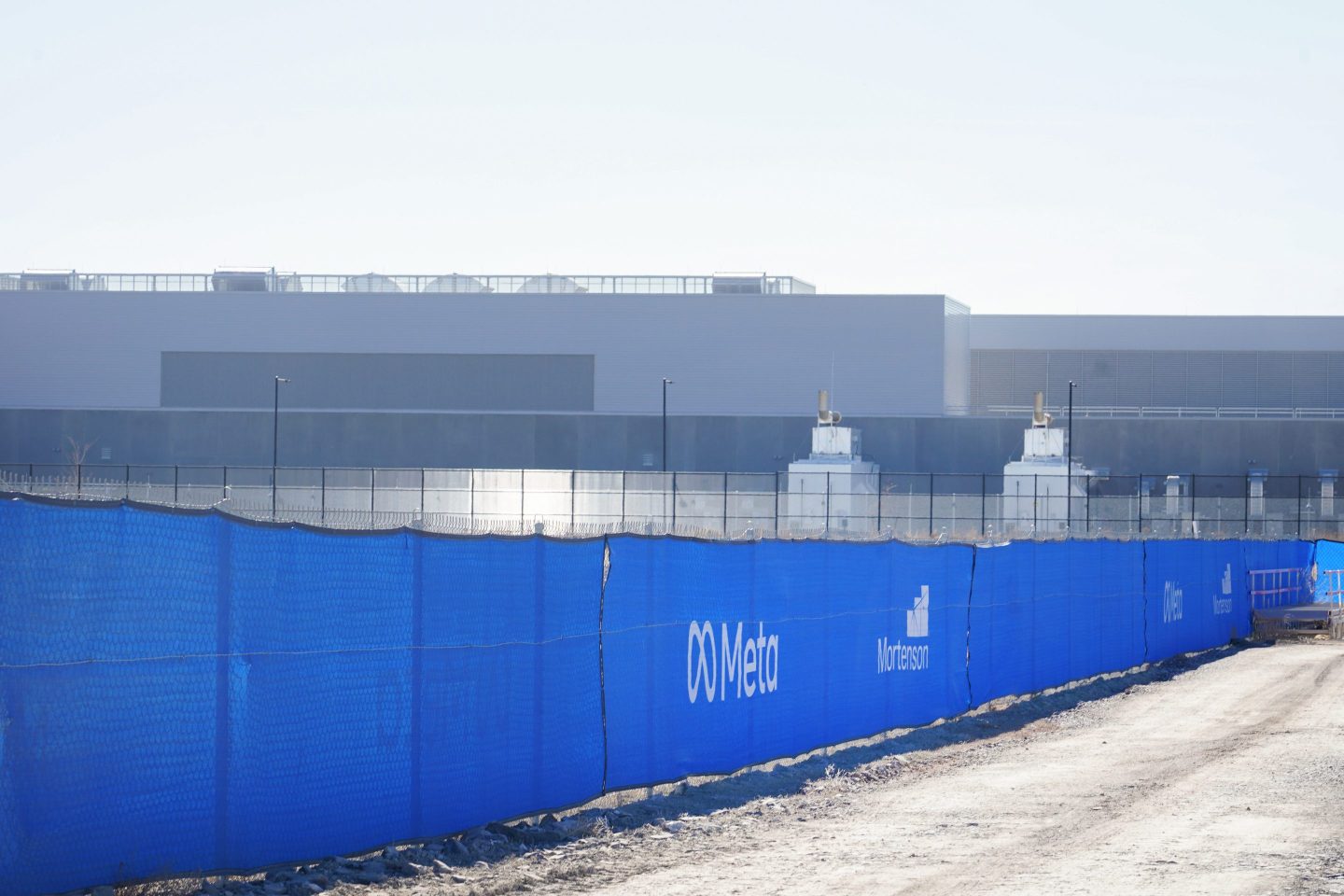
The artificial intelligence buildout is being driven primarily by five hyperscalers—Alphabet, Amazon, Meta, Microsoft, and Oracle—and has effectively become a capital-expenditure sprint with an eventual price tag expected to be in the trillions, most of it committed to constructing the massive data centers and cloud infrastructure AI requires. The fab five have thus far made total commitments of $969 billion, with more than two thirds, $662 billion, planned for data center-related leases yet to start, according to a Moody’s analysis published last month. Much of the buildout is being paid for with operating cash flows, but the sheer magnitude of the spending has prompted companies to shake up the calculus by bridging the gap between capex and free cash flow with bonds.
In 2025, Alphabet, Amazon, Oracle, Meta and Microsoft issued about $121 billion in new debt via bonds, compared to $40 billion in 2020. And the pace is not expected to slow down anytime soon: Wall Street estimates show the AI-related bond supply could be in the range of $100 billion to $300 billion this year. Over the next three to five years, total data center investment could run $1.5 trillion to $3 trillion, according to some analyses.
ANDREW CABALLERO-REYNOLDS / AFP) (Photo by ANDREW CABALLERO-REYNOLDS/AFP via Getty Images
The trend is already changing the stakes for businesses that have traditionally had no need to borrow, introducing a new layer of stakeholders, obligations, and risks that are transforming how internet companies operate and how they are valued by investors. Bond investors, unlike equity investors, don’t seek out unlimited upside, they focus on being compensated fairly for taking on risks, including those related to overinvestment that leads to a glut in supply.
“Any kind of large capital expenditure cycle that we have seen over history at some point leads to the risk of overinvestment,” said Mohit Mittal, chief investment officer of core strategies at global bond fund manager Pimco, which has about $2.3 trillion in assets under management. “There may be some form of over investment over the next two years that leads to a correction or a growth slowdown.”
The debt-fueled AI buildout also changes the financial profile for some internet companies. “In an asset-light model, you tend to have higher equity multiples, and in an asset-rich model, you have multiples that are a little lower,” Mittal said.
Investing for the long run
A flurry of deals at the end of 2025 saw Alphabet, Oracle, and Meta sell more than $70 billion in bonds over the course of weeks. That was in an overall investment-grade bond market that saw nearly half a trillion flow into taxable bond funds last year with foreign investors picking up about $304 billion in U.S. corporate bonds, according to asset manager Breckinridge Capital.
Kevin SigRist, chief investment officer of the $143 billion North Carolina pension system and a significant long-duration corporate bond buyer, said the yields for the hyperscalers’ bonds are near 5%, which is attractive on its own before factoring in the strong balance sheets and corporate profitability.
Yet, SigRist says the NC pension system remains generally underweight the sector relative to benchmark.“ The issue for us is the spreads are very, very tight,” he said. “And as you go longer, there’s not much of a yield pickup at all.” Still, the hyperscalers appear to be attractive to the two traditional buyers of ultra-long maturity bonds: corporate pension funds and life insurance companies.
That pool of demand is ideally suited for hyperscalers with top credit ratings (four of the five hyperscalers carry credit ratings on the investment-grade elite spectrum) and bonds stretching 30 or 40 years into the future. In February, Alphabet even issued a rare 100-year bond, becoming the first tech company to do so in decades. More details about the buyers of these bonds will be revealed in the spring and later this year, when investors publish disclosures, but SigRist expects the wave of issuances to be well absorbed in 2026, much like it was in 2025.
“The fact that investors are comfortable taking down 30-and 40-year debt, in some cases 100-year debt, certainly suggests that investors are very comfortable that this is a balanced risk-reward opportunity,” says Anders Persson, chief investment officer and global head of fixed income at $1.4 trillion manager Nuveen.
In the case of Alphabet, for instance, long-term debt jumped from $10.9 billion at the end of 2024 to $46.5 billion at the end of 2025, but its total cash at the end of 2025 was $126.8 billion. Measuring total obligations to market cap of about $3.6 trillion, you get about 3.4%, meaning the obligations are just above 3% of the company’s market cap, even in a conservative scenario where total obligations include future, not-yet-commenced leases.
George Frey/Bloomberg via Getty Images
‘It’s different this time’
Nuveen’s Persson, who was a tech analyst during the dot-com era on fixed income, has the benefit of hindsight as he assesses the current situation. Most of the issuers back then had no free cash flow and in some cases, no revenue.
“It truly was a bubble that ended up bursting because this was, at the time, a brand new kind of opportunity, and the issuers that came to market were basically startup companies,” Persson said.
It’s a world away from the likes of Alphabet, Microsoft, Amazon and Meta, which are sitting on balance sheets built like fortresses, and until the recently announced capex spike for 2026, were generating strong free cash flows. Even a significant misallocation of capital wouldn’t threaten the solvency of companies with the financial profiles of Alphabet or Microsoft.
“It’s different this time, which is obviously a bit of a cliché, but for now at least, this is being approached quite prudently,” said Persson.
Among the five hyperscalers, Oracle is the outlier with a Baa2 credit rating, which is just two rungs above so-called junk bond territory. Typically, the lower the rating, the greater the probability of default and the more yield bond issuers have to offer to attract buyers. Essentially, credit investors want to be paid more to own the risk of a company like Oracle versus Alphabet or Microsoft.
Oracle has already leaned in on debt, relative to the other hyperescalers. The company has disclosed more than $248 billion of not-yet-commenced data-center lease commitments and it has borrowings of about $124 billion. Last year, Oracle issued $25.8 billion in notes with maturities dating to 2065 and last month pledged to raise $45 billion to $50 billion more this year, split between debt issuance and equity. On Thursday, Bloomberg reported that Oracle was planning to layoff thousands of employees as it grapples with a cash crunch to finance its data center build out. Oracle declined to comment.
The FOMO factor
One problem with these mammoth capital cycles is that they create their own momentum with competitors following each other into larger and larger investments because the cost of being wrong models out smaller than the cost of being left behind if it all succeeds as planned. The looming risk is in the aggregate however, as history almost always shows that more gets built than the market can immediately absorb.
James Manning/PA Images via Getty Images
Credit rating service Moody’s warned investors in February that on-balance sheet debt as well as economic debt related to not-yet-begun leases should be on investors’ radar as they think about risk. For instance, Alphabet and Meta, which carry Aa2 and Aa3 ratings, had to pay 10-15 basis point premiums over their existing debt to get their deals done, an analysis from Janus Henderson notes.
“The pricing reflects both the scale of their ambitions and the market’s cautious stance on the amount of debt likely coming to the capital markets in 2026 and 2027,” the Janus Henderson authors noted. “In short, while debt is a more attractive financing source for hyperscalers, and credit investors remain willing to fund the AI revolution through numerous vehicles, relative compensation is required.”
Indeed, for Persson, the Nuveem chief investment officer, the question isn’t whether there’s too much risk associated with buying the data center debt, it’s whether the bonds those companies are issuing to fund the buildout are priced to compensate investors for the full range of risks they’re taking on in a $969 billion commitment wave.
Across the five hyperscalers, on-balance sheet debt is roughly $420 billion. The larger commitments live in the leases, including those yet to commence. Under the accounting rulebook known as GAAP, a lease commitment only winds up on the balance sheet as a liability if a company is “reasonably certain” to renew the lease, Moody’s noted. Much of that information lives in footnotes in financial filings, but bond fund managers are taking it all into account.
On a gross basis without leases, hyperscaler leverage is marginally low, and they had more cash than debt as of 2025 year-end. Add in the leases and the figure is still low, but it’s less low than it was and it’s the first blush of something that could bloom into a concern.
“We are incorporating these obligations and making those adjustments, particularly given the size of the leases and their growth potential,” Persson said. “Because ultimately, in our mind, these are commitments that they have to honor. We have to effectively view them as debt when we’re reviewing the credit quality of these companies.”
And the fear factor is real in assessing the risk scenario and the debt the companies are taking on in issuing bonds. There’s economic debt versus balance-sheet debt to contend with, the shift from an asset-light model to an asset-heavy model, and the risk that this surge in spending won’t translate into revenues—or they won’t translate into revenues fast enough. The stock market appears to be moving on a hair-trigger any time there’s a spark of AI-related news, which means every quarter is a bit of a guessing game in terms of how stocks will respond.
Ultimately, the companies leading the buildout have balance sheets that are likely strong enough to survive it if they get it wrong, unlike the shale bust, the fiber glut, and the vanishing of thousands of utilities. But we won’t know until after it’s already happened.
“You only find out after the fact,” said Pimco’s Mittal. If you start to see it ahead of time, then others see it too, and investment starts to slow down on its own.
“Every company will be quite different,” Mittal said. “There will be winners and losers in this environment.