In early 2021, an army of retail traders made massive bets on meme stocks and briefly melted down the market. Trading volume swelled to such a huge extent that popular brokerage Robinhood had to halt buy orders for stocks like GameStop for a few days in order to escape a liquidity crisis. At the time, the situation led to claims of a conspiracy, but the reason for the meltdown was more mundane: Wall Street’s creaky infrastructure could not settle trades fast enough.
Robinhood CEO Vlad Tenev and others called for an overhaul, and since then there has already been progress, as stock trades now settle a day sooner than in 2021. But the financial industry is also pushing ahead with a more radical solution: turning stocks into digital assets that can be traded and settled instantly on a blockchain.
It is not just crypto firms and fintech players leading this charge for “tokenization.” Big banks like J.P. Morgan are also using blockchains to facilitate trades in certain assets and, in doing so, transforming the financial ecosystem more broadly. Already, tokenization—which Tenev has described as a “freight train” poised to eat Wall Street—has brought fundamental changes to how stocks and other assets are traded.
The potential upsides to tokenization are huge, but significant questions remain over how to implement it. Meanwhile, some fear the coming train could undermine some protections for individual “retail” investors and destabilize a U.S. equities market whose reliability has for decades been the envy of the world.
The tokenization wave isn’t the first push to overhaul Wall Street’s under-the-hood operations. In the 1970s, traders confronted what became known as the “paperwork crisis,” which saw stock markets, drowning in orders, shut down mid-week simply to keep up with recordkeeping. Repeated work stoppages finally led to a computer-based solution.
“Once upon a time there were leather-bound journals that said who owns all the stock,” explains Robert Leshner, a former economist who now runs the tokenization firm Superstate. “Then, people said, ‘This is too hard, let’s not update anymore,’ so they decided to create a legal fiction that assigned ownership of all the stock to the Depository Trust & Clearing Corporation,” or DTCC.
The DTCC regime, which has been in place for decades, means it’s no longer necessary to record every single share transfer. Instead, the clearinghouse keeps track of the stock held by different brokerages on behalf of their customers and settles up transactions between those brokerages the next business day.
Under this system, the brokerages nominally own the stock, but all the rights that attach to it—dividends, voting privileges, and so on—remain with the customers. The system has worked pretty well over the decades, and for those who insist on doing things the old-fashioned way, DTCC means they can still demand physical copies of their shares. (This option is popular with “GameStop truthers,” who believe reverting to paper will thwart a Wall Street conspiracy against retail investors.)
Now, though, the current DTCC system of “T+1”—in which the clearinghouse closes out trades the next business day by reconciling accounts among brokerages—has come to feel outdated in an age when so much business is conducted instantly and around the clock. This has prompted companies like Leshner’s Superstate to offer a faster alternative. The startup is working with companies to issue versions of their shares that trade on a blockchain, an arrangement under which the firms don’t have to rely on intermediaries to hold or track their stock. It also means stock trades can be settled instantly, while allowing firms to interact with their shareholders more directly.
Outside the U.S., tokenized assets are already helping investors avoid big trading commissions and invest in private companies like SpaceX
Other firms are approaching tokenization in a different fashion. Robinhood, for example, doesn’t help firms tokenize their stocks, but instead takes stocks available on the open market and offers them in a blockchain “wrapper” as a sort of derivative. These offerings are currently available only in Europe, where stock owners can buy and sell the “Stock Tokens” alongside assets like Bitcoin.
Retail investors unfamiliar with tokenization may be surprised, and possibly alarmed, to discover that a company they own is trading in the crypto-verse. For now, at least, it’s not something to worry about.Currently, even tokenization boosters say the new blockchain system will exist alongside the old one rather than replace it. So why do all this in the first place?
For the average investor who trades only from time to time, the arrival of tokenized assets won’t mean much. Active traders, though, will appreciate the move to blockchain, since it opens the door for more trading after hours and on weekends. The new regime will also be appealing to institutional investors, since it will free up collateral that might otherwise be tied up waiting for settlement.
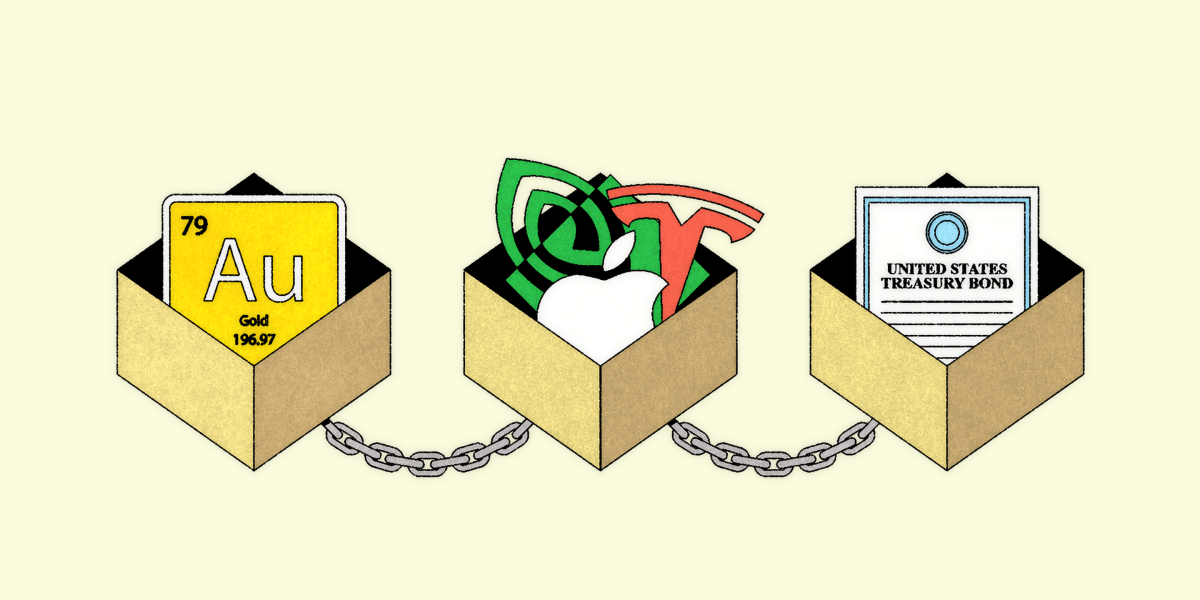
“Imagine you’re a hedge fund and want to buy $1 million of Tesla stock,” says Johann Kerbrat, SVP of Robinhood Crypto. “You buy it on Friday, so you don’t have the money anymore, but you don’t get the shares in your account until Monday. So for three days, you can’t do anything.” It’s not just stocks being tokenized. BlackRock’s BUIDL fund, working with Superstate’s tokenization rival Securitize, offers access to money-market funds and U.S. Treasuries via blockchain, and has already grown to $2 billion in assets under management. Meanwhile,J.P. Morgan is offering tokenized versions of private equity assets on its in-house Kinexys blockchain, in part because the process makes capital calls easier to track and manage.
This is likely just the beginning. Rob Hadick, a partner at venture capital firm Dragonfly Capital, notes that other realms of finance like credit and fixed income are still conducted primarily in pre-digital fashion, with some transactions still made official by means of a fax. A switch to tokenization could enable such transactions to settle faster and more reliably. Hadick says it will also produce savings for banks and brokerages since it will reduce the ranks of back-office staff and disrupt specialized middlemen who handle tasks like loan origination and servicing fees. Meanwhile, for traders of all sorts, tokenized assets will be easier to move across brokerages or post as collateral.
It is still early days, especially in the U.S., where the Securities and Exchange Commission has yet to give the green light to tokenized equities. As of mid-November, the total value of such assets worldwide was about $660 million, according to research site RWA.xyz; the most popular ones include tokenized versions of index-tracking ETFs and Big Tech stocks such as Tesla, Nvidia, and Alphabet.
But that nascent state hasn’t stopped brokerages from pushing forward, including crypto shop Kraken, whose tokenized versions of select U.S. stocks are doing a brisk trade in markets like Brazil and South Africa, where traders still pay hefty commissions that can amount to 10% or more, even as such fees have largely been eliminated in the U.S. Robinhood, meanwhile, got its hands on shares of privately held OpenAI and SpaceX, and has given away tokenized versions of them to European customers.
As for the DTCC, it would be easy to assume the clearinghouse opposes the tokenization wave. Quite the opposite: According to two sources familiar with the company, the outfit is eager to move into blockchain, partly because it offers a potential way to expand into private markets. Asked for comment, the DTCC did not provide details but did suggest it is embracing the technology.
“DTCC believes in the power and potential of tokenization to evolve and modernize market infrastructure. We are actively working to enable capabilities that further our products and services,” said Brian Steele, DTCC’s president of clearing and securities services.
Not everyone is convinced a rush to tokenization is a good thing. Those urging caution include Citadel Securities, which has asked the SEC to adopt a go-slow approach. According to a source close to the firm, the trading giant fears that some crypto-aligned firms want to use the rulemaking process around tokenization to gain exemptions from long-standing consumer protection obligations. The person also expressed concern that a rapid shift could undermine trust in a U.S. equities market that is the biggest in the world and has been fine-tuned for decades.
This concern may not be unfounded. Already, there have been notable discrepancies between the prices of traditional shares of a company’s stock and the prices of tokenized versions offered by the likes of Kraken. Meanwhile, it’s unclear if every firm offering tokenized equities has put in place adequate guardrails when it comes to custody and fiduciary obligations to the customer. What happens, for instance, in the event of a crypto firm going bankrupt while holding tokenized shares of a customer’s stock?
And while every financial institution appears to view blockchain as the technology of the future, they may not agree as to which blockchain. Robinhood, among others, is relying on the open-source Ethereum chain to build out its tokenization business, while J.P. Morgan appears wedded to its own proprietary chain. According to Hadick, the venture capitalist, this situation could slow adoption, since, he says, other big firms like Goldman Sachs will be reluctant to rely on a blockchain controlled by a rival.
Hadick adds, though, that any impasse is unlikely to last long, since “one thing blockchains do well is coordinate trust.”
This article appears in the December 2025/January 2026 issue of Fortune with the headline: “Get ready to own a tokenized portfolio.”