We sometimes talk about stress in the abstract: law practice is “stressful.” True, but exactly what is stressful about it? Stress varies based on the type of legal work we do every day. Your matter mix—the blend of litigation, compliance, transactions, or advisory work—shapes how your body breathes, braces, reacts and rests. Here’s how to counterbalance legal practice stress patterns.
How Your Matter Mix Affects Your Nervous System
Over time, your work trains your nervous system to adapt to your professional environment. That adaptation is exactly what our bodies are supposed to do to help us survive.
Unfortunately, the survival adaptation to continual stressors can have negative effects on our physiology, especially if we don’t recognize how our work is training our nervous systems. That’s why it’s important to understand the patterns our bodies are building in response to our specific work. Then, we can take effective steps to manage stress so we can remain physically and mentally healthy.
1. Adversarial Litigation: The Fight Response on Repeat
Litigation trains us to anticipate opposition. We prepare for attack, sharpen arguments, and search for weaknesses in the other side’s case. Depositions, cross-examinations, oral arguments, and contentious negotiations all require us to stay alert and ready to respond. Even when we appear calm, our bodies are rehearsing confrontation.
Physiologically, this maps closely onto sympathetic activation: the fight response. Shoulders lift. The jaw tightens. Breath becomes shallow. Your heart rate rises slightly before a difficult call or hearing. You scan for threats and prepare a rebuttal before the other person finishes speaking. Over time, this becomes baseline. Hypervigilance feels like competence. Being ready feels like safety.
Your body forgets how to fully power down because powering down feels vulnerable.
The cost is mental and physical exhaustion. But that’s not all. Conflict at work can bleed into your tone at home. Rest can start to feel unproductive, even unsafe, as if you should be preparing for the next round. Quiet moments may trigger mental rehearsals of arguments or replay past exchanges, keeping your body braced long after the conflict has ended.
What to Do to Counter Fight-Mode Stress: From Fight to Intentional Recovery
We cannot remove intensity from litigation. The work requires activation. What we can do is engage in deliberate downshifting. After a deposition, mediation or hearing, create transition time—even 10 or 15 minutes—to walk, breathe deeply or physically discharge the adrenaline spike. Strength training, brisk walking, or any activity that metabolizes stress hormones can help the body calm down and reset.
Equally important is signaling safety to your body. Lengthening your exhale, unclenching your jaw and lowering your shoulders—these are small interventions, but repeated consistently can retrain the nervous system to exit fight mode.
If our work repeatedly trains activation, we must intentionally allow for recovery.
2. Regulatory Compliance: The Freeze-and-Hold Pattern
Not all stress is loud. Regulatory and compliance work often demands sustained precision and error avoidance. We review filings, analyze records, draft language that must withstand scrutiny, and anticipate institutional consequences.
The pressure is less about open conflict and more about getting it right.
This creates a different physiological profile. Instead of overt fight activation, many compliance-focused lawyers live in a subtle holding pattern. Muscles brace without visible movement. Breath becomes shallow but steady. The nervous system narrows its focus and locks in. This resembles a controlled form of freeze — not collapse, but containment. The body holds.
Because this stress is quiet, it can go unnoticed. Perfectionism becomes virtue. Vigilance becomes identity. Being “the careful one” is rewarded. Yet chronic holding carries a cost: neck and upper back tension that never quite resolves, digestive disruption, mental looping, and fatigue that may feel disproportionate to the day’s physical demands.
What to Do to Counter the Hold-and-Contain Pattern: From Freeze to Release
The antidote to chronic containment is interruption and release. Schedule movement breaks between document reviews. Stand up. Shake out your arms. Stretch your jaw and neck. Take a full exhale before beginning the next section of a draft. These actions may seem small, but they directly counter the bracing response.
It also helps to externalize vigilance. Checklists, structured review systems, and clearly defined stopping points reduce the sense that your nervous system alone must hold all potential risk. When your work demands sustained precision, you must deliberately practice physical and cognitive release.
3. Transactional Deadlines: The Sprint-and-Crash Cycle
Transactional practice often runs on cycles. There are quieter preparation periods followed by intense closing phases marked by late nights, compressed timelines, and rapid decision-making. As deadlines approach, urgency spikes. Focus sharpens. Sleep shortens. Caffeine increases.
This pattern produces a surge-and-depletion rhythm. Cortisol rises before key milestones as the body mobilizes. After the deal closes, there is often a crash—fatigue, emotional flatness, or irritability. Over time, the nervous system can become conditioned to urgency. Calm periods feel uncomfortable. Without a looming deadline, motivation dips because the body has learned that intensity equals productivity.
The risk to the body from this cycle is cumulative depletion. Repeated sleep disruption and adrenaline spikes erode baseline resilience and make it harder to recover between cycles.
What to Do to Counter the Sprint-and-Crash Cycle: From Intensity to Restoration
We can’t change the cyclical nature of transactional work, but we can counter the intensity of the deal process with intentional restoration — before, during and after the closing.
Before anticipated crunch periods, prioritize sleep, protein and hydration as much as possible.
During crunch time, identify at least one non-negotiable anchor habit that remains intact. This could be something as simple as a short daily walk, a consistent bedtime routine, a daily five-minute meditation or a brief morning workout.
After major deadlines or closings, schedule recovery intentionally. Try to craft days with a lighter workload. Reduce cognitive burden. Get extra sleep. Spend time outside.
When your practice is cyclical, you must integrate restoration throughout that cycle.
4. Advisory and Leadership Roles: ‘The Responsible One’ Pattern
In advisory, in-house and leadership roles, stress can arise because we are the ones others rely on to assess risk, anticipate fallout and make measured decisions. We absorb other people’s urgency and metabolize it into calm guidance. On the surface, we may appear steady. Internally, there is constant calculation.
This role trains chronic responsibility. The nervous system remains subtly alert because you are holding complexity and anticipating consequences. Even outside formal work hours, your mind may rehearse future scenarios or revisit prior decisions. Over time, being “the responsible one” stops feeling like a role and starts feeling like a state of being.
Responsibility is not physiologically neutral. Rather, it is sustained cognitive and emotional labor. Without deliberate boundaries, the nervous system never fully relaxes. There is no downtime.
What to Do to Counter Chronic Responsibility Stress: Transition Away from Always-On
The key here is creating defined periods when you are not the decision-maker.
Establish clear endpoints to the workday, even if they are imperfect.
Use physical rituals—closing a laptop, turning off notifications, taking a short walk—to signal transition.
Engage in activities that involve the body rather than analysis: exercise, cooking, gardening, or time outdoors.
Just as importantly, resist the reflex to mentally rehearse tomorrow’s risks during personal time. Chronic responsibility requires intentional disengagement in appropriate ways. Your nervous system needs space where it is not scanning for consequences.
5. A Strategic Approach to Legal Practice Stress Patterns
Generic wellness advice often fails lawyers because it ignores context. “Reduce stress” and “improve work-life balance” assume stress is the same, no matter its source. It isn’t. Our bodies are adapting intelligently to the specific environments in which they repeatedly work. The question is not whether we are resilient enough. It is whether our recovery practices actually counteract our specific stress patterns.
What about you? Do you live primarily in confrontation, in precision and scrutiny, in deadline surges, in chronic responsibility, or in some combination of them all? Once you identify the dominant mode, the next step is straightforward: choose counter-practices that physiologically offset it.
If you argue for a living, build in physical discharge and deliberate downshifts.
If you scrutinize for a living, prioritize movement and release from holding.
If you sprint for a living, protect and maintain cyclical recovery.
If you carry nonstop responsibility, find time when you are not anticipating consequences.
Your nervous system is not failing you; it is responding appropriately to the demands you repeatedly place on it. Your matter mix is shaping your physiology every day. Small, consistent actions aligned with the reality of your work can counterbalance legal practice stress patterns and create the wellness you need.
More Health and Well-being Tips on Attorney at Work
Five Ways Attorneys Can Build, Nourish and Replenish This Winter
Indoor Fitness Tips for Attorneys With Busy Schedules
Why Are You at the Office Until 10 p.m.?
Five Ways to Stay Energized
Top-Rated Mindfulness and Meditation Apps
Healthy Habits for Deskbound Lawyers
How to Be Productive When You’re Depressed
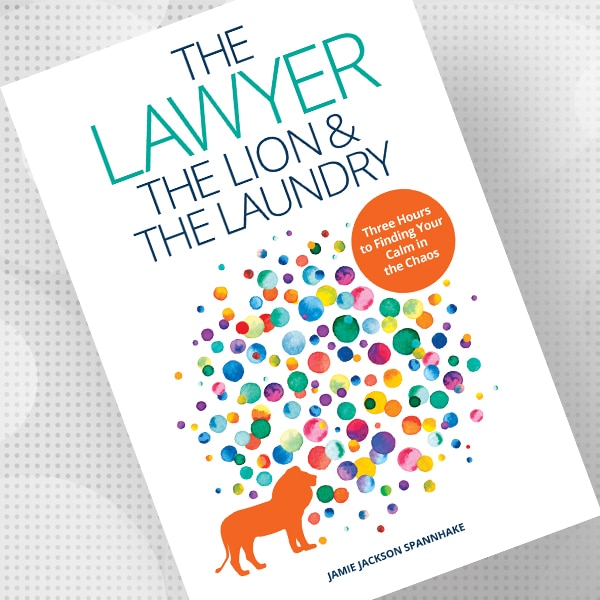
Three Hours to Finding Your Calm in the Chaos
BESTSELLER! THE LAWYER, THE LION & THE LAUNDRY
Join lawyer and certified health coach Jamie Jackson Spannhake in an enlightening journey. Read her bestselling book and learn how to “choose, act and think” in ways that will clarify your desires and set priorities so you can reclaim your time and enjoy your life. Includes exercises.
Image © iStockPhoto.com.