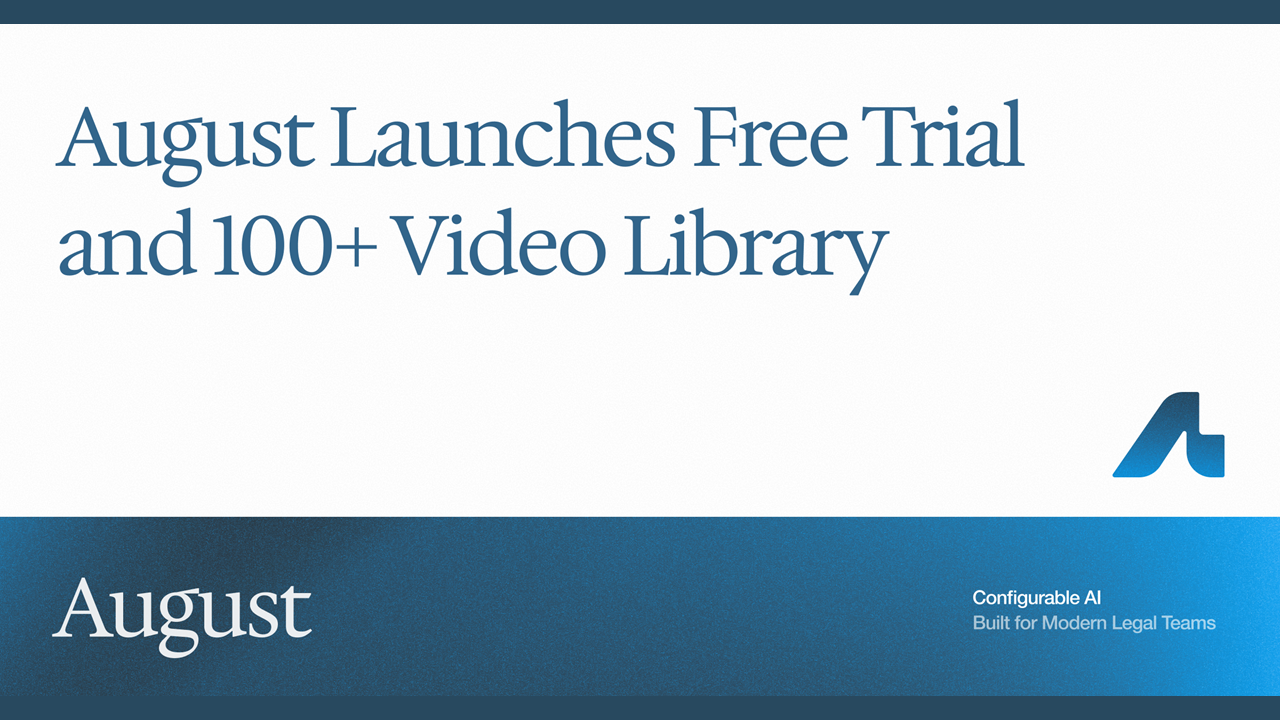
Aiming to remove the sales-cycle obstacles that have kept generative AI tools out of reach for many solo and smaller-firm lawyers, August today launched immediate self-service access to its legal AI platform, including a two-week free trial, alongside a comprehensive library of over 100 video tutorials.
For the first time, the company says, smaller law firms from solos to midsized can access the same capabilities as large firms without the usual barriers of extended sales processes, lengthy implementations, expensive training programs and dedicated IT staff.
“Most legal AI has been built for BigLaw,” said Thomas Bueler-Faudree, co-founder of August. “That means the solo practitioner in Anchorage or the three-partner firm in Austin gets left behind.
“I worked for an attorney in Alaska at a small firm where a tool like this would have been invaluable, but the barriers to entry were impossibly high. We built August to change that.”
Breaking Down the Barriers
For law firms, the process of buying many of the leading legal AI products can require months of negotiations and implementation. August is betting that its new self-serve model will flip this approach entirely.
Lawyers can sign up today, receive two weeks free, and immediately start using AI across their entire workflow — from drafting motions and demand letters to due diligence extraction to reviewing contracts with AI-generated playbooks based on their own precedent documents.
The sign-up process is quick.
The self-service platform maintains all the core capabilities that August has offered larger firms since its launch last year. These include integration across web, Outlook and Word with full context preservation; deep document understanding; and an agent-based architecture that adapts to different practice areas and workflows.
But instead of requiring sales calls and implementation timelines, lawyers can start using its AI capabilities within minutes of signing up.
“We’ve seen solo practitioners go from not using August to using all of these features within one 30-minute call with one of our team members, and that’s including the entire onboarding process,” Bueler-Faudree told me in an interview yesterday. “Now they use it more than ChatGPT.”
August Academy
Alongside the self-service platform, August is launching August Academy, a comprehensive library of video tutorials and practical lessons covering everything from document review strategies to advanced research techniques. The educational content is available for free — users do not even need to be August customers to access the videos.
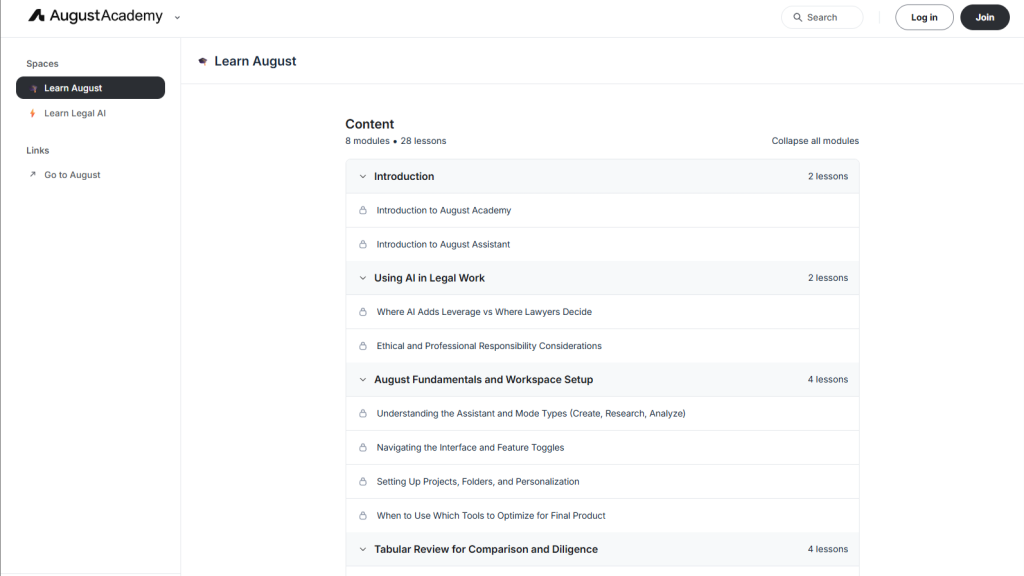
The academy provides tutorials filtered by practice area, use cases and comfort level with AI, helping lawyers understand not just how to use the technology, but when and why to apply it. The library will be continuously updated with new content as August adds capabilities and as the legal AI landscape evolves.
Vivan Marwaha, August’s head of marketing, said that the platform tailors its onboarding and educational emails based on a lawyer’s practice areas. “Attorneys can thoughtfully use AI in a lot of their workflows, and the academy provides the educational element to make that adoption successful.”
What the Platform Can Do
August functions as what Bueler-Faudree describes as a “legal operating system” — a platform that connects to documents in SharePoint, emails in Outlook, and integrates directly into Word. The platform can handle any legal task or workflow, he said, whether due diligence, drafting long agreements, or litigation work such as drafting motions and managing discovery.
Based on a brief demonstration that Bueler-Faudree and Marwaha gave me yesterday, the platform’s capabilities include:
Litigation workflows: Automatic deposition transcription with the ability to ask questions about testimony or use it to prepare for the next deposition.
Contract review: Upload existing playbooks to create AI-powered review tools, or have the system generate playbooks by analyzing precedent contracts.
Document drafting: Create any type of memo, email, summary or legal document with context that persists across web, email and Word.
Due diligence: Tabular review that uploads document corpuses and converts them into interactive tables for analysis.
Custom workflows: Users can create their own workflows or modify pre-built ones for tasks like drafting motions or preparing divorce documents.
August integrates with SharePoint, iManage, NetDocs, Google Drive, and Dropbox, with SharePoint, Dropbox, and Google Drive connections available automatically during onboarding.
“You can literally just connect your SharePoint and say, ‘I have a new client in Virginia that is incorporating in Delaware with a couple of subsidiaries. Can you look at all my model corporate documents from Nevada and templatize them for Virginia?’” Bueler-Faudree said. “It will literally go through your SharePoint to do this for you.”
The Technology Behind It
August partners with the three major LLM providers — OpenAI, Anthropic and xAI — selecting which model to use for each task behind the scenes. The company says its team of lawyers and engineers has determined which models are best for specific tasks.
The platform emphasizes accuracy and transparency, showing users exactly what it’s doing at each step of a workflow. According to Marwaha, this technical investment has yielded results that partners are studying.
“Our partners are doing case studies with August because they are seeing how we are contributing to their models and tech stack,” he said. “When asking about a specific document, August will give a citation to a scanned PDF and bring you to page 117, which might be the exhibit of that document — not even the core document, but the exhibit. And the citation is 100% correct.”
This focus on accuracy addresses one of the biggest concerns lawyers have about AI tools. “Accuracy is killer in law,” Bueler-Faudree said. “You have to be 99.9999% accurate all of the time. We’ve really built the technology to reduce hallucination down to almost zero.”
Early Success Stories
August has already been working with larger law firms since its public launch last August and has onboarded numerous smaller firms that reached out through the website or LinkedIn. The company has now decided to remove the sales process entirely to reach the many solo practitioners and small firms seeking access.
One early adopter is Patricia Wolfe, shareholder at the law firm Hunt Ortmann. “August has become a really valuable partner to how I work,” she said. “The platform quickly and easily handles the tedious parts of discovery work, like drafting discovery requests, summarizing depositions, and running deposition transcript searches for key terms, so that I can focus on the high level strategic decisions that actually require legal expertise.”
Bueler-Faudree cited another example of a solo practitioner who has been able to take on HVAC roll-up due diligence for a family office — work that would traditionally go to a much larger firm because the economics would not favor a smaller practice.
“Customers who use August now have a competitive advantage against law firms that don’t,” Marwaha said. “We’ve seen this in our customers who are now able to grow their business and take on work that not only could they not do before, but their competitors are not doing.”
August cited Hicksons in Australia as one example, noting the firm went from having a very small healthcare practice to doing five times the number of cases in 2025 after adopting the platform.
Two-Week Free Trial
The platform costs $375 per month or $4,000 annually per user. The two-week free trial includes full platform access and all August Academy content, with no credit card required.
The self-service model represents a departure from competitors in the enterprise legal AI space, including Harvey and Thomson Reuters CoCounsel, which require sales conversations before attorneys can access the platforms.
“None of our competitors are doing this,” Bueler-Faudree said. “That’s because we believe very strongly in our product and therefore we’re just removing some of the guardrails in terms of the salespeople and the enterprise process that you need to go through to access good AI for your practice.”
August has raised $7 million in funding from New Enterprise Associates (NEA), Pear VC, Afore Capital, Stanford Law School, and executives at OpenAI, Bain Capital Ventures, and Ramp.