Key Findings
If all 50 states established legal, open, statewide sports gaming markets, we estimate aggregate gross gaming revenue (GGR) would increase by $15.6 billion annually, more than doubling the size of the current legal market.
Non-exorbitant taxA tax is a mandatory payment or charge collected by local, state, and national governments from individuals or businesses to cover the costs of general government services, goods, and activities. rates are essential to encourage sports betting market activity to move from illicit markets to legal markets.
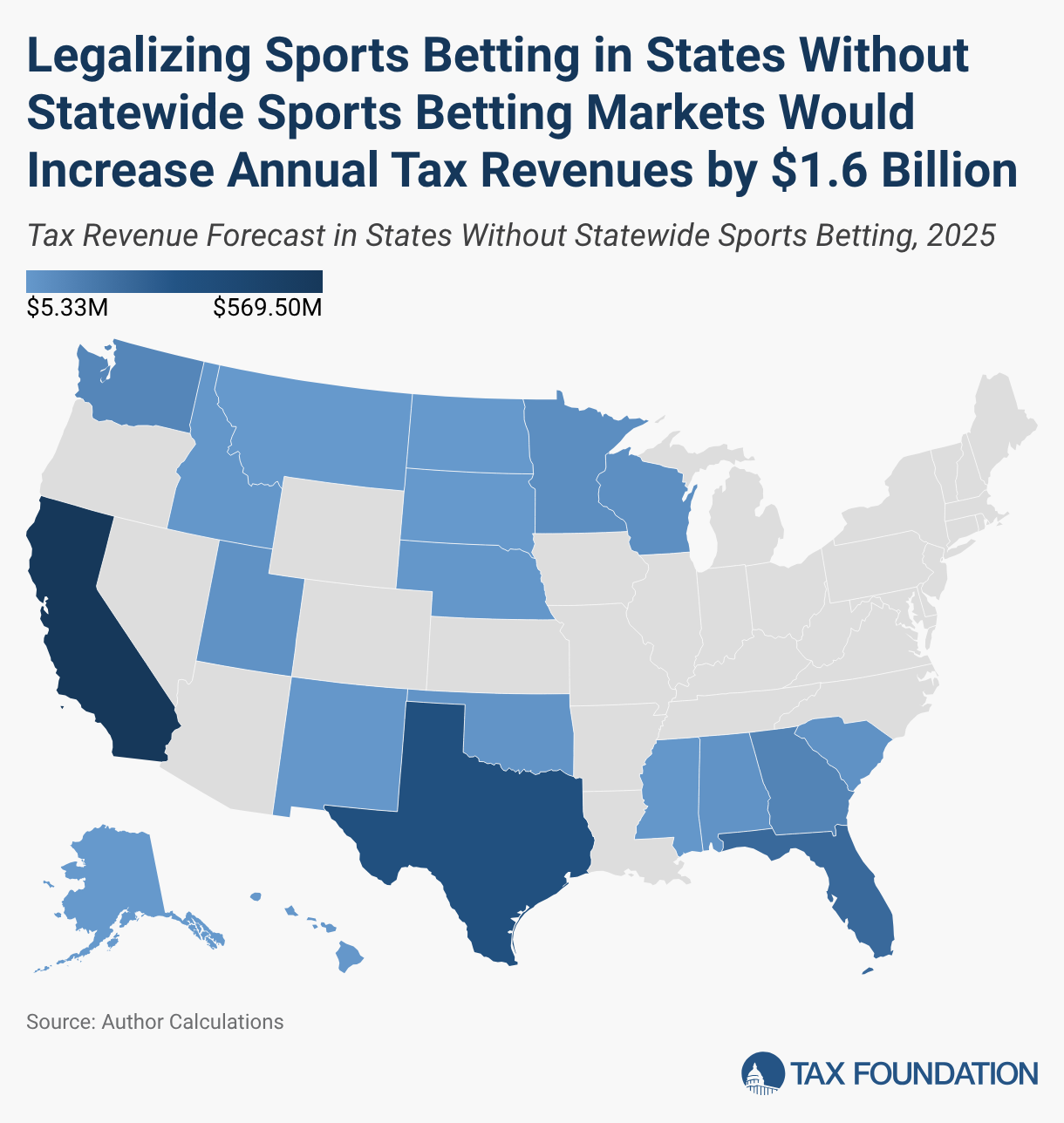
Legal sports betting markets in all states would generate an additional $1.6 billion per year in tax revenue, assuming a 10 percent GGR tax. The largest tax revenue gains would be in California ($570 million), Texas ($326 million), and Florida ($199 million).
Restricted access markets and those with monopoly control granted to state lottery commissions severely limit revenue potential compared to open, statewide, mobile markets.
Introduction
The sports wagering market is booming. Consumers legally wagered more than $157 billion on sporting contests in fiscal year 2025, creating more than $3.2 billion in state sports wagering tax revenue. In December, Missouri became the latest state to establish a legal sports betting market. Despite the rapid size and growth seen in sports betting markets over the past decade, the market could easily double in size again, providing substantial revenue to states that have yet to establish a legal marketplace.
The sports gaming industry has transformed over the past eight years. Once a niche form of gambling—limited almost exclusively to in-person wagers in Las Vegas and Atlantic City or to remote wagers through illegal bookies—the sports betting world ignited on May 18, 2018, when the Supreme Court struck down the anti-sports-betting Professional and Amateur Sports Protection Act in Murphy v. NCAA. Post-Murphy, states were granted the ability to regulate sports betting independently. Many states quickly responded by establishing their own legal sports wagering marketplaces, and the number of states operating legal sports betting markets has increased every year since. Combined with the ability to make wagers online and via smartphone apps, the sports gaming industry grew exponentially.
Taxes have been, and will continue to be, central to the development of legal sports betting markets. Tax revenue was the carrot many state policymakers needed to support legalized sports betting. And non-exorbitant tax rates are essential for sportsbooks to operate profitably and for customers to want to participate in legal markets instead of illicit ones (which do not have the protections that legal markets offer).
Looking forward, the growth of the sports betting industry may have just begun. With legal markets not yet operational in many states, we estimate that a nationwide sports betting marketplace would more than double the size of the current legal market. In this paper, we analyze the existing US market and tax landscape, then estimate the effects of establishing statewide, legal sports wagering markets in all US states.
Launch Interactive Map
Tax Design and Rates
States employ a wide range of restrictions and tax rates on sports betting.[1] While most states have legalized sports wagering in some form, consumers only have statewide access to online sports betting platforms in 30 states and the District of Columbia. Most states levy an ad valorem tax on the revenues of sportsbook operators. Many states levy the tax on gross gaming revenues (GGR), an estimated measure of sportsbook profitability from gaming activity, prior to any deductions for operational expenses.
A few states take a different approach to taxing sports betting activity. Tennessee levies a tax directly on the sports betting handle (i.e., the toal dollar amount of wagers). In addition to a GGR tax, Illinois now charges an additional ad quantum fee of up to $0.50 per bet. The Oregon lottery granted DraftKings a monopoly for online sports betting in the state in exchange for the state receiving 51 percent of the sports betting proceeds.
We convert these different approaches to an approximate GGR tax to compare tax rates across states. The highest tax rates are levied in New Hampshire, New York, Oregon, and Rhode Island at 51 percent of sportsbook revenues. Nevada and Iowa levy the lowest tax rates at 6.75 percent.
It is important to note that states can define the GGR tax baseThe tax base is the total amount of income, property, assets, consumption, transactions, or other economic activity subject to taxation by a tax authority. A narrow tax base is non-neutral and inefficient. A broad tax base reduces tax administration costs and allows more revenue to be raised at lower rates. differently, particularly as it relates to promotional wagering. Promotional wagers allow players to make bets without using their own funds to make a wager. Treatment of promotional wagers can dramatically affect the underlying tax burden faced by sportsbooks.[2] If states include winnings from free or promotional bets in GGR, the tax burden will be even greater than the stated GGR rate.
A major concern with high tax rates, such as states that apply a 51 percent tax rate or greater, is that those rates discourage participation in legal markets. GGR is different than operator profit. For a business to thrive in a legal market, the revenue remaining after taxes must be enough to cover expenses necessary to ensure safe legal market activity, like cybersecurity and data integrity, as well as normal operating expenses.
Illicit operators can get a significant advantage over those who abide by the rules and regulations simply by dodging taxes. This fuels illicit market activity and counteracts one of the major goals of establishing legal markets.
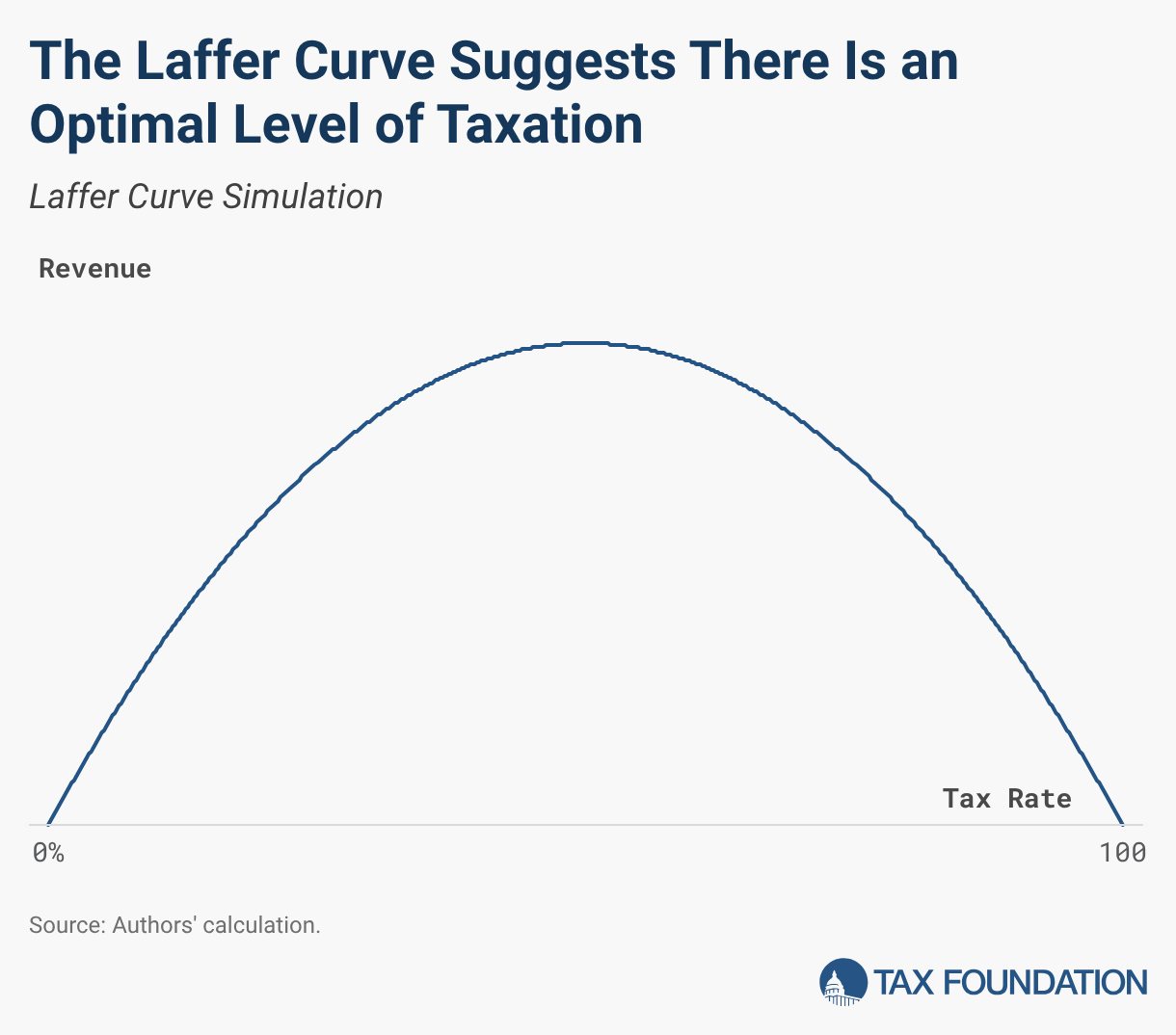
In tax terms, shrinking quantity means taxing a narrower base, trying to squeeze more and more revenue out of a smaller pool of taxpayers. This ties directly to the classic concept of the Laffer Curve. At very low levels of taxation, rate increases will increase collections. However, at some point, further rate increases will generate less revenue.
Tax rates aren’t the only restrictions inhibiting the growth of legal sports betting markets. Several states restrict access to sportsbooks. In Mississippi, Montana, New Mexico, North Dakota, South Dakota, Washington, and Wisconsin, would-be gamblers can only place bets at select locations, such as retail casinos, state-operated facilities, or tribal lands. These bettors may or may not have access to online betting platforms at each facility.
Other states mandate a partnership with the state lottery commission or hand control of online sports betting markets directly to the state lottery commission. In Connecticut, “master wagering licensees”—those permitted to offer online sports betting—include the Mohegan Tribe, the Mashantucket Pequot Tribe, and the Connecticut Lottery. Online gaming operators wishing to offer services in Connecticut must partner with one of those groups.
Montana monopolized all sports betting, giving full operational control to the Montana Lottery Commission; market-leading sportsbooks like DraftKings and FanDuel are unavailable in the state. Rhode Island requires 17 percent of GGR to go to the Providence-headquartered gambling and entertainment group Bally’s CorporationAn S corporation is a business entity which elects to pass business income and losses through to its shareholders. The shareholders are then responsible for paying individual income taxes on this income. Unlike subchapter C corporations, an S corporation (S corp) is not subject to the corporate income tax (CIT). (in addition to the 51 percent GGR tax) as the host facility for the required sports betting servers located in their casinos, leaving only 32 percent of GGR to stay with the sportsbooks.
Restricted access to sportsbooks means less betting activity gets pulled from illicit markets into legal, taxable markets. In Arkansas and Delaware, GGR per person ages 18-44 was less than $50, while the average in other states was $224.
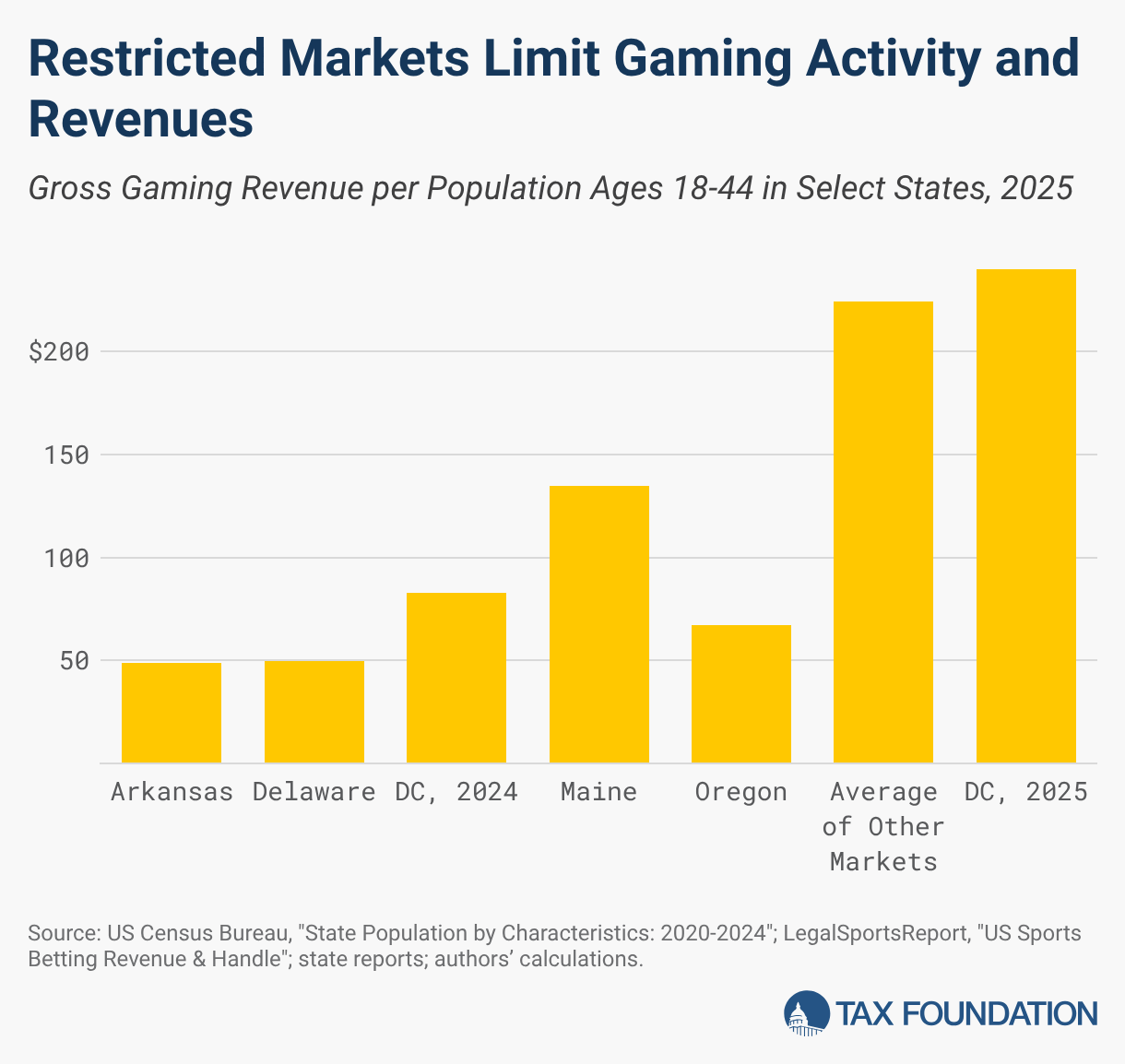
Washington, DC, provides a great case study of the costs of relying on a monopolized sports betting market. In 2019, the DC Council controversially granted the Office of Lottery and Gaming (OLG) a sole-source monopoly contract with Intralot to run the city’s single sports betting app.[3] Amidst a flurry of unsatisfied customers, underperformance, and fraud, the Council ended the monopoly in 2024, opening the market to multiple sportsbooks.[4] By the end of fiscal year 2025, DC produced a $240 GGR per adult, just above the national state average.
Markets for Sports Betting in States Without Statewide Legal Markets
To estimate market outcomes in states that have yet to create legal statewide sports wagering markets, we use data from existing legal markets. We first calculate the aggregate quantity of sports betting activity and the resulting GGR.
We base our GGR estimates on the adult population ages 18-44. Table 1 shows that GGR per adult varies substantially in states with legal sports betting markets.
Table 1. Wagering Activity Varies Considerably by State
State Sports Betting Gross Gaming Revenue and Population Ages 18-44, 2025
Source: US Census Bureau, “State Population by Characteristics: 2020-2024”; LegalSportsReport, “US Sports Betting Revenue & Handle”; state reports; authors’ calculations.
While state GGR averaged $233 per adult in fiscal year 2025, state averages ranged from as low as $48 in Arkansas to $427 in Nevada. Because Nevada is a gambling destination, and our goal is to estimate own-state gambling totals, we exclude the Silver State from our estimates, decreasing the national GGR average to $229 per adult ages 18-44.
With a GGR baseline of $229, we then extrapolate potential sports betting GGR for states without statewide gaming. We adjust the baseline figure for factors likely to influence gaming, including state median income, the percentage of the population living in rural areas, and the number of major professional and collegiate teams.
The maturity of legal state markets also varies in our data. By July 2025 (the end of fiscal year 2025), West Virginia’s legal sports betting market had been operational for six and a half years, while North Carolina’s legal market had been operational for only a handful of months. The average market was operational for four years, so our estimates represent GGR and tax potential roughly four years after legalization.
Table 2 reports our estimates for GGR and tax revenues in states without current statewide legal betting markets. We estimate GGR would increase by $15.6 billion annually from nationwide legalization, more than doubling the size of the current legal market.
Table 2. Legalizing Sports Betting in Markets without Statewide Sports Betting Would More than Double Annual Gross Gaming Revenues
Gross Gaming Revenue and Tax Revenue Forecast in States Without Statewide Sports Betting, 2025
Authors’ calculations.
If each state applied a 10 percent tax on sportsbook GGR, the resulting annual state tax revenue from these new markets would be nearly $1.6 billion. The federal government would also collect roughly $397 million annually from its 0.25 percent sports betting handle tax.
California would collect nearly $570 million in tax revenue, Texas would add $326 million, and Florida would generate over $198 million annually. Smaller markets such as North Dakota and Alaska would generate $5.3 million and $6.2 million, respectively.
The legalization of sports betting has reshaped the American gaming landscape in less than a decade, transforming what was once a niche pastime into a multibillion-dollar industry. States have embraced sports wagering not only as a source of entertainment for consumers but also as a reliable stream of tax revenue, with policy design playing a critical role in establishing a sustainable marketplace.
As more states consider legalization, the stakes are high: California, Texas, and Florida alone could add billions in new tax revenue. Yet the future of sports betting will depend on how policymakers structure tax regimes, regulate access, and ensure that legal markets remain competitive with illicit alternatives. Sports betting has become an integrated feature of modern American sports and gaming, and its trajectory suggests that the story is only beginning.
Individual State Profiles
Launch Interactive Map
While most US states have embraced legal sports betting in some form, several states have yet to authorize statewide sports betting. This section examines states that have not yet legalized sports betting, forecasting potential handles, GGR, and tax revenues from a mature wagering market.
Our estimates are based on the national average GGR per adult ages 18-44 in each state. However, based on the wide range of handles in states that have already legalized sports betting, we adjust our estimates for each state based on several factors.
Demographically, the size and wealth of a population are primary drivers of overall spending on any product, including sports wagering. Additionally, states that have popular sports teams are likely to experience a larger market for wagering on those home teams. We adjust our state handle estimates by four major variables:
The number of adults ages 18 to 44, a primary demographic for sports betting, in a state in 2024, according to the US Census Bureau[5]
The median household income of a state in 2024, according to the US Census Bureau[6]
The total average home game attendance of every NFL, NBA, and MLB team in a state, according to ESPN, and adjusted home game attendance of large college sports teams, according to NCAA and D1.ticker[7]
The percentage of a state’s population that is reported as rural by the US Census Bureau[8]
Alabama
Alabama has a moderate population of adults with a relatively large proportion of rural population. With a relatively low median income and a significant rural population, the Alabama sports betting market would likely be smaller than a wealthier or more urban state of similar size.
Alabama is also not home to any major professional sports teams. However, the state has very prominent college sports teams whose games garner significant average attendance. The popular college sports scene in Alabama is likely to generate additional interest in sports betting there.
All things considered, the state of Alabama would likely generate approximately $28 million in tax revenue from a mature, well-structured legal sports betting market with a tax rate of 10 percent of gross gaming revenue.
Download PDF
Alaska
Alaska is one of the least-populated states in the nation, with about a third of that population being rural. The median income in the state is higher than in most other states, though the discretionary income (available to be spent on gambling) may be offset by a higher cost of living there.
The state boasts no major professional or college sports teams, which may leave interest in sports betting lower there than in other states where sports are more prominent. Any fans of the major sports in Alaska would be primarily wagering on games held out of state.
Alaska is not likely to be a particularly large market for sports wagering, but a well-structured, mature legal market taxed at 10 percent of gross gaming revenue could be expected to generate approximately $6 million for the state.
Download PDF
California
California has the largest population of adults and one of the highest median incomes. It is also the least rural US state. These factors alone prime the state for a particularly large sports betting market.
Additionally, California holds 12 major professional sports teams and five prominent college sports teams. This would likely attract even more interest in sports wagering as the large population of fans root for their home team.
Legal sports wagering in California, well-structured and with a tax rate of 10 percent of gross gaming revenue, could be expected to generate approximately $570 million in revenue for the state. This is by far the largest potential in any state, but it is also subject to significant reduction should the market be overburdened by regulations or exorbitant taxes.
Download PDF
Florida
Florida currently has sports betting, but legal betting activity is limited to the Seminole Tribe of Florida and Hard Rock Bet. We estimate the effects of an open and competitive statewide legal market.
Florida has the third largest population of adults and an average median income. With the state being one of the nation’s least rural, Florida would be demographically primed to have a particularly large legal sports betting market.
Seven major professional sports teams and five prominent college sports teams call Florida home. With such a thriving sports scene, the state is likely to experience more interest in wagering on sports outcomes and performances than a typical state.
A well-structured, competitive legal sports betting market in Florida would be poised to become one of the nation’s largest, and a 10 percent tax on the gross gaming revenue from that market could be expected to generate approximately $199 million for the state.
Download PDF
Georgia
Georgia is home to a notably large population of adults and boasts a moderate median income. Only a moderate proportion of that population is rural, leaving the state with a slight demographic advantage for creating a large sports betting market.
The state is also home to both major professional and college sports teams of outsized popularity, which is likely to draw increased interest in sports betting should a legal market be established. Georgians seeking to wager on their home teams would have plenty to choose from.
Georgia could be expected to generate approximately $89 million in tax revenue from a 10 percent tax on gross gaming revenue from a mature, well-structured legal sports betting market.
Download PDF
Hawaii
Hawaii has a relatively small population of adults but a relatively small proportion of rural population. The state also has a notably high median income—somewhat offset, however, by the increased cost of living there—which positions the state well for a successful legal sports betting market.
The state of Hawaii boasts no major professional sports teams and only one prominent college sports team, which may leave most sports fans rooting for out-of-state teams. This may signal less interest in sports betting than in other states.
These factors, taken together, suggest Hawaii could generate approximately $11 million in tax revenue from a 10 percent gross gaming revenue tax on a well-structured sports betting market.
Download PDF
Idaho
Idaho has a relatively small population of adults but a slightly above average median income. A significant portion of the state’s population is rural, however, which may indicate reduced overall interest in sports betting.
The state is not home to any major professional sports teams, but it does have one prominent college sports team that garners significant attendance at its home games. This may lead to somewhat reduced interest in sports betting relative to states with more emphasis on sports.
A mature, well-structured legal sports betting market in Idaho could be expected to generate approximately $13 million in tax revenue for the state from a 10 percent tax on gross gaming revenue.
Download PDF
Minnesota
Minnesota boasts a slightly larger than average population of adults, with a significant proportion of that population being rural. The state also has a relatively high median income, which positions the state well demographically for a sports betting market.
The state is also home to three major professional sports teams and a prominent college sports team that collectively garner significant attendance at their respective home games. This may indicate an outsized interest in sports betting in Minnesota relative to states with fewer in-state sports teams to bet on.
A well-structured sports betting market could be expected to generate approximately $47 million in taxes from a 10 percent tax on gross gaming revenues in Minnesota.
Download PDF
Mississippi
Mississippi has a relatively small population of adults and is one of the most rural states in the nation. The median income in Mississippi is also the lowest in the nation. This leaves Mississippi much less well-positioned for a sports betting market than wealthier or more urban states.
Mississippi is also not home to any major professional sports teams. However, the state does have two very prominent college sports teams whose home games are popular. Allowing wagers on college sports would be crucial to the success of a sports betting market in Mississippi.
With a 10 percent tax on the gross gaming revenue from a well-structured sports betting market, Mississippi could be expected to generate approximately $14 million in tax revenue.
Download PDF
Montana
Montana has one of the smallest populations of adults across states and is one of the most rural. The state’s median income is slightly below average, which may indicate that a sports betting market would be relatively small in Montana.
There are also no major professional or college sports teams in the state, which would leave bettors looking to out-of-state teams to wager on.
Overall, a well-structured sports betting market could be expected to generate approximately $7 million for Montana from a 10 percent tax on gross gaming revenue.
Download PDF
Nebraska
Nebraska has a relatively small population of adults and a moderate proportion of rural population. The state’s median income is only slightly below average across states, which may indicate that Nebraska would experience a relatively small sports betting market.
However, Nebraska boasts a particularly popular college sports team whose home games garner much attendance. A relatively popular college sports scene may attract more interest in sports betting in the state, though there are no major professional sports teams to do the same.
Nebraska could be expected to generate approximately $13 million from a 10 percent tax on the gross gaming revenue of a well-structured, mature sports betting market.
Download PDF
New Mexico
New Mexico has a relatively small population of adults, but only a moderate proportion of rural population. This positions the state for a relatively small market in sports betting, especially with the state’s notably low median income.
While there are no major professional sports teams in the state, there is one moderately popular college sports team. This may attract some interest in sports betting, but likely not nearly as much as in states with more prominent sports teams.
New Mexico could be expected to generate approximately $12 million from a 10 percent gross gaming revenue tax on a well-structured legal market in sports betting.
Download PDF
North Dakota
North Dakota has one of the smallest populations of adults in the country and a significant proportion of rural population. The state has a moderate median income that provides no particular advantage or disadvantage for sports betting.
There are no major professional or college sports teams in the state of North Dakota, which would leave bettors with only out-of-state teams to wager on. This may indicate a less popular sports betting market than in other states with prominent sports teams.
North Dakota could expect to generate approximately $5 million in tax revenue from a 10 percent tax on gross gaming revenue on a well-structured sports betting market.
Download PDF
Oklahoma
Oklahoma has a slightly below average population of adults and a significant proportion of rural population. With a notably low median income, the state is demographically positioned for a small sports betting market.
While the population is small, Oklahoma boasts a major professional sports team and two prominent college sports teams that garner outsized attendance at their home games. The popularity of sports in Oklahoma is likely to attract more interest in sports betting than in states without an emphasis on sports.
A well-structured legal sports betting market, taxed at 10 percent of gross gaming revenue, could be expected to generate approximately $24 million for the state.
Download PDF
South Carolina
South Carolina has a slightly above average population of adults and a significant proportion of rural population. With a below average median income, South Carolina is not particularly well-suited for a large sports betting market.
The state does not host any major professional sports teams but does have two notably popular college teams. Allowing wagers on college sports would thus be crucial to capturing the full potential of South Carolina’s sports betting market.
Once built out, a well-structured sports betting market in South Carolina could be expected to generate approximately $32 million in tax revenue from a 10 percent tax on gross gaming revenue.
Download PDF
South Dakota
South Dakota has a notably small population of adults, with a significant proportion of that population being rural. The state has an average median income. Together, these factors likely indicate a relatively small market for sports betting.
There are no major professional or college sports teams in South Dakota, so sports betting may be less popular than in states with prominent home teams to wager on.
Taxing a mature, well-structured sports betting market at 10 percent of gross gaming revenue could be expected to generate approximately $5 million for the state.
Download PDF
Texas
Texas has one of the nation’s largest populations of adults and a relatively small proportion of rural population. With an average median income, the state is positioned to have a significant sports betting market.
This is especially true given the popularity of the state’s seven major professional sports teams and seven prominent college sports teams. With such a large emphasis on sports in the state, Texas is likely to garner a relatively higher interest in sports betting.
Once established, a well-structured sports betting market could be expected to generate approximately $326 million for the state from a 10 percent gross gaming revenue tax.
Download PDF
Utah
Utah has a slightly smaller than average population of adults, but only a small proportion of that population is rural. The state’s median income is notably high, which likely makes Utah well-positioned to have a relatively large sports betting market.
There is one major professional sports team in Utah, along with two prominent college sports teams. The popularity of home games in-state is likely to indicate a relatively greater interest in sports betting among the population of Utah.
If able to attract bettors, a well-structured sports betting market in Utah could be expected to generate approximately $33 million in revenue from a 10 percent tax on gross gaming revenue.
Download PDF
Washington
Washington has a notably large population of adults, and a relatively small proportion of that population is rural. Combined with a significantly higher than average median income, the state of Washington is demographically well-positioned for a relatively large sports betting market.
The state also boasts two major professional sports teams and a prominent college sports team whose home games garner significant average attendance. These in-state home teams likely indicate a relatively higher interest in sports betting among the population of Washington.
Washington could expect to generate approximately $80 million in tax revenue from a 10 percent gross gaming revenue tax on a mature, well-structured sports betting market.
Download PDF
Wisconsin
Wisconsin has a slightly larger than average population of adults, with a significant proportion of that population being rural. This positions the state well for a sports betting market in addition to its moderate median income.
Additionally, the state is home to three major professional sports teams and one prominent college sports team. The significant home game attendance across the state likely indicates a relatively higher interest in sports betting among fans wagering on their home teams.
Considering these factors, Wisconsin could expect to generate approximately $43 million in tax revenue from a 10 percent gross gaming revenue tax on a well-structured sports betting market.
Download PDF
Stay informed on the tax policies impacting you.
Subscribe to get insights from our trusted experts delivered straight to your inbox.
Subscribe
References
[1] Adam Hoffer and Jacob Macumber-Rosin, “Online Sports Betting Taxes by State, 2025,” Tax Foundation, Sep. 26, 2025, https://taxfoundation.org/data/all/state/online-sports-betting-taxes/.
[2] Adam Hoffer, “Bets on Legal Sports Markets Pay Off Big for States, Sportsbooks, and Consumers,” Dec. 10, 2024, https://taxfoundation.org/research/all/state/sports-betting-tax-revenue/.
[3] Jill R. Dorson, “Washington, D.C. Legalizes Sports Betting, Gives Lottery Virtual Monopoly,” Dec. 18, 2018, SportsHandle, https://sportshandle.com/washington-dc-legalizes-sports-betting-gives-lottery-virtual-monopoly/.
[4] Meagan Flynn, “D.C.’s sports betting flop ends in $6.5 million settlement, fraud accusations,” Jan. 14, 2025, The Washington Post, https://www.census.gov/programs-surveys/geography/guidance/geo-areas/urban-rural.html.
[5] US Census Bureau, “State Population by Characteristics: 2020-2024,” June 2025, https://www.census.gov/data/datasets/time-series/demo/popest/2020s-state-detail.html.
[6] US Census Bureau, “Household Income in States and Metropolitan Areas: 2024,” Sep. 11, 2025, https://www.census.gov/library/publications/2025/acs/acsbr-025.html.
[7] ESPN, “NFL Attendance – 2025,” https://www.espn.com/nfl/attendance; ESPN, “NBA Attendance Report – 2025,” https://www.espn.com/nba/attendance/_/year/2025; ESPN, “MLB Attendance Report – 2025,” https://www.espn.com/mlb/attendance; NCAA, “Men’s Basketball Attendance Records Through 2022-23,” 2024, http://fs.ncaa.org/Docs/stats/m_basketball_RB/2024/Attend.pdf; D1.ticker, “2024 FBS Attendance Trends,” https://www.d1ticker.com/2024-fbs-attendance-trends/.
[8] US Census Bureau, “Urban and Rural,” September 2023, https://www.census.gov/programs-surveys/geography/guidance/geo-areas/urban-rural.html.
Share this article