Michael Jones, CPA walks us through a day the shoes of auditor like himself and how he leverages AI to increase efficiency.
Highlights
CoCounsel Audit transforms technical research from hours to minutes with defensible citations.
AI-powered quality control automates report reviews while preserving human judgment focus.
It’s Monday morning, and Michael Jones is reviewing his day’s priorities. As a principal with 30 years in public accounting and a quality control leader at his firm, Michael’s morning routine would be familiar to any audit professional: coordinating schedules across multiple engagement teams, ensuring compliance with evolving professional standards, conducting technical research on complex transactions, and overseeing quality control reviews.
But here’s what makes Michael’s workday different from five years ago: He has an unseen team member working alongside him—artificial intelligence.
Managing approximately 90 assurance engagements with a team of three requires orchestration, not just technical expertise. Michael faces the same balancing act as audit leaders nationwide: How do you maintain quality and compliance while keeping up with the complex nature of modern audit work?
For Michael and a growing number of forward-thinking audit professionals, purposeful AI adoption provides the solution.
Jump to ↓
The orchestration challenge: What a day really looks like for an auditor
The modern audit leader isn’t just a technician—they’re an orchestrator managing multiple high-stakes performances simultaneously.
For Michael, the scope of responsibility extends far beyond fieldwork. “We have approximately 90 or so assurance engagements and so coordinating schedules and coordinating engagements and making sure everyone’s working on what they need to is a part of my daily routine and then making sure that we obviously comply with the professional standards… as well as oversight of the team members as they’re completing their tasks.”
This daily juggling act requires Michael to wear multiple hats: engagement manager coordinating teams across 90+ active engagements, technical standards expert interpreting complex accounting standards and providing direction, and quality control gatekeeper reviewing audit reports and protecting the firm from peer review findings.
Each role demands different skills, different thinking, and different time allocations. The challenge isn’t doing any one of these jobs well—it’s doing all of them at once while maintaining the quality and rigor that the profession demands.
Modern auditors can’t keep pace through longer hours or larger teams. Instead, intentional technology deployment—AI tools that handle structured, repeatable tasks—allows auditors to focus on judgment, oversight, and the human elements of audit work that technology can’t replace.
AI as the first-stop audit research assistant
Technical research has always been a cornerstone of quality audit work. Complex accounting transactions require standards interpretation. Auditing standards questions need authoritative answers. And time pressure makes efficiency critical.
Traditionally, this research consumed hours of an auditor’s day—searching through codifications, cross-referencing guidance, synthesizing multiple sources, and documenting the rationale. For a principal auditor managing 90 engagements, that time adds up quickly.Michael’s approach centers on Thomson Reuters CoCounsel Audit as his first-stop research partner.
“I don’t use ChatGPT for research or anything like that. I only use CoCounsel…” Michael explains. His reasoning isn’t anti-AI—it’s about being strategic with AI. Michael needs research that stays within a trusted, standards-based ecosystem where every answer is defensible in a peer review or regulatory inspection.
CoCounsel Audit transforms Michael’s research workflow in three critical ways:
Speed: Research that used to take hours now takes minutes. Michael can query complex accounting standards questions and receive structured, authoritative responses quickly enough to keep engagements moving forward.
Accuracy: CoCounsel Audit pulls from professional standards and regulations, providing citations that auditors can document and defend. These aren’t general AI responses with hallucination risk—they’re purpose-built audit intelligence.
Confidence: When peer reviewers or inspectors ask “How did you reach this conclusion?” Michael has defensible research with clear citations to authoritative sources.
Empowering the whole audit team
But Michael’s use of CoCounsel Audit extends beyond his own research. He’s deploying AI as a training accelerator for junior staff.
Rather than making himself the bottleneck for every technical question, Michael pushes research tasks down to managers and staff. “Hey, go out to CoCounsel, check it first and see what you get for an answer and then discuss that… and make sure that it meets what we need for documentation as well as the citations…”
This creates a powerful learning loop: staff query → AI draft → human review and discussion → documentation. Junior auditors develop research skills faster because they’re getting immediate, structured feedback from AI, then refining their thinking through discussion with a principal auditor like Michael.
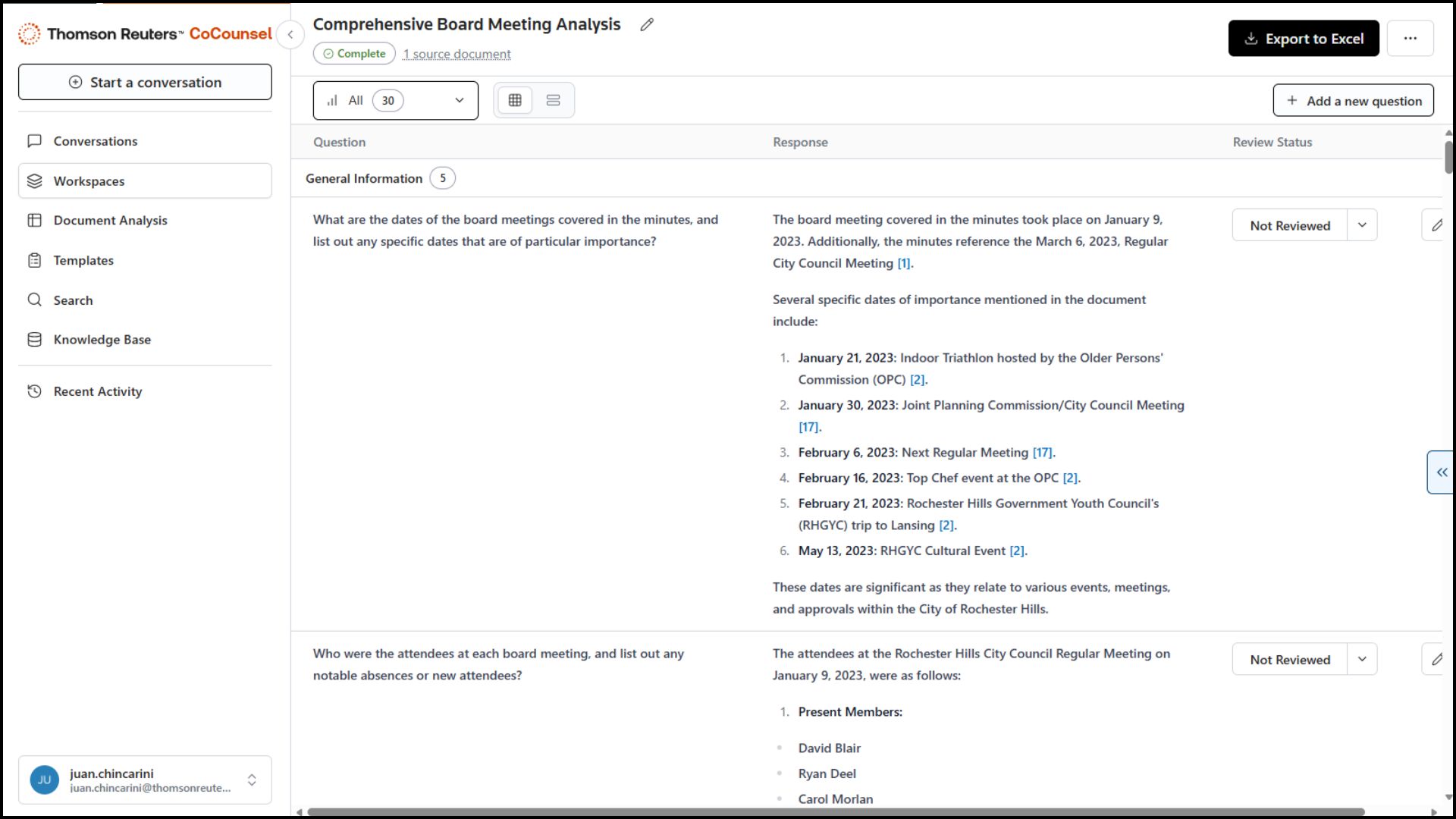
The result? CoCounsel Audit becomes a training accelerator for junior staff, a first-pass technical reviewer, and a documentation support tool—all within a single workflow. A more capable team emerges, able to handle technical complexity without constant hand-holding.
Transforming quality control from manual to AI-powered
If research is where AI saves time, quality control is where AI transforms workflows entirely.Manual review of audit reports is time-intensive and demanding. Checking spelling, grammar, required elements, and disclosure compliance can take hours per report. And the risk of human error is real—missing a required element or disclosure can lead to peer review findings that damage a firm’s reputation.
The solution Michael deployed involves a complete reimagining of his quality control process using AI.
For external quality control reviews of other firms’ audit reports, Michael built a specific AI-powered workflow:
Input: Scan in audit reports from the firm being reviewed
AI research: Run the report through CoCounsel Audit using a custom template
AI checks: “I scan in the audit reports and have CoCounsel review the report for things like spelling, grammar, tying out tables… making sure the reports, the independent audit reports, contain all the required elements that the professional standards require. Those types of things also have it look at disclosures.”
Output: Michael focuses on judgment calls and issues, not mechanical checking
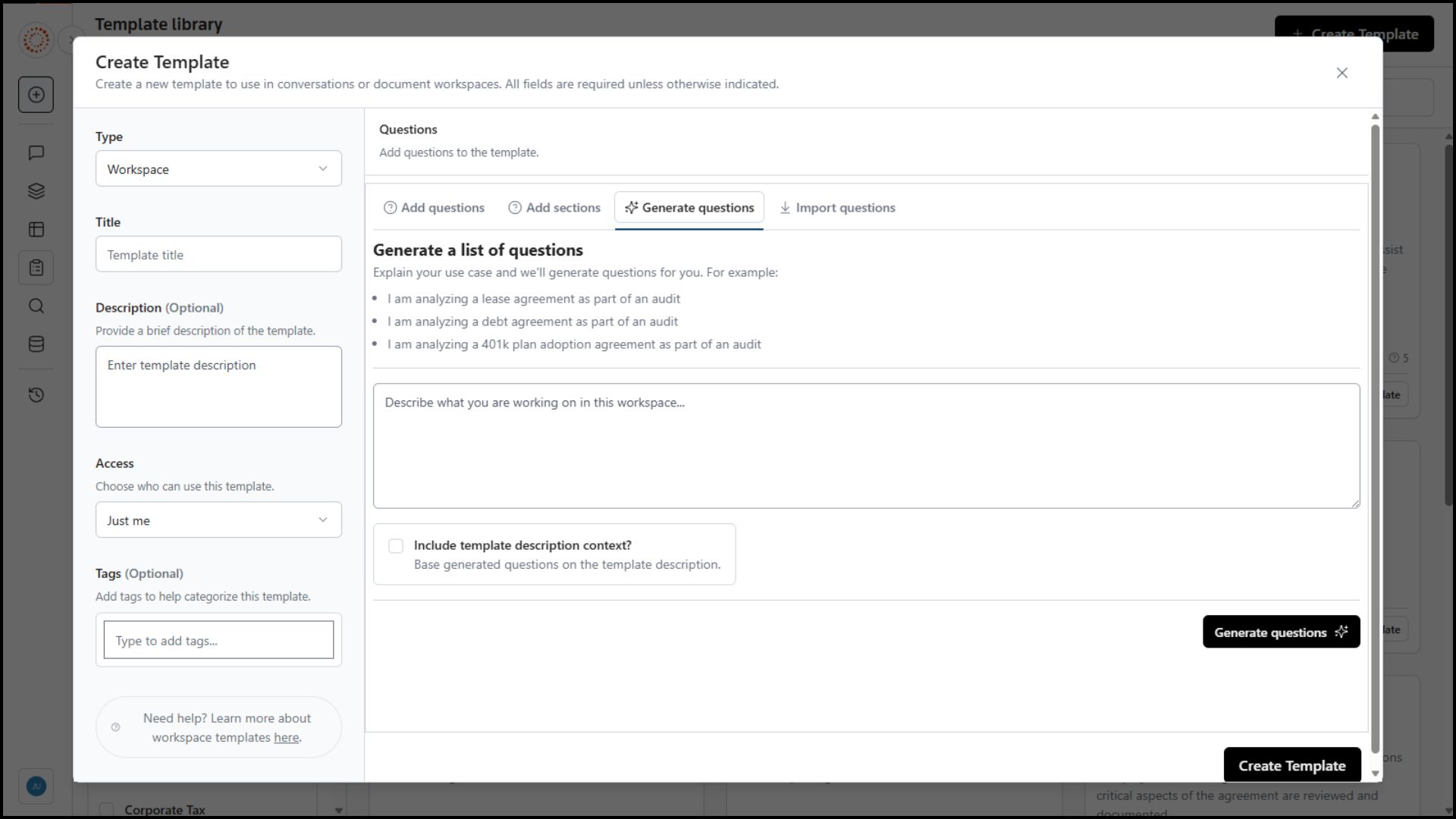
The before-and-after comparison is striking. Previously, Michael spent hours doing line-by-line review, manually checking tables, and cross-referencing disclosure requirements. Now, the structured, repeatable quality control pass happens automatically, freeing Michael to focus on the high-value work: evaluating judgment, assessing risk responses, and identifying systemic issues.
“It’s been very valuable and time saving in allowing me to perform those outside services.”The goal? Enhance quality by making sure nothing falls through the cracks while human judgment stays focused where it matters most.
Trust and guardrails: Why ecosystem matters
Michael’s intentional choice to use only CoCounsel Audit for research—and to avoid general-purpose AI tools—reflects a broader reality about AI in auditing: auditors can’t afford to use unvetted AI tools.
Peer reviews, regulatory inspections, and professional liability all require defensible sources. A wrong answer from a generic AI tool could lead to material misstatements, restatements, or worse. The accuracy imperative in auditing is non-negotiable.
Michael isn’t anti-AI. He’s anti-uncontrolled AI.
“We so far have stuck… with only the products and solutions that Thomson Reuters is offering,” Michael explains. “I think it gives me some comfort knowing that it stays within that ecosystem and only pulls from relevant and pertinent professional standards and regulations.”
This distinction matters. General-purpose AI tools are trained on vast amounts of internet content—some accurate, some outdated, some simply wrong. They can hallucinate citations, misinterpret technical guidance, or provide answers that sound confident but lack authoritative backing.
Thomson Reuters AI tools are purpose-built for audit professionals, offering vetted sources where answers pull only from authoritative professional standards and regulations—FASB, AICPA, PCAOB, SEC guidance—not random internet content. Every response includes citation-backed answers that auditors can document and defend in peer reviews or inspections. It’s a professional-grade ecosystem built for auditors, by audit experts who understand the stakes and the standards.
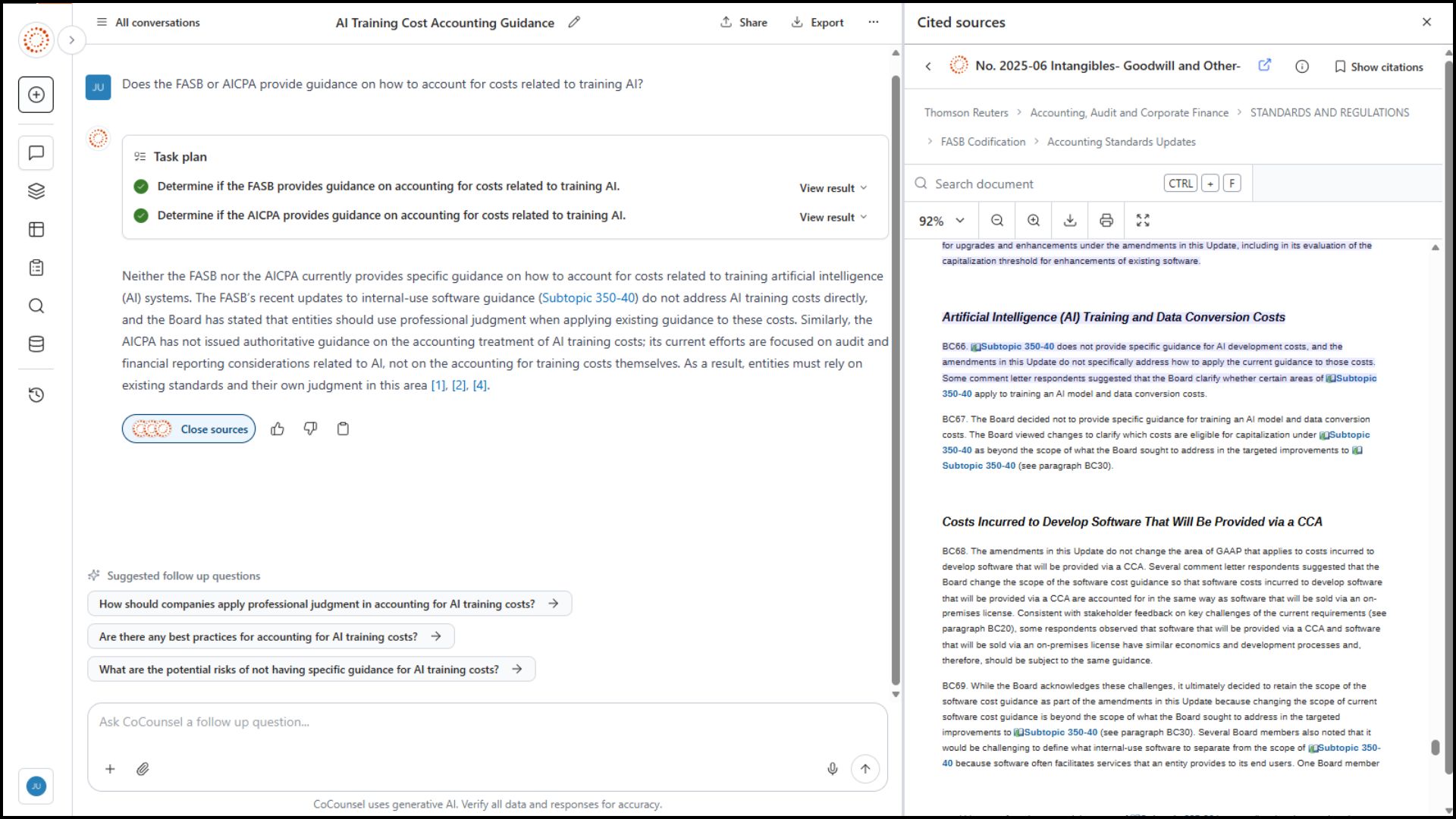
Staying inside a trusted ecosystem isn’t a limitation—it’s a competitive advantage. It allows Michael to move fast with confidence, knowing his research and quality control processes will withstand scrutiny.
One auditor’s advice to another
Michael understands why some firms hesitate to adopt AI. It’s an unknown. It’s evolving quickly. There are legitimate concerns about accuracy, control, and professional liability. And there’s inertia from established workflows that have worked for decades.
But Michael’s advice to firms on the fence is direct: “For any firm that wants to be competitive in the future, they’re going to need to adopt AI.”
These aren’t empty words—they’re grounded in competitive reality. As AI tools become more sophisticated and more widely adopted, firms using these tools will complete audits faster, with higher quality, and at lower cost. Firms without AI will find themselves at a competitive disadvantage, unable to match the efficiency and quality of AI-enabled competitors.
Michael’s recommendation: “Look at their practice and see where they can utilize AI, not necessarily to replace people, but to gain efficiencies and to have a stronger work product…”
This framing is crucial. AI adoption enhances auditors rather than replacing them. It positions firms for competitive advantage in a profession that’s being reshaped by technology. It allows quality and efficiency to work together rather than in tension. And it requires strategic choice: where to deploy AI for maximum impact.
The audit of tomorrow will look different than today
Michael’s day looks different than it did five years ago. AI handles mechanical work—spelling and grammar checks, audit standards citations, and disclosure compliance reviews. Michael focuses on judgment, client relationships, and team development.
The audit profession is being reshaped. Firms have a choice to lead or follow.
This transformation isn’t about making audits easier. It’s about making them better. More efficient, yes—but also more rigorous, more defensible, and more focused on the judgment and insight that only human auditors can provide.
Michael’s story is one auditor’s journey, but it points to a broader transformation. Today’s auditor using AI isn’t working less—they’re working smarter, with technology amplifying their expertise rather than replacing it.
Ready to transform your audit workflow?
See how CoCounsel and Audit Analyze can enhance your firm’s efficiency and quality. Explore CoCounsel Audit
Want deeper insights into AI implementation? Download our white paper: AI Tools in Audit—A Practical Implementation Guide