If you’re suffering from tariff fatigue, well, join the club. This writer, too, is exhausted from tracking the last-minute delays, relentless trade talks and will-they-won’t-they deals that have upended the news cycle since President Donald Trump took office.
But we can all soon release our collective bated breath (at least, for this round). Thursday, Trump formalized a barrage of new tariffs that will soon be unleashed on trade partners big and small.
The tariffs were initially supposed to go into effect today, but in releasing its full list of nations and their rates, Trump pushed the effective date to Aug. 7. The exception is Canada, whose new tariff rate (35%) began today.
Trump has stated multiple times that there will be no extensions or grace periods. In addition to the blanket one-week delay, Trump also announced on his social media site, Truth Social, that there would be a 90-day extension of a pause on tariffs for Mexico.
The latest tariffs are the delayed versions of Trump’s “Liberation Day” reciprocal tariffs — first announced on April 1, then delayed for 90 days and finally extended again to Aug. 1. During that period of limbo, international trade partners scrambled to negotiate.
Some — including Britain, Vietnam, Japan, Indonesia, the Philippines and the European Union — have struck deals to lessen the pain. Others will have to manage with what they’ve been given.
What’s happening with the biggest trade partners?
Here are the tariff rates for some of the nation’s biggest trade partners.
European Union: 15% tariff, excluding aircraft and their component parts, semiconductor equipment, some generic pharmaceuticals, critical raw materials, certain chemical goods and some agricultural products. Despite lobbying by countries like Italy and France, the 15% tariff will apply to wine and spirits. The new tariff rate will not be added to existing tariffs. Under the deal, the E.U. must purchase $750 billion worth of energy-related goods over three years and invest an additional $600 billion in the U.S.
Canada: 35% tariff, up from 25%, effective today. The levy excludes goods included in the U.S.-Mexico-Canada Agreement (USMCA). Energy products and potash that don’t qualify under the USMCA face a 10% tariff. Antidumping duties and countervailing duties on softwood lumber total more than 30%.
Mexico: 90-day delay on a new 30% tariff (up from 25%), as of July 31. However, Mexico will still pay the existing 25% tariff on goods not covered under the USMCA.
China: A 90-day truce with China is still in effect until Aug. 12. After a series of trade war escalations, the two countries agreed to pause retaliatory tariffs. The agreement, reached May 12, set tariffs on Chinese imports at 30% (down from 145%) while the U.S. exports face a 10% tariff (down from 125%). This week, with the end to the pause rapidly approaching, the two nations are meeting in Stockholm to negotiate the terms of a trade deal.
Japan: 15% tariff. Before a deal was reached on July 22, Trump previously threatened a 25% tariff. Under the agreement, Japan must $550 billion in U.S. investments and loans.
South Korea: 15% tariff. Under the deal, South Korea must create a $350 billion investment fund and purchase $100 billion of liquefied natural gas.
India: 25% tariff, down from 26%. Trump also threatened an additional “penalty” if India continues to purchase Russian oil.
How have other nations fared?
Most countries have a baseline tariff of 15% with a few exceptions, including Britain, which secured its own 10% tariff agreement on May 8.
The blanket tariffs are a baseline, which means individual nations’ tariffs are added on top of that rate, unless a separate trade agreement or carveout were negotiated.
Other countries face tariffs well above the baseline, including:
30%: Algeria, Bosnia and Herzegovina, Libya and South Africa.
25%: Brunei, India, Kazakhstan, Moldova and Tunisia.
20%: Bangladesh, Sri Lanka, Taiwan and Vietnam.
19%: Cambodia, Indonesia, Malaysia, Pakistan, Philippines and Thailand.
As of Aug. 6, a 40% tariff will go in effect for Brazil, which will bring its total rate to 50%.
What additional tariffs are in effect?
Steel and aluminum: A 50% tariff began March 12. On June 23, the tariff was extended to include household appliances and other “steel derivative products.” Britain is exempt from this tariff.
Automobiles and their parts: A 25% tariff on automobiles went into effect April 3. A separate 25% tariff on automobile parts began on May 3. Auto tariffs on Japan-made vehicle imports were lowered to 15% on July 22.
Tomatoes from Mexico: A 17% tariff began on July 14.
Copper: A 50% tariff began today.
Transshipping: A 40% tariff on countries that attempt to dodge U.S. tariffs by routing goods through other countries first.
What other tariffs are on deck?
On Wednesday, Trump moved to shut down the de minimis exemption, worldwide. The long-standing loophole excludes businesses from paying tariffs on low-value packages shipped to the U.S. It’s been around since 1938 and was originally intended to ease trade inefficiencies, and was expanded in the 1990s to cut costs for businesses and consumers. Trump had ended the exemption for Chinese businesses in May. The expanded order won’t go into effect until Aug. 29.
Additional tariffs are under consideration for select goods, including lumber, pharmaceuticals, rare earth minerals, aircraft and related components and trucks. The U.S. is also set to release the results of its probe into semiconductor and chip imports by mid-August.
When will we feel the effects from tariffs?
When taking all tariffs into account, consumers face an overall effective average tariff rate of 18.2% — the highest since 1934, according to a report from Yale University’s Budget Lab released on Monday.
The Budget Lab projects that the tariffs are likely to disproportionately affect clothing and textiles, driving up commodity prices for leather products like shoes and handbags (+39%); apparel (+37%); and textiles (+39%).
The full effects of tariffs haven’t been felt and, with retailers stocking up goods ahead of the tariff deadlines, it’s unclear exactly when consumers will begin to see higher prices.
During a press conference following the Federal Open Markets Committee (FOMC) July meeting this week, Fed Chair Jerome Powell said that companies are absorbing most costs, but consumer prices are starting to go up for certain goods, but how much prices will rise depends on the retailer. “We know from surveys that companies feel that they have every intention of putting this through to the consumer,” Powell said. “But, the truth is they may not be able to in many cases.”
Financially resilient companies may be able to absorb higher costs in the immediate term. For example, the 25% tariffs on automobiles have been in effect for months, yet prices haven’t risen dramatically. A July 14 report from Kelley Blue Book, shows that the average sales prices for a car went up 1.2% in June — higher than previous months, but still well below the 10-year average annual price increase of 3.9%.
Still, it’s uncertain how long carmakers will be willing to keep price increases down. Tariffs have reportedly cost General Motors $1.1 billion and Volkswagen $1.5 billion over the last three months. Yale’s Budget Lab projects that motor vehicle prices could rise 12.3% over the next couple of years.
An ongoing court case could halt tariffs
In the midst of sweeping tariffs and continuing negotiations with major trade partners, a federal appeals court case could upend Trump’s trade war.
In May, a federal trade court judge determined that Trump overstepped his bounds with some of his tariffs by invoking the emergency powers law. Trump has argued that trade deficits and drug trafficking justifies use of the International Emergency Economic Powers Act, which has been in place since 1977 and can only be used when there is an “unusual and extraordinary threat.”
However, the Justice Department soon appealed, allowing for a temporary halt that kept tariffs active. Yesterday, judges in the U.S. Court of Appeals for the Federal Circuit heard the case, but no decision date has been set.
The results of that decision are likely to be appealed to the Supreme Court, which could opt to take on the case, or not.
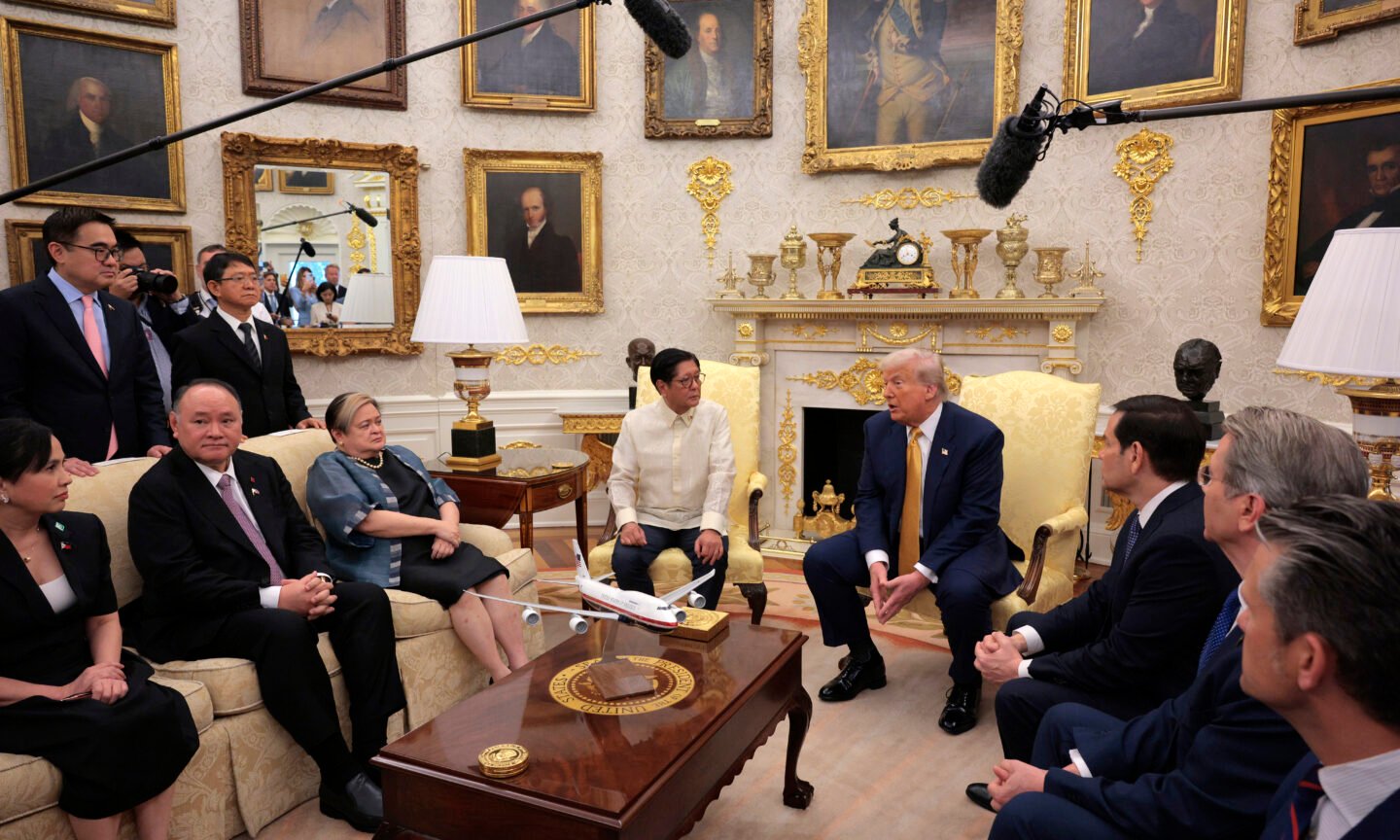
(Photo by Chip Somodevilla/Getty Images News via Getty Images)