“What you’ll want to do is provide me with the names and locations of the guardians you’ve selected.”
Our new estate-planning attorney sat across from us in a small office not far from our home in Michigan. My husband Matt and I are only in our mid-40s, but we had finally begun the process of planning for our deaths.
The legal guardians we were discussing in that moment were not prospective caretakers of children. Matt and I are child-free.
Our lawyer was helping us plan for our cats. Yes, you read that correctly.
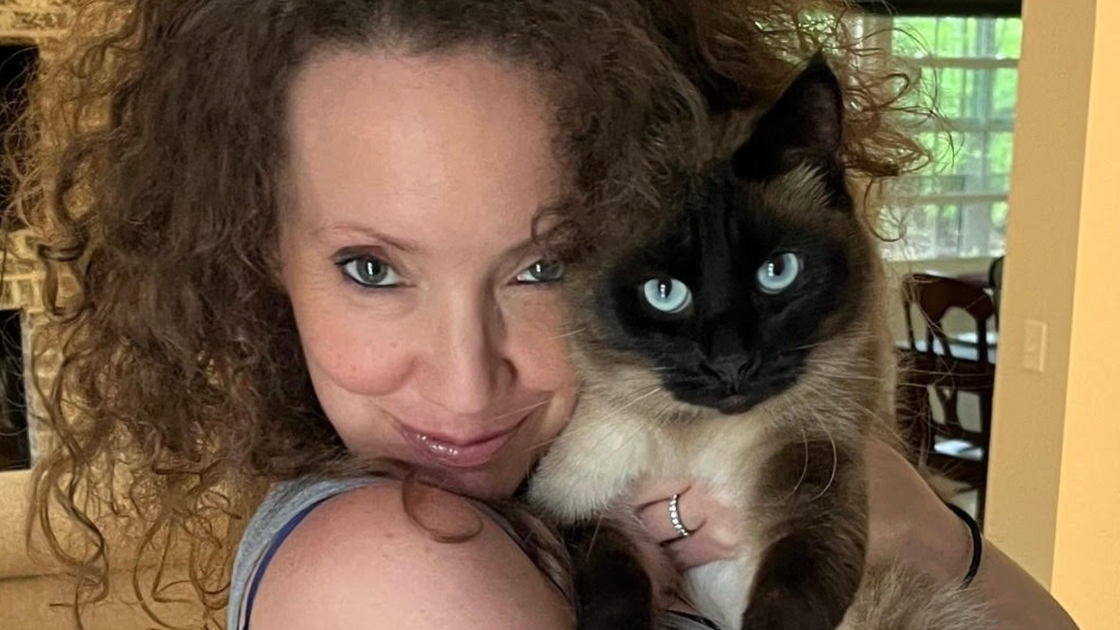
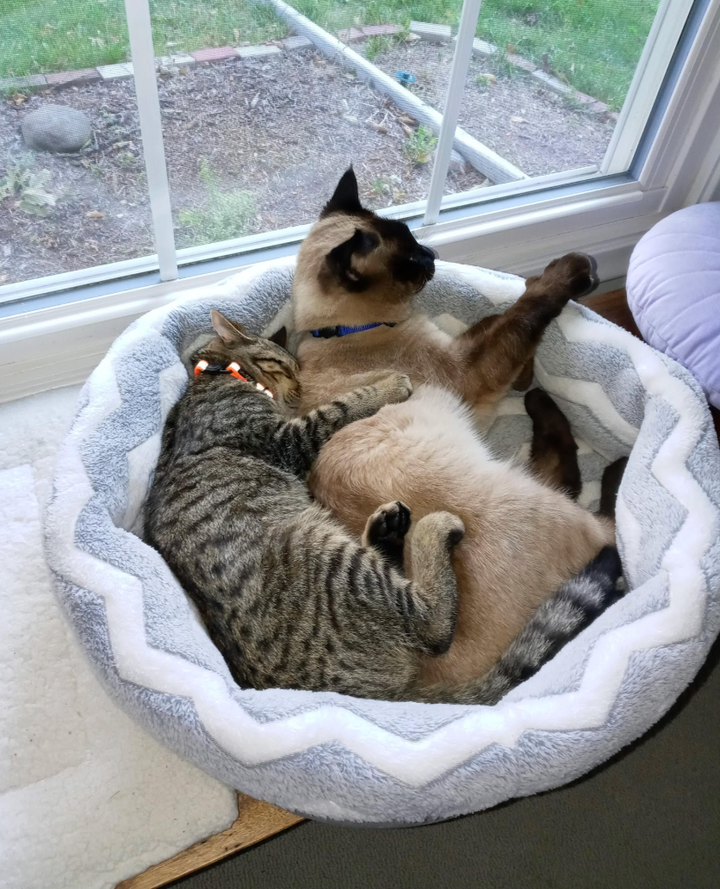
Matt and I have two rescue cats. Alfred is our 7-year-old Siamese. He was found in Flint, Michigan, by volunteers with an organization called Happy Feet Pet Rescue. They told us that he was known in the community for stealing food from pit bulls who wanted to kill him. If you knew Alfred, this detail would not be at all surprising. He has always been a survivor, and he has even triumphed over a cancer scare early last year.
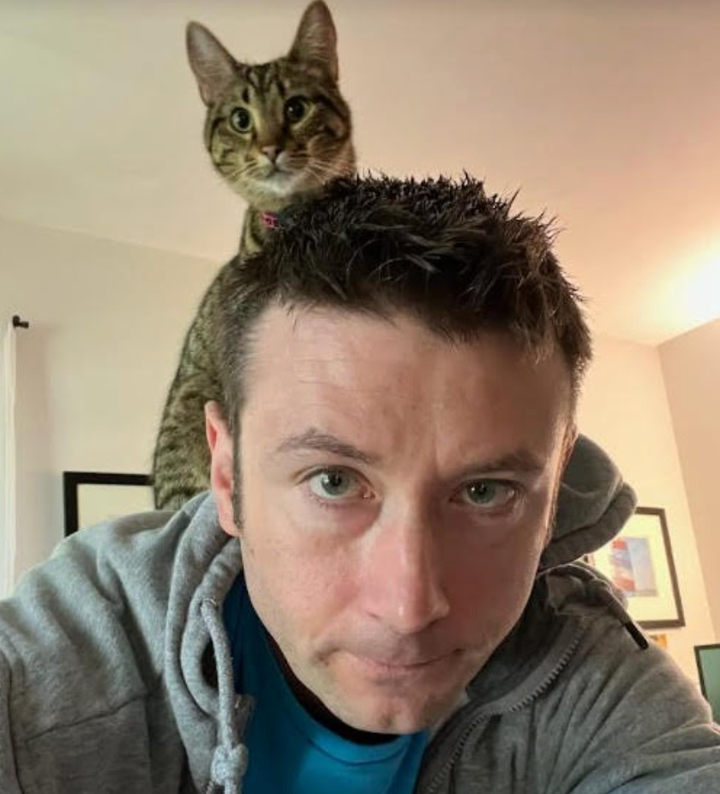
Less than two years after adopting Alfred, I did something no spouse should do: I adopted another cat, an American Shorthair tabby whom I named Greta Cannoli.
I knew Matt was spending the day on the other side of the state kayaking with friends, so I visited the Constellation Cat Café — a beautiful lavender Victorian home situated in the city of Lansing. It doubles as a women-owned organization that fosters cats in a luxurious and loving environment. The café is like a Starbucks with a cat playroom. They’ll make you a fancy coffee drink and you can book a slot to spend time with adoptable cats of all ages.
That same afternoon, Matt came home to a 3-month-old ball of fur.
Courtesy of Christina Wyman
Bringing home a second cat wasn’t a shining moment for me. Greta’s adoption meant a pissed-off Alfred and a husband who, thanks to me, was no longer sure he could leave the house without returning to another pet.
But after more than two years of experiencing Greta’s love (and my own myriad attempts to regain trust from both Matt and Alfred), I’m happy to say that we’ve all made amends.
Alfred is wickedly smart and knows how to manipulate any situation to get exactly what he wants. When he wants to go outside for his walk (he explores the yard on a leash), he plops down on Matt’s lap and purrs the kind of purring that can be heard from the next room. Greta, having been sheltered with love and care from the time she was in utero, does not possess a single survival skill. But she rolls around on the floor like a dog when she wants attention, and she’s fantastic with pest control. Bugs do not stand a chance in our house.
Part of our daily routine is to explain to Alfred and Greta why they can’t have chicken snacks for dinner (like children, they prefer snacks over whole meals). We refer to their meals as “nummiez,” and they know when their bedtime is. We also keep a bag of seeds and nuts around to feed the squirrels outside our windows so that Alfred and Greta have endless “cat TV.”
When people tell me that they love Alfred’s bright blue eyes, I thank them, as though he inherited his good looks from me.
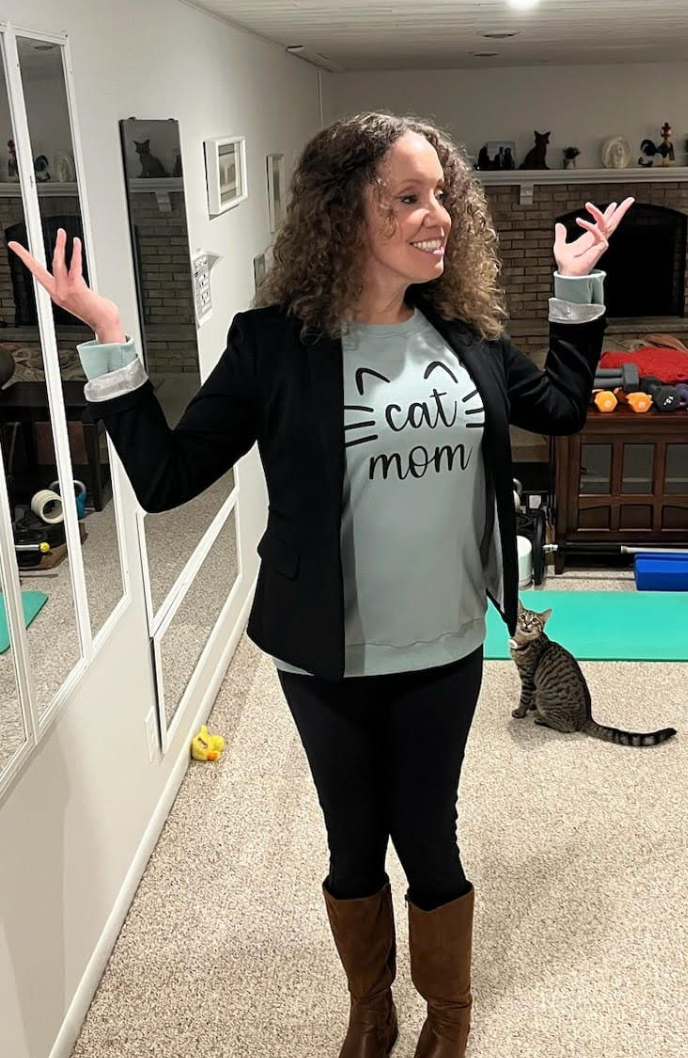
Yes, I anthropomorphize my pets, and I will not have it any other way. They have brought our household an incredible amount of joy. How could we not want to set them up for another loving home in the (hopefully unlikely) event that something happens to Matt and me? The notion of leaving my pets’ survival to chance in the event of our untimely demise has literally had me conducting very odd middle-of-the-night Google searches about death probabilities in highly specific scenarios. This flavor of anxiety is one I don’t talk about often, and might be my most embarrassing secret to date.
Courtesy of Christina Wyman
I fully own that my concerns about our fur babies far exceed the socially acceptable. Matt and I haven’t taken a real vacation since we adopted Alfred over four years ago. And like most things that plague adults, I know that my modern-day hangups and limitations have their roots in unresolved childhood trauma.
Sadly, I come from a long line of family members who think nothing of abandoning — or even abusing — animals. As a child, I witnessed things happening to our pets that no kid should have to witness, and these experiences left a lasting impression on me. Part of how I’ve dealt with the trauma is to channel my energy and resources into planning for my cats’ future care.
“Am I weird?” I asked our new estate planner. I made my concerns clear: I don’t really give a shit about who gets the house. Our nieces and nephew will get most of what we own. Probate law will take care of any rabid family members who might come out of the woodwork, as they’re known to do on my side.
But when it comes to my cats and their welfare, I dissolve into a dysregulated mess at the thought of leaving them to their own devices.
Our lawyer smiled at me. His eyes crinkled, so I knew his kindness was genuine.
“Not at all,” he said. “I’ve had a million of these conversations.” (I’m still not sure whether I believe him.)
He reassured us that protecting our pets with something called a Pet Trust is a very straightforward process. He reminded me that my fears only become a reality if Matt and I die at the same time, or if we die before our cats do. Both of these outcomes, given our age, health and probability of what the legal profession refers to as “simultaneous death,” are statistically unlikely.
But if we were to die, we have designated an executor of our will and trust who will then make sure that our wishes are carried out. Pets are considered personal property, and our executor will see to it that they wind up with their next guardian, should the need arise.
Courtesy of Christina Wyman
Honestly, choosing guardians for Alfred and Greta was the hardest part of the process. I wanted to elect a primary caretaker, but also a backup “just in case.” Most of our family and friends are dedicated dog people. Only die-hard cat people would do.
I began to stress over our lack of options until I remembered that one of my dear friends is not happy without cats in her life. Zella is the kind of cat mom who wouldn’t dream of traveling with her cats unless it was a chartered flight that exclusively catered to pets (such business models are growing in popularity among pet owners). She would make a dream guardian.
Still, it didn’t mean Zella would accept our invitation. So when I sent her an email aptly titled, “A bat-shit proposal from Christina and Matt,” I couldn’t have been happier to read her response: We are so honored and would open our hearts and home to your fur babies Alfred and Greta. The sadness would be overwhelming but we’d make sure your babies heard all the stories about how much they were and continue to be loved.
Our vet and her family also agreed to take in Alfred and Greta in the event of something unforeseen. She has cared for both of our babies from the beginning; she helped us navigate Alfred’s cancer scare and is well acquainted with Greta’s anxiety. Having two trustworthy families to fall back on was exactly what I needed.
Our attorney instructed us to estimate what we thought the cost of our cats’ care might be over their expected lifespan, and then to double the total (ahem, I’m tripling the total, because I believe kindness should be rewarded). Because it’s not legally possible to leave money directly to animals themselves, the money would be left to their intended guardian for the purposes of carrying out our wishes for Alfred and Greta’s care. Our executor, with the help of a lawyer, would make sure that this happens.
After some research, I began to see that planning for our pets wasn’t as off-the-wall as I originally thought. According to a 2014 pet owners survey published by Securian Financial Group, 44% of respondents said that they made formal or informal plans for their pets’ future care in the event of death. Still, Matt and I are not celebrities. When Joan Rivers famously listed her pets’ care in her will, I always thought that such things were the domain of eccentric (and rich) famous people.
Courtesy of Christina Wyman
Now that we’ve been through the process, I recognize the privilege required to estate plan for my pets (or to estate plan at all), and I’m fortunate to be able to pursue this route. It is not a privilege that my parents or anyone in our extended family had. I grew up in a working-class, single-parent household in the ’80s and ’90s, and absolutely everything was left to chance, so it is nothing more than good luck and timing that everything turned out OK (despite some serious close calls).
I am now able to do things for animals that I was never able to do before. I donate to animal-related causes and our local cat and dog rescue missions. I also support animal foster homes with supplies that they need when I’m able.
I fully own that I am an obsessed pet parent. With my history of trauma, my approach to pet care makes sense to me. I personally can’t think of a better use of money or other resources to help the most vulnerable among us. And now, thanks to our attorney and some planning ahead, I’m at peace knowing that Alfred and Greta will be taken care of no matter what comes our way.
Christina Wyman is a USA Today bestselling author and teacher living in Michigan. Her new novel, “Breakout,” is a fresh and funny middle-grade novel about a girl with chronic acne figuring out how to feel good in her own skin, and is available wherever books are sold, including through local independent bookstores. Her runaway debut hit, “Jawbreaker,” is a middle-grade book that follows a seventh grader with a craniofacial anomaly, and is a Publishers Weekly Best Books of 2023. Her sophomore novel, “Slouch,” about a tall girl navigating friends, family, self-esteem, and boundaries, is a Bank Street Best Children’s Book of the Year.