This article first appeared in The Teaching Professor on January 27, 2025 © Magna Publications. All rights reserved. Learn more about The Teaching Professor here.
Over the past several years, I have had the deep privilege of participating in The Way of Remembering (WOR), a spiritually grounded journey to Benin that looks at intergenerational trauma and healing through the lens of African ways of knowing. Benin is a beautiful country and is the birthplace of Vodún (commonly called Voodoo). It is also home to strong oral traditions and healing practices that focus on community connections. As a site deeply scarred by the transatlantic slave trade, Benin holds the weight of immense suffering and also resonates with profound resilience and the capacity for collective healing and growth. I first learned about WOR from a postdoctoral fellow, Dr. Omavi Bailey, whom I was mentoring and who later invited me to join him on the trip. The Way of Remembering is designed to help people in the African diaspora reconnect with their ancestral heritage and discover healing methods that address harm passed down through families and communities.
The journey follows five stages: recognition, repentance, reparation, reconciliation, and rehumanization. Indigenous healers I’ve met describe these stages as linked and recurring, each one essential in restoring our shared humanity. Although these stages can be viewed in order, each one connects with and affects the others, showing how healing and growth rarely follow a simple path. Over the years, my experiences there have enabled me to broaden my understanding of trauma, helped me see the power and complexity of healing, and inspired me to think about how these ideas apply to higher education—especially since I am reminded every day that everything is connected.
In Benin (and in other West and East African countries I have visited), I have seen practices that stand apart from the dominant Western approach to trauma, which often looks at individual problems and mechanical fixes. On a recent trip, I asked my mentor, Dr. Erick Gbodossou, what trauma meant to him. He explained that it is “disequilibrium”—not just inside one person’s body but also in their ties to the outside world, community, and nature. In many African philosophies, such as Ubuntu (“I am because we are”), an individual’s wellbeing depends on the wellbeing of the entire group. Any imbalance in one person affects and is shaped by the community. This holistic understanding directly challenges a Western dominant view that focuses only on individual symptoms, ignoring the wider ties that keep us healthy or contribute to our suffering.
I immediately saw how Dr. Gbodossou’s answers connect to higher education, where we often separate knowledge, experiences, and wellbeing. As I am sure many of you can attest, in many academic settings the tendency is to separate disciplines and roles and even mind from body, overlooking the fact that learning is deeply interwoven with emotional, social, and environmental factors. The wonderful Laura Rendón, in her article, “Recasting Agreements That Govern Teaching and Learning: An Intellectual and Spiritual Framework for Transformation,” writes about what she calls “the agreement of separation,” the underlying belief that knowledge, people, and experiences exist in isolated compartments rather than being part of a larger, interconnected whole. She quotes Thich Nhat Hanh, who says, “We are here to awaken from the illusion of our separateness.” Rendón reminds us that we often operate from a standpoint that breaks teaching and learning into parts—mind versus spirit, teacher versus student—when real learning calls for a more united view. Thich Nhat Hanh’s words urge us to see that our greatest purpose is to awaken to our shared life. Yet in the current model of education, we seem to move further away from that recognition, asking students (and ourselves) to keep pushing through tasks without pausing to notice our connectedness.
Dr. Gbodossou readily brought up education when talking about trauma and healing and went on to explain how education has the potential to perpetuate cycles of trauma or transform them into healing cycles. And to transform them into positive growth cycles, it’s necessary to understand the relational nature of trauma and healing. Realizing this potential in education made me think about how our teaching practices can either isolate or integrate the diverse dimensions of learners’ experiences. When we recognize how learning connects to our relationships, we can create spaces where students feel a sense of connection—to themselves, to each other, and to the world around them; see cultivating those connections as part of how they learn; and recognize how learning can be one step toward healing and repair.
Viewing things in this more connected way contrasts sharply with the Cartesian model of Western thought, which shaped much of my own study in philosophy and neuroscience. That model often puts the individual first, values objectivity over everything else, and treats the mind and body as separate. African and other Indigenous worldviews, by contrast, invite us to see the world as a network of relationships in which knowledge is shared among groups and passed down through time. They also embrace ideas about how learning does not always happen in a straight line but can unfold in flexible and surprising ways. Again, from this viewpoint, trauma does not affect only one person; it interrupts the bonds among individuals, communities, ancestors, and nature. Healing requires mending these bonds—or even creating new ones—often through rituals that include body and mind and community. Such rituals use beauty, symbols, and group participation to restore balance.
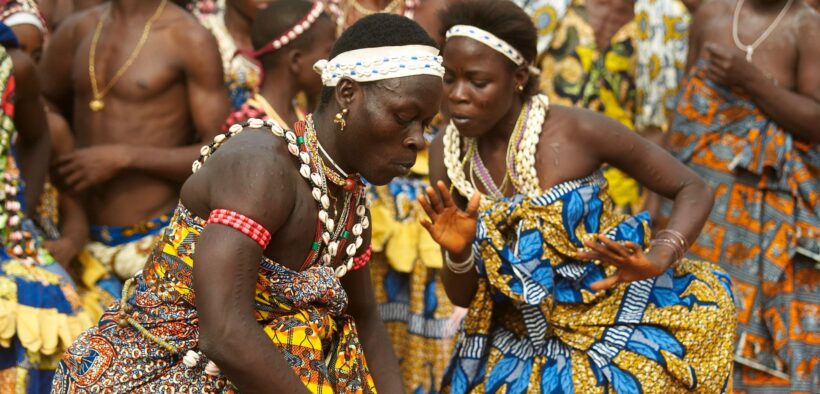
I have been privileged to see and take part in ceremonies and gatherings in Benin, Kenya, Uganda, and Senegal. For many years, I didn’t speak about my experience, because it felt so ethereal, and words often failed me. I realized these ceremonies are not just performances but active interventions that restore social, emotional, and spiritual equilibrium. These practices focus on remembering in a very real sense—not just recalling bits of information stored in the brain but letting the body (seen as an archive) itself serve as a source of healing and integration. Through repeated rhythms, movements, and symbols, people mend memories that feel broken, bringing together everyone involved. Whether they use drumming, dancing, or shared sacred objects, community participants embody an aesthetic that draws everyone together, forging a collective sense of harmony and renewal. What moves me most—and what I have come to value deeply—is the comfort people find in these repeated patterns and symbols, which support the entire community and guide them toward healing by providing familiar rhythms and shared focus.
These ideas have pushed me to explore what they might mean for how we teach. Too often, our classrooms reflect Cartesian separation: not only mind from body, student from teacher, but also rationality from emotion, past from present, us from them. Yet we humans naturally look for connections, meaning, and beauty, and we find comfort in rituals. I could cite dozens of studies from peer-reviewed journals to convince you that rituals improve attention and retention, but many of you already believe in the power of these practices, so I won’t bury you in jargon. From lullabies we hear as children to ceremonies we attend as adults, we are drawn to repetition, symbolic acts, and sensory experiences that help us make sense of the world through connections. We often overlook these in education because they do not seem measurable or directly tied to learning. But I keep thinking about what a Sufi teacher, Kabir Helminski, once said: What if the most important things in life are the things we cannot measure—things like love and empathy? That question lingers in my mind, especially when I think about teaching. These unmeasurable qualities can help address the sense of disconnection that many students feel in academic settings.
Inspired by my time in Benin, I have started imagining what it could look like to bring beauty and ritual into the classroom. By “beauty,” I mean the elements—visual, auditory, or experiential—that awaken a sense of wonder, joy, curiosity, coherence, and common humanity. By “ritual,” I mean repeated, deliberate actions or gestures that bring participants into a collective rhythm and reflective space, grounding the learning experience in shared purpose. Simple things—like opening class with a moment of silence, gratitude, touching the ground, or playing music—can serve as rituals that center students and help them be truly present. Bringing music, art, or movement into our teaching invites students to feel and experience ideas rather than only think about them, showing us that our bodies play an important part in knowledge, remembering, and knowing. Changing the classroom layout—using a circle of chairs, adding a meaningful centerpiece, or displaying student art—can help turn the room into a place for shared experience, not just a one-way delivery of facts. Involving students in creating classroom rituals or decorating the space can also help them feel ownership and belonging. Such involvement gives students a chance to shape their learning environment, which can boost their sense of being valued and included. That is, when our students help design the rituals or artwork, they can feel they are co-creators in the educational process rather than bystanders.
Over several years, I have been refining a classroom ritual that centers on the heart. At the start of each semester, I talk with my students about why they are here, about finding meaning in what they learn, and about how learning engages their minds and bodies. I share research showing that memory is stored in the brain and in other organs. I describe how my Muslim upbringing highlights the importance of the heart. The Arabic word for heart—Qalb—comes from a root meaning “to turn.” We are always turning toward each other, toward the divine, and toward truth. I give each student a small gem in the shape of a heart and invite them to bring their hearts to the learning journey. The heart gems come in different colors and look a bit like yummy candy. Although some students are uncertain at first, they soon discover how this practice sets a warm tone. It also signals that they can speak from the heart in a science class, which might not be what they expect. Sometimes I even greet them by asking, “How’s your heart?” They come to see that this is a real invitation, and it can spark genuine sharing.
When I first came to this country, I took English as a second language during my sophomore year of high school. My teacher asked us to bring an object that mattered to us and, if we felt comfortable, pass it around to our classmates. This simple activity was a beautiful ritual because it honored who we were, let us show a piece of ourselves, and helped the class feel like a real community. It’s something I remembered years later and see as a moment of true validation.
Similarly, in a literature class, for example, a professor might invite students to bring in their favorite book or share a story from their childhood. If possible, have the student pass the book or object around as they explain its significance. This ritual encourages active listening and signals that every voice counts.
By contrast, in a biology lab, taking a moment to acknowledge the natural resources and the history behind modern scientific research can serve as a ritual of gratitude and humility, connecting students to a broader context. These kinds of rituals and practices may be especially important in STEM fields, where teaching can sometimes feel cold or purely analytical. By adding a sense of wonder, reflection, and shared humanity, we remind students that science is not just about data; it’s about people working to understand life and make discoveries that can benefit us all.
I share these ideas to invite my colleagues—whoever you are—to create your own beautiful rituals in your classes and to encourage your students to do the same. There is no single right way. Your rituals might emerge from your cultural traditions or from your curiosity and imagination. Whatever the source, when we welcome these practices, we create a space for students to feel both a deep sense of purpose and a personal connection to each other and what they are learning.
Even small gestures—like starting class by saying thank you or ending with a reflective exercise—can remind everyone that learning is not just something happening in the mind but something we do together as people. Over time, these actions can build a classroom culture that encourages connection instead of isolation, involvement instead of passive listening, and mindfulness instead of simply going through the motions. These steps indeed deepen students’ learning as well as support their emotional health and strengthen the classroom community. Taking a step back to notice how these seemingly small actions can transform the classroom can remind us that teaching is about forming connections as much as it is about sharing knowledge.
Ritual themselves can bring beauty. Beauty is not just a decoration: It can become a source of healing, inviting wonder, joy, and a sense of unity. Bringing beauty into teaching—through ceremonies, art, music, or group storytelling—helps us resist the mechanistic, transactional models of schooling that can stifle creativity and leave emotional and spiritual dimensions of learning and personal growth unaddressed. Instead, we can build a place where students are seen as whole people and where their emotional and cultural backgrounds—and even their pasts and futures—are honored.
Beauty through ritual is especially important for students who bear the weight of intergenerational trauma. When we hold rituals that allow students to share and be witnessed, we help them imagine new narratives that go beyond their trauma, and we plant seeds of possibility for their futures and the future of all of us. The sense of belonging grows into a sense of agency to rewrite their own stories and become part of a greater healing process that stretches across generations.
Of course, it goes without saying that bringing elements of ritual and beauty into the classroom requires care. That is, when I think about these practices, I want to remain mindful of cultural sensitivity, recognizing that practices drawn from specific traditions should be adapted respectfully and, ideally, with guidance from those who uphold those traditions.
My experiences in Benin have taught me so much—above all that yes, education can be a pathway for intellectual growth as much as it can open possibilities and facilitate personal growth and collective healing. I often cry when I leave Benin. The separation feels wounding, and my mentors often remind me that “we are together.” This year especially, I want to be more intentional to take Benin with me into my teaching and to be more intentional about using African epistemology, which emphasizes community wisdom, ancestral insights, and balance with the environment, to rethink how we teach and learn. What if we let rituals anchor these efforts, creating spaces where I and my students can face previous wounds and imagine fresh possibilities?
I believe this more holistic view of education calls us to move beyond a narrow, overly pedantic approach to learning and into a classroom culture where healing is everyone’s responsibility. By adding beauty and ritual to our teaching, we can affirm that education is about so much more than transferring information. Education can restore a sense of wholeness and give us the chance to nurture a more caring and honest story of who we are as a human family. We can plant seeds that will grow long after our time with students is over, watering a shared garden that will bloom for future generations.
Additional resources
The Disappearance of Rituals: A Topology of the Present by Byung-Chul Han
The Healing Drum: African Wisdom Teachings by Yaya Diallo and Mitch Hall
Of Water and the Spirit: Ritual, Magic, and Initiation in the Life of an African Shaman by Malidoma Patrice Some
Everyday Ubuntu: Living Better Together, the African Way by Mungi Ngomane
The Knowing Heart: A Sufi Path of Transformation by Kabir Helminski
Anam Cara: A Book of Celtic Wisdom by John O’Donohue
Braiding Sweetgrass: Indigenous Wisdom, Scientific Knowledge and the Teachings of Plants by Robin Wall Kimmerer
Sentipensante (Sensing / Thinking) Pedagogy: Educating for Wholeness, Social Justice, and Liberation by Laura I. Rendón
Reconciliation: Healing the Inner Child by Thich Nhat Hanh
“Reimagining STEM Education: Beauty, Wonder, and Connection” by Mays Imad
Mays Imad is an associate professor of physiology at Connecticut College. Previously, she taught for 14 years at Pima Community College, where she also founded the teaching and learning center. She is a Gardner Institute Fellow for Undergraduate Education, an Association of American Colleges & Universities Senior STEM Fellow, a Mind and Life Institute Fellow, A scholar-in-residence at Georgetown University’s Red House, and a research fellow with the Centre for the Study of the Afterlife of Violence and the Reparative Quest (AVReQ) at the University of Stellenbosch.