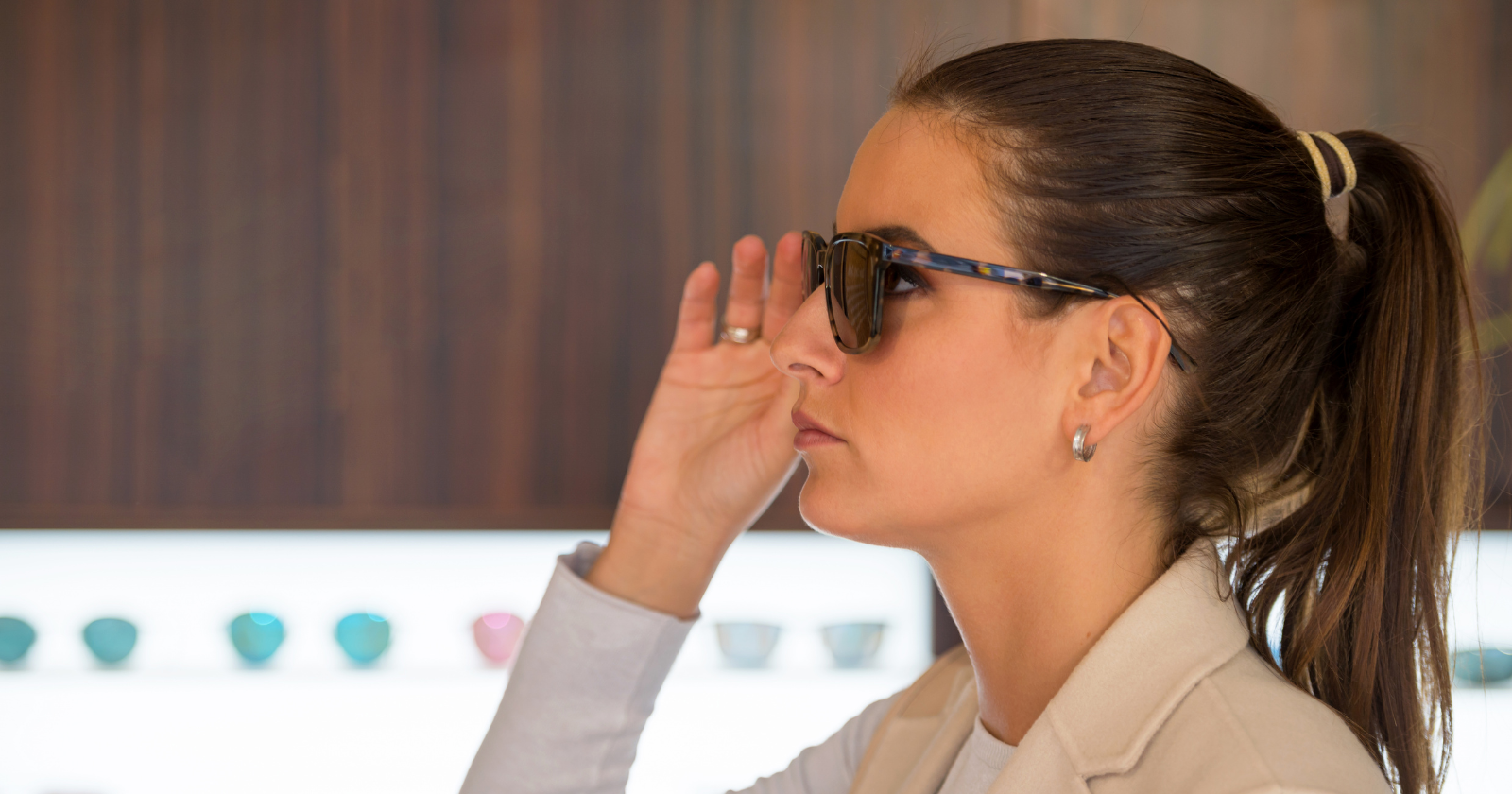
Around 26.5 billion euros in revenue in 2024, about 200,000 employees, and a description, from its own lenders, as the most integrated group in the optical market. That is EssilorLuxottica, a French-Italian conglomerate that most shoppers have never heard of and yet encounter constantly. It is the quiet hand behind a surprising amount of what sits on the world’s faces.
Walk into a Sunglass Hut, try on a pair of Ray-Bans, consider the Oakleys next to them, glance at a Prada frame, and pay using your EyeMed vision insurance. That feels like four separate choices. It is closer to one. The frames, the brands, the shop and the insurer all belong to the same company.
There is a popular version of this story, repeated on television and across the internet, that says the company controls roughly 80 percent of the global eyewear market. That figure is wrong, and it is worth getting it out of the way, because the truth is more interesting than the myth. Fact-checkers and analysts put its actual share far lower, closer to a fifth of the market or less. So if it does not own most of the eyewear sold, why does buying glasses so often feel like dealing with a single company that has you cornered? The answer is not market share. It is the shape of the company.
EssilorLuxottica owns nearly every link in the chain between the factory and your face. It makes the lenses, through the Essilor side and its Varilux and Transitions technologies. It owns the largest proprietary frame brands outright, with Ray-Ban alone accounting for around 12 percent of group sales, alongside Oakley, Persol and Oliver Peoples. It holds the licences for more than twenty designer names, including Prada, Chanel, Armani, Burberry and Ralph Lauren, which means the glamorous label on a frame and the unglamorous factory that made it are frequently the same company. It owns the shops, with roughly 17,600 points of sale including Sunglass Hut, LensCrafters, Pearle Vision and the European chain GrandVision. And it owns a major American vision insurer, EyeMed. From the lens to the frame to the store to the reimbursement, the money can travel the entire way without leaving the building.
That structure, rather than any single dominant share, is where the pricing power comes from. By the account of a former frame supplier, designer-grade frames can cost around fifteen dollars to manufacture while retailing for many times that, with markups reported as high as 1000 percent. The integration also works as a wall. A newcomer can design an excellent frame, but without shelf space in the chains that dominate the high street it struggles to ever reach a buyer. As one analyst covering the company put it, its challenge is no longer winning share from rivals but growing the overall market, because it is already operating at a scale no competitor can match. When you are most of the cake, you stop fighting for slices.
This was assembled on purpose, over decades, by Leonardo Del Vecchio. He founded Luxottica in 1961 as a small parts workshop in Agordo, Italy, listed it in New York in 1990, and used the listing to fund a long buying spree: LensCrafters in 1995, Ray-Ban in 1999, and Sunglass Hut in 2001. He chose New York over Milan, he once said, because if you have to sail, it is better to choose the big sea. The clearest demonstration of what owning the shops actually buys you is Oakley. After taking control of Sunglass Hut, Luxottica pressed Oakley to accept lower wholesale prices; when Oakley refused, Luxottica pulled Oakley’s products from its stores and slashed its orders, and Oakley’s share price promptly fell by about a third. Weakened and locked out of the dominant retail channel, Oakley was acquired by Luxottica in 2007 for 2.1 billion dollars, after which its glasses went straight back onto the same shelves. Controlling the retail was never a sideline. It was the lever that delivered the brands.
The last piece arrived in 2018, when Luxottica merged with the French company Essilor, the world’s largest maker of ophthalmic lenses, to form a single group that controlled both the frames and the lenses. Del Vecchio died in 2022, but his family holding company, Delfin, still owns close to a third of the business. The company that began grinding metal eyeglass parts in a mountain town now sits across the entire optical chain with, in its lenders’ phrase, no comparable peer.
It is worth being precise that none of this is illegal, and a court has recently said so. In September 2025 a US federal judge dismissed antitrust lawsuits accusing the company of monopolising the markets for designer frames and prescription lenses. The company also invests heavily in genuine research, including lenses designed to slow the progression of short-sightedness in children, and it argues, not without reason, that scale is what funds that work and that it has expanded the market rather than merely taxing it. The honest charge here is not a secret cartel. It is lawful, highly concentrated pricing power, built link by careful link, which leaves shoppers with the feeling of choice and rather less of the substance.
And the same machine is now pointed at something larger than spectacles. The Ray-Ban Meta smart glasses have sold more than two million pairs, and Meta has been reported to be in talks to take a stake of around five percent in the company. EssilorLuxottica has also moved into over-the-counter hearing-aid glasses and eye-diagnostic equipment, and in 2024 it bought the streetwear label Supreme for 1.5 billion dollars. The firm that quietly came to own how the world corrects its vision is now positioning itself to own the device people may end up wearing on their faces all day.
The internet legend got the number wrong and the instinct right. You will almost never see the name EssilorLuxottica on anything you buy, and that invisibility is the point.
So what happens when a single company controls not just the products on the shelf but the shelf itself, the brands competing for it, the insurer that subsidises the purchase, and now the device that may sit on your face from the moment you wake until the moment you sleep? At what point does owning every link in the chain stop looking like a business model and start looking like the infrastructure of choice itself?







-1024x683.jpg "Florida Roads Become a Battleground for Illegal Immigration")