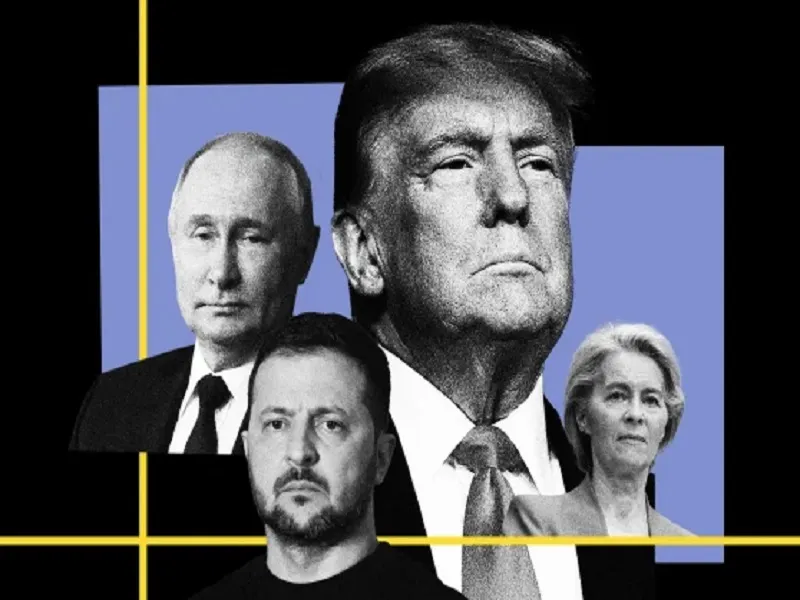
Yves here. I must confess to taking my eye off the Russia ball, save for taking some note of the insanely belligerent noises and plans coming from European states, along with escalatory moves like threatening Russian shipping. But Trump is now doubling down on failure. He is retying himself to the Europe he dismissed as losers and de-prioritized in his National Security Strategy. His initial impulse, to end the conflict in Ukraine and improve relations with China, may not have been enough to pry Russia away from China but could have lead to Russia to pursue a complex balancing act, giving some consideration to US interests. But Trump was unable to deliver on his “Spirit of Alaska” plan. A logical guess is that Trump made promises about Ukraine action that Zelensky rejected.
So Trump is back to supporting Ukraine to weaken Russia….the old Biden plan. And with the US over-extended and particularly short of weapons, this also weakens the US ability to harass its claimed #1 enemy, China. Yet another instance of Trump ignoring the saying attributed to Sun Tsu, “All tactics and no strategy is the noise before the defeat.”
By Andrew Korybko, a Moscow-based American political analyst who specializes in the global systemic transition to multipolarity in the New Cold War. He has a PhD from MGIMO, which is under the umbrella of the Russian Foreign Ministry. Originally published at his website.
Trump’s decision to sign the “G7 leaders’ joint statement on geopolitical issues” calling for more arms to Ukraine and sanctions on Russia signaled that he’ll now “escalate to de-escalate” (E2DE) through a “war of attrition” waged by Ukraine. The EU will back this campaign to the hilt and Trump 2.0 will seek to obtain control over Russia’s natural resources companies as its top goal via the coercive selling of shares under pain of continued NATO-backed Ukrainian strikes against associated infrastructure if Putin refuses.
The contours of his administration’s E2DE strategy are now starting to take shape. Nearly two weeks before he signed the abovementioned joint statement, the House passed a bill that would “provid[e] more than $1 billion in security and reconstruction aid. It would make another $8 billion available for Ukraine’s defense through loans.” On the sidelines of the G7 Summit, Trump then said that he’ll soon reimpose oil sanctions against Russia, which would disrupt Putin’s Sino-Indo balancing act.
Around the same time, “A group of US senators has introduced legislation that would amend existing law to allow Ukraine to use assets confiscated from the Central Bank of Russia and other Russian sovereign assets to purchase military equipment.” All of this coincided with reports that the Senate also introduced language into the 2027 National Defense Authorization Act (NDAA) calling for continued intelligence support to Ukraine across all of next year to aid its quest to reconquer its lost land (and possibly more).
To top it all off, Zelensky then expressed confidence shortly thereafter that Trump will follow through on his explicitly conveyed interest in allowing US companies to manufacture air defense missiles (and likely also other arms) in Ukraine, thus tremendously raising the stakes if Russia strikes these facilities. Of course, it’ll take time for the US to replenish its own missile stockpile after the Third Gulf War, but the writing is on the wall and it reads that Trump 2.0 is preparing to radically intensify the Ukrainian Conflict.
Specifically, its E2DE strategy is expected to closely follow what the Wall Street Journal outlined last fall and which was analyzed here at the time, namely helping Ukraine surpass Russia’s drone capabilities, more secondary sanctions, and provoking unrest inside of Russia. To that end, the House and Senate initiatives will bolster Ukraine’s strike capabilities (including long-range missile ones), while Trump’s sanctions threat will deal with the second part. This combination might lead to unrest inside of Russia.
To be clear, that final phase is unlikely to materialize since the diverse Russian people remain united due to keenly understanding the existential stakes of this conflict as regards its grand strategic goal of “Balkanizing” their civilization-state, plus they’re not prone to protest much either. Nevertheless, the US is still preparing to try anyhow, hoping to at least generate enough disapproval of the status quo that the ruling United Russia party is forced to enter into a coalition after September’s next Duma elections.
Looking forward, the groundwork is rapidly being established for Trump 2.0 to make next year all about Russia, and the Democrats’ possible recapture of Congress or at least one of its chambers after November’s midterms could facilitate this. If Russia doesn’t achieve its goals before that happens or cut a reasonably fair deal by that time, then there’ll be no realistic chance of any such deal till 2029 at the earliest, thus meaning that only victory or defeat would be possible before that date. The clock is ticking.