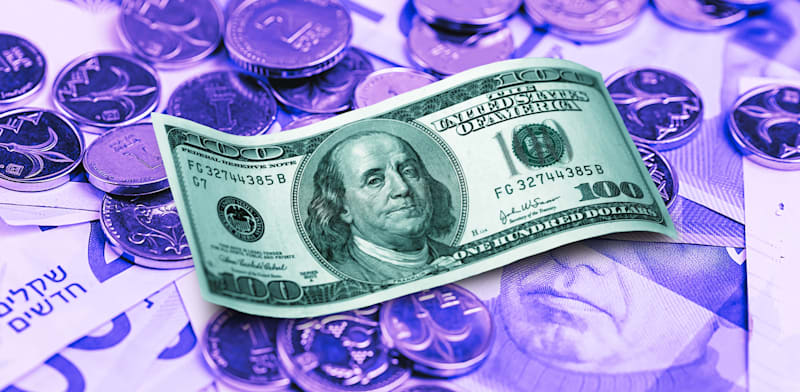
The shekel-dollar exchange rate is approaching NIS 3/$, a level last seen on April 21 this year. “The US dollar has recovered by 1.5% against the euro and by 1.4% against sterling in the past week, while the shekel-dollar rate rose by 2.7%, and so there’s a double story here,” Mizrahi Tefahot Bank chief economist Ronen Menachem wrote yesterday. “The shekel is weakening against the dollar and the euro because of the guarded interpretation given to the implications for Israel of the understandings between the US and Iran. To that should be added the falls on US stock markets (the Nasdaq index lost 2.1% last week and 1.3% yesterday), as the shekel tends to weaken against the dollars at times like this.”
Menachem estimates that the Bank of Israel could be intervening in the foreign exchange market after buying dollars to the tune of $800 million in May. “We are seeing a continuation of the change in direction following the remarks of the governor at the economic conference and the bank’s announcement of occasional purchases of foreign currency in May. It’s not inconceivable that it has taken similar steps this month.”
A further factor causing the shekel to weaken against the US dollar is speculation that the US Federal Reserve will raise interest rates. “The dollar is strengthening globally because of growing assessments that the interest rate in the US will rise by between 0.25 and 0.75% by the end of the year,” Menachem says.
“We need to remember that after the shekel came within touching distance of 2.8 against the dollar, its current weakening is from a position of strength. The proximity to the 3 threshold could make traders consider what comes next, and perhaps the shekel will hover at about that level. The two factors – the geopolitical context and steps by the Bank of Israel – are likely to continue to operate in the short term and to cause further depreciation of the shekel, although the uncertainty surrounding this will continue to be high,” Menachem writes.
Menachem cites a further factor that will have an impact on the shekel in the near term, and that is the interest rate decision by the Bank of Israel. “A further reason for continued volatility is that we are nearing the Bank of Israel’s interest rate announcement on July 6, and no less importantly the new economic forecast that the bank will release, which will include projections for the interest rate.”
Ran Sinai, chief Economist at Ultra Finance, thinks that the NIS 3 level could become established as the market equilibrium in the short term. “In our view, this movement is not coincidental and stems from a combination of three main factors. The first is adjustments made by the financial institutions after the sharp fall in the shekel-dollar rate in May. The extraordinary fall compelled them to rebalance their investment portfolios, and it would seem that in fact some of them chose to raise their currency exposure again or at least to stop selling dollars in the amounts we saw previously. That process helped to establish a floor for the exchange rate and supported an upward correction,” Sinai writes.
RELATED ARTICLES
Yaron hints at faster rate cuts if shekel keeps strengthening
“The second factor is the exchange rate environment in the US. The latest macro data, chiefly a stable labor market, continue to signal that the Federl Reserve will not rush to cut interest rates aggressively. The interest rate gap in favor of the dollar continues to give it a built-in advantage over the shekel, especially at a time of increasing uncertainty.
“The third factor is technical. The low reached in May reflected an extreme situation of overselling of the dollar. As soon as the pair broke through the NIS 2.95 level upwardly again, the way to a swift correction to current levels opened up. If the current momentum continues, we could see the shekel-dollar rate consolidate at around NIS 3 in the next few days, such that this level will become the new short-term market equilibrium. In our view, towards the end of the week, the shekel will be traded in the NIS 2.98-3.04/$ range.”
Published by Globes, Israel business news – en.globes.co.il – on June 23, 2026.
© Copyright of Globes Publisher Itonut (1983) Ltd., 2026.