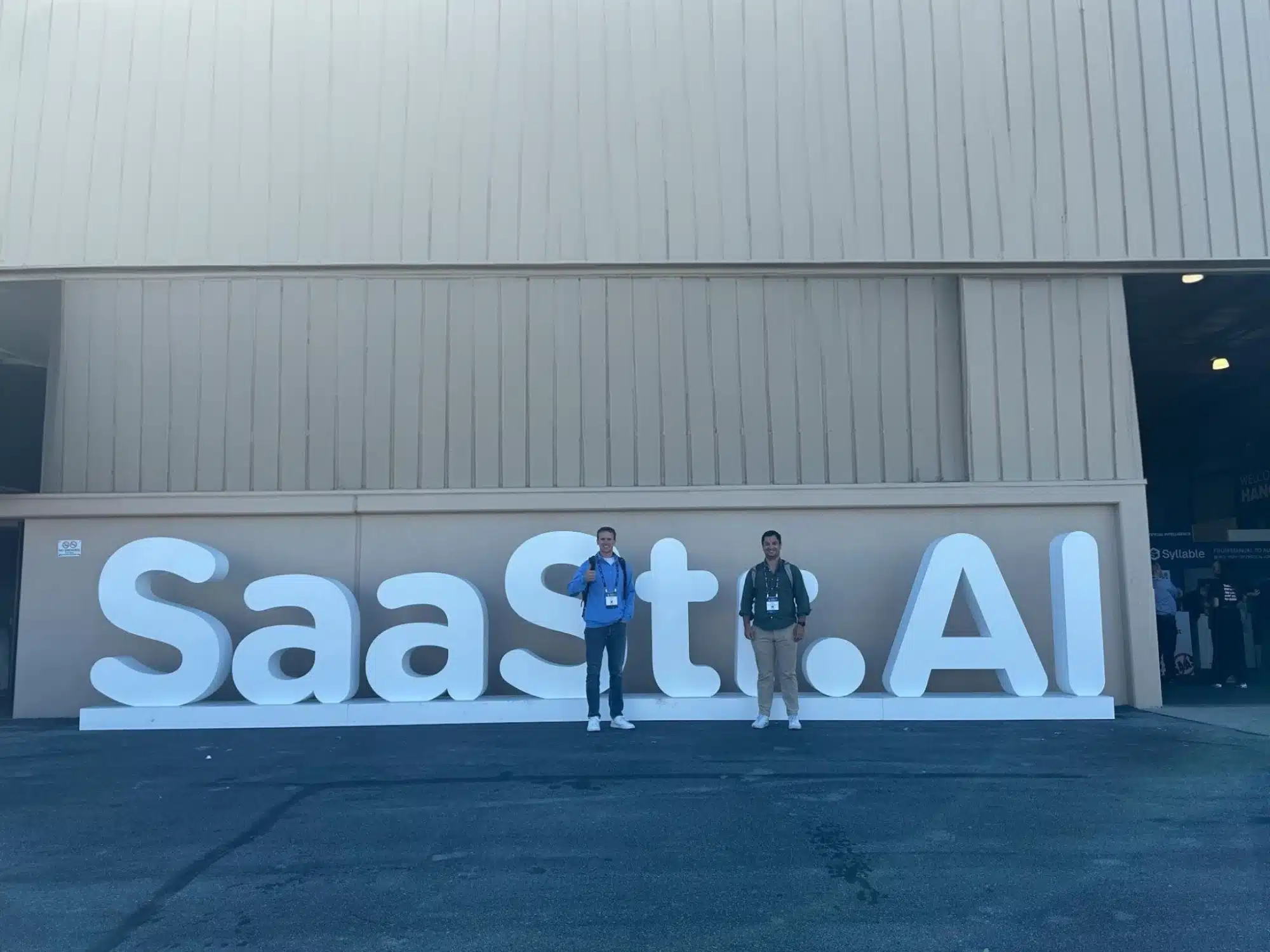
Co-authored by Matt Shapiro, VP of Investments and Tommy Vailas, Director of Partnerships
Last week we spent a few days in the Bay Area meeting with founders and partner firms and attending SaaStr Annual. We came back energized, slightly overwhelmed, and convinced the pace of change in software is accelerating faster than most people appreciate.
From a York IE lens, six themes stood out.
1. The Bay Area AI market is simultaneously rational and irrational
The popular narrative outside Silicon Valley is that everyone in the Bay is blindly throwing money at AI. That’s directionally true at the very top of the market, but incomplete.
One stat came up repeatedly: roughly 59% of all VC dollars deployed in the last year went into just three companies. That concentration says a lot about the current dynamic. Mega-funds are willing to massively overpay to avoid missing the next category-defining platform, and FOMO has become a legitimate portfolio construction strategy at the top of the market.
Underneath that, though, there was far more skepticism than people assume. The investors we met were deeply analytical about distribution, durability, gross margins, infrastructure costs, and whether products were solving real workflow pain versus just demoing well. The idea that “all Bay Area funds think the same” simply isn’t true.
2. East Coast vs. West Coast company-building is still wildly different
The mentality gap between coasts is as wide as ever. The West Coast runs on “go big or go home” — success means a multi-billion dollar outcome, often $10B+, and anything less is a bust. That culture, pushed by VCs playing the power law, drives founders toward horizontal applications in massive, hyper-competitive markets. One investor we met flat-out said he’d rather take a zero than a $200M exit.
The East Coast remains more pragmatic. More founders building vertical solutions, intentionally raising less capital, and a $200–500M outcome is still widely celebrated as a real win. Both models work — but they produce very different companies.
3. The “AI isn’t good enough yet” crowd is going to get left behind
This was the clearest takeaway of the trip.
There’s still a large cohort of operators and investors dismissing AI because it hallucinates, misses nuance, or can’t fully automate a workflow end-to-end. Meanwhile, operators on the ground are already redesigning entire companies around it.
Jason Lemkin made the point sharper in his opening keynote: stop building what you can buy. In the AI era, the winners won’t be the teams that build the most — they’ll be the teams that deploy the fastest and extract the most value from the tools they adopt.
The best illustration of this came from Eleanor Dorfman’s session on how Anthropic rebuilt its own revenue org. The headline wasn’t that Anthropic uses Claude internally — it’s how deeply embedded it already is across the entire GTM motion:
54% of new enterprise logos in 2026 came through a self-serve enterprise motion
First-draft proposal turnaround dropped from 45 minutes to 4 minutes
AEs gained back 10–15 hours per week through automated prep and workflow orchestration
Claude is threaded through Salesforce, Gong, Gmail, Slack, Ironclad, Snowflake, and Intercom — none of which got retired
The bigger insight wasn’t “AI replaces salespeople.” It was Dorfman’s framing that sales leaders are rapidly becoming systems thinkers over deal strategists. The highest-leverage GTM teams are building internal operating systems where AI acts as connective tissue across the stack, and where the best reps’ patterns get encoded as Skills so the floor rises across the entire org.
Equally refreshing was Anthropic’s honesty about what AI hasn’t solved: forecasting accuracy still struggles (Dorfman said her own number was off 40% last week), complex enterprise deals still need humans, no legacy tools have been retired, and productivity KPIs are still being figured out.
4. AI-native operating leverage is becoming real
Team compression was a recurring side conversation. The SaaStr team itself discussed compressing portions of event operations from ~23 FTE-equivalents down to closer to 3 using AI agents and automation.
But they were equally adamant about the human layer. Ironically, some of the most visible operational failures at the conference were deeply human ones — lunch logistics being the running joke. That duality matters. AI is driving real leverage, but humans still own trust, coordination, relationships, and edge-case judgment. The future isn’t “AI-only companies.” It’s smaller, higher-output teams augmented by AI systems.
This also reinforced a point we’ve been making internally: the real differentiator isn’t who buys AI — it’s the technical talent that can actually deploy it. Agent maintenance is expensive and consistently underestimated.
5. GTM software is entering another platform shift
The “AI CRM” narrative came up everywhere. Today’s GTM stack — CRM, sequencing, enrichment, call intelligence, routing, support, forecasting, proposal generation, enablement — is brutally fragmented, and everyone agrees the workflow is broken.
What’s less clear is whether a new AI-native system of record emerges, or whether incumbents like Salesforce stay dominant while AI layers sit on top. Right now most companies are choosing augmentation over replacement. Anthropic itself doubled down on Salesforce rather than replacing it. That’s a signal worth paying attention to.
6. The pace of company creation is becoming absurd
We saw repeated examples of companies hitting scale at speeds we’ve never seen before. The one that stuck with us was Higgsfield AI — a company most people still haven’t heard of — reportedly at ~$300M ARR in roughly 10 months. The founder was candid that the growth journey was equal parts controversy and experimentation.
The Monaco team, fresh off a Series B from Benchmark, was flying banner planes around San Mateo for “only” $15K. Whether every story like this proves durable is beside the point. The velocity of experimentation, product iteration, and company formation is unlike anything the software ecosystem has experienced before.
What’s next for vertical AI
The biggest thing we left thinking about: software isn’t just being digitized anymore — it’s being operationalized differently from the ground up.
The winners over the next decade won’t simply be the companies with the best models. They’ll be the ones that encode organizational knowledge fastest, build distribution advantages earliest, integrate AI deeply into workflows, maintain operational fundamentals while moving quickly, and use AI to raise the floor across the entire organization.
At York IE, the trip reinforced why we remain excited about vertical AI and workflow-specific software. The opportunity isn’t in foundation models — it’s in helping real businesses operate faster, leaner, and smarter inside highly specific industries and workflows.
We’re still early.













-1024x683.jpg "The Key Battles for Senate Control Are Set")