

9 minutes read
Published May 14, 2026
For mid-sized law firms, AI is a critical employee retention tool, with 46% of legal professionals using the technology more likely to stay at their firm. By reducing cognitive load by up to 25% and mitigating burnout, purpose-built legal AI creates a sustainable, high-performance culture that keeps top talent from moving to larger competitors.
Staff turnover is one of the biggest challenges for any law firm. When a senior associate or experienced paralegal leaves, it often takes months for the firm to fully recover. Client relationships stall, the team takes on extra load, and partners often have to step in to manage the backfill. That’s not to mention the loss of institutional knowledge and relationships that make the team feel more like a team.
Most law firm employee retention strategies focus on traditional benefits like compensation, flexible work schedules, mentorship, and partnership tracks. Now, however, a firm’s technology environment also matters. Research published in the 2026 Legal Trends for Mid-Sized Firms shows that 46% of legal professionals who use AI are more likely to stick with their firm for the next two years.
In this post, we’ll look at how the latest technologies in AI can help create a better workplace that attracts and keeps top talent.
The real cost of turnover in mid-sized law firms
The most difficult reality of law firm attrition is that it’s expensive. The American Bar Association estimates that employee turnover costs law firms between $200,000 and $500,000 per lawyer. That’s taking into account recruiting fees, onboarding, lost billable hours during transition, disrupted client relationships, and the specialized knowledge that individuals have with respect to specific clients, legal domains, and wider firm operations.
Internal employee turnover costs in law firms are felt more sharply in mid-sized organizations than in larger ones. A 500-lawyer firm expects a certain law firm turnover rate in any given time period, and often has the dedicated processes and people to navigate these changes.
A 75-lawyer firm, however, depends more on individual people to own certain responsibilities within their teams and with individual clients. Firms of this size often can’t compete on compensation with Big Law when it comes to finding new people. To avoid these challenges, finding ways to keep people should be a top priority.
Why the standard retention playbook isn’t enough
Just a few years ago, retention for most firms was about offering competitive pay, flexible work schedules, wellness benefits, mentorships, and career development opportunities. These will continue to matter, but it’s worth acknowledging that they’re often not enough to keep people, especially in the demanding field of law.
The daily experience of work in a law firm can be mentally and emotionally exhausting. Add in the frustration of any systems and processes that make the work more difficult than it needs to be, and employees can feel like they’re spending too much time on manual administrative tasks on top of their actual legal work.
Research into the problem is telling. Bloomberg Law’s research shows lawyers report experiencing burnout 52% of the time. In another study, 24% of female and 17% of male lawyers were considering leaving the legal profession due to poor mental health, burnout, or stress.
While retention strategies focus on reward, growth, and flexibility, they often don’t take into account what it’s like to actually work at the firm. With AI, this will become even more of a defining factor for employees doing the work.
AI won’t replace your lawyers, it makes them want to stay
While firm owners and managers worry about employees leaving the firm, many lawyers are worried about losing their jobs. AI is a key concern, especially with headlines about Baker McKenzie laying off support staff in favor of AI, and Axiom’s recent survey showing 76% of lawyers fear AI will replace them in their roles.
While some firms have consolidated their workforce, the reality is that there is still a lot of work to be done. The wider trend is that most of the biggest firms plan to hold onto the people they have. In recent research from Harvard Law School, none of the AmLaw 100 firms interviewed planned on reducing their attorney headcount, even despite the 100x productivity gains many of them have seen.
AI is creating better work environments for legal professionals, and in turn, leading to better business outcomes for law firms.
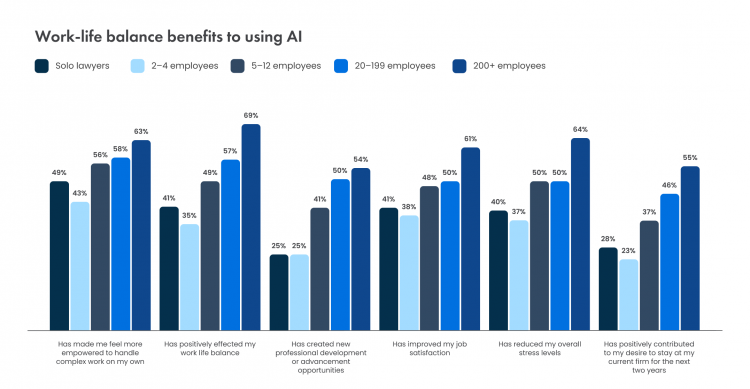
At mid-sized firms, among those using AI, 58% say AI has empowered them to handle more complex work and 57% say the technology has improved their work-life balance. 50% also experience less stress, and 46% say AI makes them more likely to stay at their current firm for the next two years.
AI makes the daily work at a law firm manageable, and that keeps legal professionals from looking for new roles.
How AI reduces cognitive load and prevents burnout
Clio recently undertook a neurological study to understand how AI can support the mental capacity of legal professionals in their law firms.
Cognitive load is the mental effort required to process information, switch between tasks, hold details in working memory, and manage administrative overhead alongside substantive legal work. The operational friction of constant context-switching, manual data entry, and managing information across email chains can take its toll on brain function and can contribute to burnout.
In the research, legal technology was shown to reduce cognitive load in legal professionals by up to 25%. Additionally, those using Clio’s AI were twice as likely to answer legal questions correctly after reviewing a will, and 40% more were able to complete the assignment than those not using AI.
Firms that support AI use among their staff can reduce the mental toll of legal work, which in turn reduces the risk of burnout and staff turnover. At the same time, they give their staff the ability to do better work more efficiently.
Read our lawyer burnout guide to learn how to spot the warning signs before they lead to turnover.
Want more research and analysis on the use of AI in mid-sized law firms?
Read our 2026 Legal Trends for Mid-Sized Law Firms report to learn more about how firms are using AI to benefit their staff and their business.
Read the report
What AI-enabled law firms look like in practice
When putting aside the cost of employee turnover and retention initiatives, the use of AI also helps firms achieve better outcomes for clients.
65% of those working at mid-sized firms say that AI allows them to handle more work volume, which saves the need for additional headcount. 44% also report improved client satisfaction, and 42% say AI has helped differentiate their firm from competitors.
Most importantly, 39% of AI-users have seen revenues improve at their firm.

When firms are doing good work for clients and growing, employees tend to find the most satisfaction from their work, and that motivation itself can be a powerful means for retention.
One of the distinctions for mid-sized firms in their AI use is that they’re more likely to be using specialized solutions for legal work (though not as much as larger enterprise firms). This is important because generic solutions like ChatGPT can end up requiring a lot of prompting work to tailor responses to a given legal situation (which can also create issues for data privacy when using free and lower-tier versions).

Legal-specific AI solutions on the other hand have tailor-made workflows built into their systems, which can greatly expedite the work and improve quality. Again, this reduces the burden on employees to get the results they need from these tools, and also gives them more confidence in their work.
For mid-sized firms especially, only legal-specific solutions, tailored to the types of work they do,will allow them to adapt to new opportunities.
The cost of not investing in AI for your team
Looked at from the opposite perspective, firms that don’t support the use of AI are essentially asking employees to do more with less. Compared to other firms, prospective employees see a workplace that requires more cognitive work, more administrative burdens on their time, and more friction that makes their days more difficult and limits their contributions.
This will be especially true for younger lawyers who are quicker to adapt to new technologies, and for whom AI is becoming core to their work.
Research from Harvard Law School indicates that new grads are entering the workforce expecting that law firms will provide technologies to help them “think more and repeat less” in their work. Debevoise makes a similar prediction, suggesting that AI capabilities and fluency will become a major influence on where legal professionals look for work.
The Debevoise prediction shows that it’s not just availability of AI that’s important. That “fluency” expectation means that workers are going to look for organizations that have adapted their workflows and culture to working with AI. Data from Legal Trend for Mid-Sized Law Firms suggests that larger firms are ahead when it comes to policy. Still, nearly a third of mid-sized law firms have no policy on the use of AI.

In addition to having guidance on the use of AI, firms need the right systems to integrate them. When adopting tailored AI solutions designed for legal work, being able to connect them with internal knowledge databases is what ensures that workers aren’t jumping between systems to complete simple tasks.
Cloud-based practice management solutions create a stark improvement over server-based systems. Not only do they give employees more flexibility in their work, they make information more accessible. This is a huge advantage for connecting AI solutions that can then very quickly catch up and use important case notes and documentation for analysis and drafting.
While 86% of mid-sized firms have adopted AI, only 57% use cloud-based practice management systems. For most, this means that employees at these firms are likely juggling multiple systems and tools. Read more about how cloud-based practice management solutions can support your firm’s technology stack in “Why Cloud Solutions Are the Foundation for AI in Law Firms.”

How to make AI part of your retention strategy
AI can make the daily work at a law firm more manageable, which reduces burnout and keeps legal professionals from looking for new roles. To successfully leverage AI as a retention advantage, firms should take concrete steps to audit, formalize, and invest in purpose-built legal technology.
Audit current AI usage at your firm. Are people using legal-specific tools integrated into their workflows, or are they patching together generic platforms on their own? The goal is to learn what tools your people are actually using. If they’re using solutions outside of what the firm provides, there’s likely a reason. Read more about shadow IT and AI in law firms.
Formalize an AI policy. Just sixty percent of mid-sized firms have an AI policy. If yours doesn’t, staff are likely making judgment calls about how to use confidential data with these systems. If your firm hasn’t done its due diligence to identify what solutions can be used, and provided guidance on their use, this could put your firm’s data privacy at risk. Not sure where to start? See our guide to building a law firm AI policy.
Invest in integrated, legal-specific AI. The cognitive load reductions cited in the Legal Trends Report come from purpose-built legal technology rather than consumer chatbots. Generic tools don’t deliver the same retention dividend. Investing in a platform solution that keeps your system connected will save time on manual prompting and greatly increase the quality and impact of work.
Measure the retention signal. Add an AI question to your next staff engagement survey. The Legal Trends Report benchmark is that 46% are more likely to stay with their firm due to AI. See where your firm lands and where the gaps are.
Want more research and analysis on the use of AI?
Read our 2026 Legal Trends for Mid-Sized Law Firms report to learn more about how firms are using AI to benefit their staff and their business.
Read the report

The mid-sized firm retention advantage
The biggest law firm employee retention risk in a mid-sized practice is asking talented people to do demanding work without the tools to do it well. Pay and culture matter, but they can’t make up for that gap on their own.
Firms that invest in AI see less stress, less burnout, more capable teams, and significantly higher intent to stay. The firms that treat AI as a retention strategy, beyond its productivity gains, will hold onto their best people while the market moves around them.
For a deeper look at how mid-sized firms are using AI to retain talent and grow, read the 2026 Legal Trends Report for Mid-Sized Law Firms.
Does AI increase or decrease employee retention in law firms?
The data strongly suggests AI increases retention. According to 2026 Legal Trends for Mid-Sized Firms, 46% of legal professionals say AI makes them more likely to stay at their firm for the next two years. AI reduces stress, improves work-life balance, and enables staff to take on more complex, fulfilling work, all of which counteract the conditions driving turnover.
What is the average cost of attorney turnover?
The American Bar Association estimates that turnover costs law firms between $200,000 and $500,000 per lawyer. The figure includes recruiting, onboarding, lost productivity during transition, and disruption to client relationships. For mid-sized firms, where each departure is felt more acutely, the financial impact can significantly affect profitability.
How does AI reduce lawyer burnout?
AI automates repetitive administrative tasks (time tracking, document assembly, scheduling, research) that consume a disproportionate share of a lawyer’s day. Research cited in the 2026 Legal Trends Report shows that legal technology can reduce cognitive load by up to 25%. Less mental burden means less burnout, which directly supports long-term retention and lower law firm attrition rates.
Will AI replace lawyers and legal staff?
Current evidence says no. Harvard Law School research found that none of the AmLaw 100 firms interviewed anticipate reducing attorney headcount, even with significant AI-driven productivity gains. The more likely outcome is that AI shifts what lawyers spend their time on, moving hours from admin to higher-value legal work, rather than eliminating roles.
How can mid-sized law firms compete with Big Law on retention?
Mid-sized firms can’t always match Big Law compensation, but they can offer something many large firms struggle with: agility. The 2026 Legal Trends Report shows mid-sized firms are adopting diversified AI toolsets faster and more flexibly than larger firms weighed down by complex integrations. By investing in AI that reduces friction and improves the daily work experience, mid-sized firms create environments where people want to stay, regardless of what Big Law is paying.
Loading …














-1024x683.jpg "The Key Battles for Senate Control Are Set")










