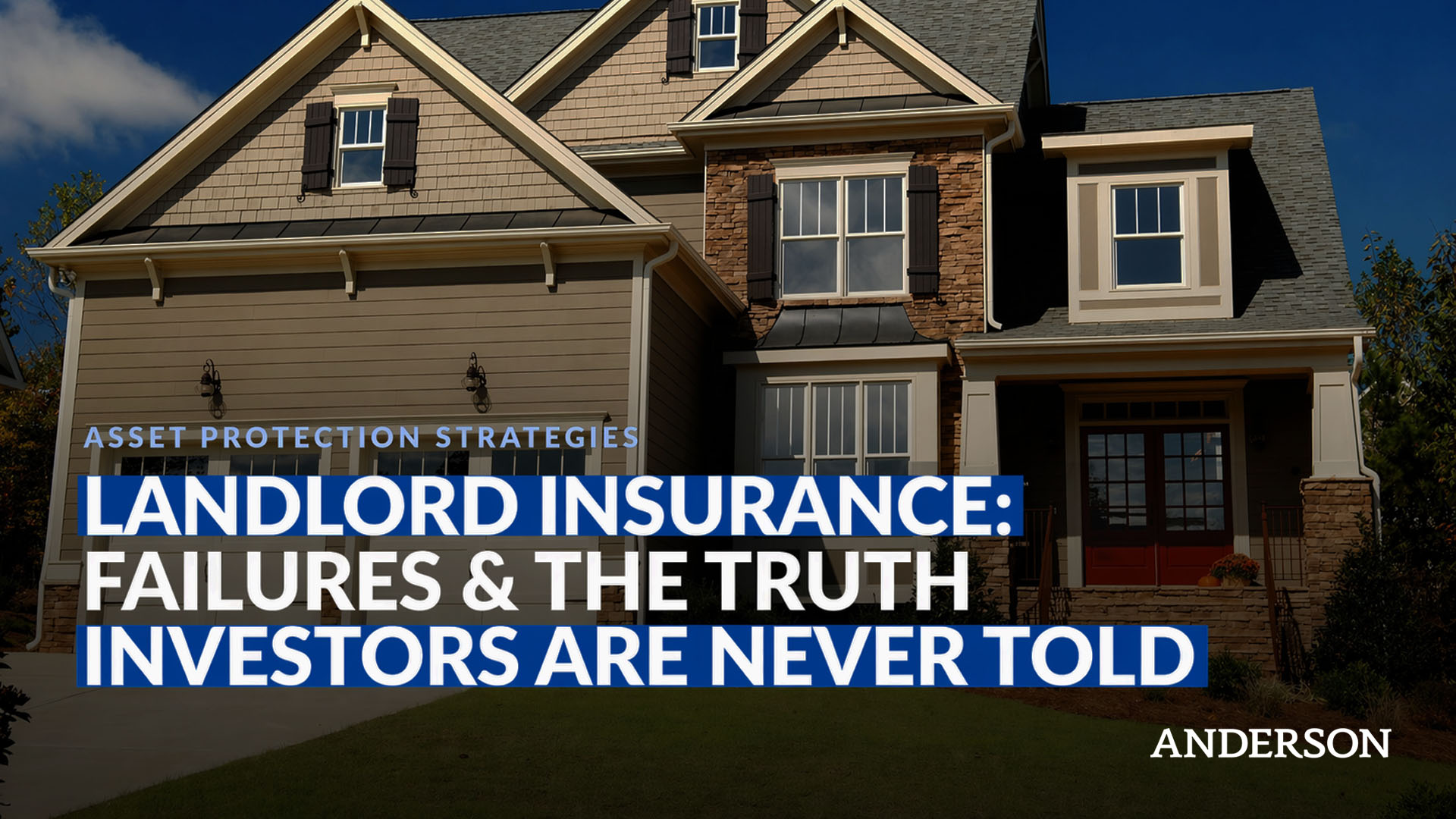
Most property owners don’t realize their landlord insurance can fail them—until it does.
Policies tied to insurance for rental property are filled with exclusions, definitions, and technicalities that can eliminate coverage when a real claim is filed. What looks like protection on paper can disappear the moment a situation falls outside those narrow terms.
If you want to see how these failures actually play out in real scenarios, watch the full breakdown here.
Why Do Most Investors Trust Landlord Insurance Too Much?
Most real estate investors assume they have mitigated any risk by buying landlord insurance.
That assumption creates a false sense of security. On its own, insurance for landlords is not a comprehensive asset protection strategy.
Insurance is a policy with limits, exclusions, and conditions that can leave you uncovered when a claim falls outside the fine print—and exposes your personal assets.
What Is Landlord Insurance Designed to Do?
Liability insurance for real estate investors covers certain risks associated with rental property ownership, such as property damage, liability claims, and, in some cases, loss of rental income.
These policies provide a layer of liability protection, but they do not eliminate risk or guarantee coverage in every situation.
Many investors never read the full general liability insurance policy, so they do not see where that protection ends until it is too late.
How Can a Habitability Claim Void Your Coverage?
A tenant injury claim may seem straightforward. But once a lawsuit includes claims tied to habitability—such as unsafe conditions, lack of heat, pests, or mold—coverage can change fast.
Even if you have liability insurance for landlords, many policies exclude habitability claims. When that happens, the insurer may deny the entire defense, even if the original injury would have been covered.
At that point, you are left covering legal costs yourself and may still be held liable for damages and medical bills.
Request a free consultation with an Anderson Advisor
At Anderson Business Advisors, we’ve helped thousands of real estate investors avoid costly mistakes and navigate the complexities of asset protection, estate planning, and tax planning. In a free 45-minute consultation, our experts will provide personalized guidance to help you protect your assets, minimize risks, and maximize your financial benefits. ($750 Value)
What Happens When a Property Is Vacant or Unoccupied?
Vacancy rules are one of the biggest traps in insurance.
If a property sits vacant for too long, often 30 to 60 days, coverage may be reduced or denied. In some situations, a property can be treated as unoccupied much sooner, especially during renovations, tenant turnover, or gaps in property management.
This creates risk not just for property damage, but for financial losses tied to uncovered claims.
Why Do Insurance Companies Focus on Vacancy and Occupancy?
Insurance companies rely on these distinctions because they increase risk and reduce their obligation to pay claims and cover damage.
Vacant or unoccupied properties are more likely to experience undetected issues, such as leaks, vandalism, or damage that worsens over time. By enforcing strict occupancy requirements, insurers create a clear point at which coverage can be limited or denied—even under real estate liability insurance policies.
For investors, this is especially relevant for short-term rentals or properties with frequent turnover.
Why Are Environmental Claims So Often Denied?
One of the fastest ways coverage can disappear is if your property has an environmental issue, especially mold.
These claims are often classified as maintenance-related or gradual damage rather than sudden events. Once that happens, they fall outside standard coverage.
Even when tenants contribute to the issue, courts can still hold landlords responsible. Without coverage, the cost of repairs and potential claims can escalate quickly.
How Do Insurers Reclassify Claims to Avoid Coverage?
Insurance companies do not just rely on exclusions. They also rely on definitions.
Damage caused by a tenant may appear to be vandalism. But an insurer may classify it as tenant damage, theft, or improper use instead. That shift in classification can significantly reduce coverage or eliminate it altogether.
This is one of the most overlooked risks in real estate liability insurance.
Where Do Renters Insurance and Tenant Risk Fit In?
Many landlords assume their policy covers tenant-related issues.
In reality, renters’ insurance is often the first layer of protection for tenants’ belongings and certain types of damage. Without it, landlords may face disputes that fall outside their own coverage.
Understanding this distinction is an important step in limiting liability.
What Is the Biggest Risk of Relying on Landlord Insurance Alone?
The biggest risk is the illusion of protection.
Insurance creates the impression you’re covered, but insurers can deny your claim and remove that protection instantly.
At that point, the responsibility shifts to you. Legal fees, repair costs, and potential judgments can quickly add up to significant financial losses.
Why Isn’t Insurance Enough for Asset Protection?
Insurance is only one layer of an asset protection strategy for landlords.
When it works, it helps. When it fails, you need a structure that limits the extent to which liability can spread. Without that structure, a single claim can affect more than just a single property.
That is why relying on insurance alone is not an effective long-term strategy.
How Do Real Estate Investors Actually Protect Their Assets?
Experienced investors combine insurance with proper structuring.
Holding properties in separate entities helps contain risk. If a claim arises and insurance fails to respond, your structure keeps the exposure limited to that one property.
This approach protects your personal assets and prevents a single issue from affecting everything you own.
What Should Investors Do to Avoid These Failures?
The first step is understanding that landlord insurance has limits.
From there, investors should:
Review their policies in detail
Identify exclusions and coverage gaps
Understand how vacancy and occupancy rules apply
Recognize how claims may be classified
Create an asset protection plan
The most important step is to build a structure that works alongside your policy, so you stay protected even if coverage fails.
How Can You Strengthen Your Protection Strategy Today?
Most investors focus on insurance. That’s the mistake.
Insurance is reactive. It only works if the carrier agrees to cover your claim. And as you’ve seen, there are plenty of situations where they won’t.
Real protection comes from what you control—your structure.
If you don’t fully understand how your policy works, you’re already exposed. But even if you do, coverage gaps, exclusions, and claim denials can still leave you paying out of pocket.
That’s why you need more than insurance. You need an asset protection strategy that limits your risk and protects your real estate investments—no matter what the insurer decides.
Schedule a free 45-minute Strategy Session with an Anderson Advisor. We’ll review your current setup, identify where you’re exposed, and build a structure that protects your real estate investments and gives you the peace of mind that your plan actually holds up when it matters most.