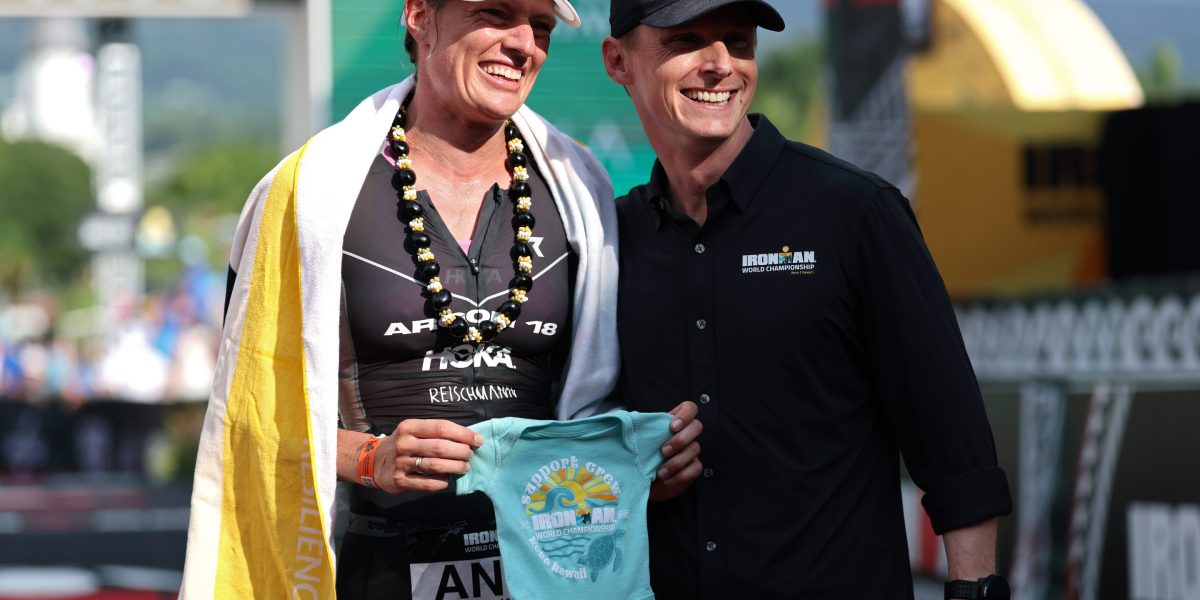
For Scott DeRue, the climb to the C-suite has mirrored the literal peaks he’s summited along the way.
As CEO of The Ironman Group, he oversees nearly 250 endurance events worldwide. But his career path has been anything but linear—spanning roles as a professor, dean of the University of Michigan’s Ross School of Business, and president of Equinox. He’s also climbed the Seven Summits, including Mount Everest and Kilimanjaro. The thread connecting it all hasn’t been a single industry or a straight-line path; it’s been intention.
“I have my family, The Ironman Group, and my passions of endurance sports and mountaineering,” DeRue told Fortune. “Every hour of every day is spent with one of those three things—and nothing else.”
That level of focus has shaped both his professional trajectory and personal ambitions. It dates back to when he was 13, unloading semi-trucks filled with upholstery fabric—an experience that taught him about hard work, paying taxes, and a lesson that would stick: no role has to be permanent.
But as he worked his way up, DeRue said success didn’t hinge on traditional networking—in fact, he believes the concept is often misunderstood.
“One of the terms that I think is most dangerous is the idea of ‘networking,’” the 48-year-old said. “Because it’s about relationships, not networking. You want to develop relationships built on mutual value and before you need them, and I think that’s an art that is lost on many.”
DeRue’s advice is simple: ditch the transactional mindset.
Rather than treating connections as one-off exchanges—swapping business cards or adding someone on LinkedIn—he emphasizes consistent, genuine engagement. That may mean checking in regularly, sharing updates, and offering help without expecting anything in return.
It’s a philosophy rooted in advice he received early in his career: think of relationships like a bank account: “There are debits and credits,” he said. “You always want to have a positive balance.”
That message likely resonates with Gen Z, many of whom struggle with how to approach professional connections. About 38% of young workers say networking makes them anxious, according to a survey conducted by Strand Partners for LinkedIn, with many avoiding it altogether because they don’t know where to start.
Today, DeRue oversees a workforce that swells to about 1,000 employees around the world during peak race season. Ironman—best known for its grueling triathlons—was purchased by Advance, the parent company of Condé Nast, in 2020 for an undisclosed amount. Prior to that, the company was sold in 2015 for $650 million.
Gen Z wants purpose in their careers. DeRue once took a whole month off work to try to find his
For Gen Z, a paycheck is increasingly not enough to feel satisfied in careers—purpose is a priority. More than half of Gen Zers and millennials say meaningful work is a key factor when evaluating employers, and 89% of Gen Z say purpose is critical to their job satisfaction and well-being, according to Deloitte’s 2025 Gen Z and Millennial Survey.
As entry-level roles grow more competitive, finding that balance can be challenging. And it’s a tension DeRue knows well.
After graduating from the University of North Carolina in 1999, he began his career at consulting firm Monitor Group (later acquired by Deloitte). While the role offered a strong start, it lacked the sense of direction he was searching for.
So, he took a month off to reflect and interview people in his life about their careers—until he identified what he calls his “North Star.”
“Since the age of 25, I’ve had one single through-line, North Star purpose: to create experiences for people that help them unlock their potential,” he said.
That clarity, he added, is what allows people to navigate uncertainty and build careers that feel meaningful over time. And looking back, even with his expansive resume, the biggest advice he would give himself is to “be bolder.”
And just as important is adopting what he calls a “no regrets” mindset.
“Even when things don’t work out, did you make a principled decision? Were you thoughtful about it?” DeRue said. “You can’t always control the outcome—but you can control how you approach it.”