Private markets are pushing into the retirement system, but new research from Morningstar suggests liquidity, not performance, may prove the bigger challenge for private equity and credit in 401(k)s.
Processing Content
As asset managers race to tap the $12 trillion defined contribution market, Morningstar’s latest research focuses on a less glamorous but crucial question: Can semiliquid private investment vehicles function inside a system built for daily contributions, withdrawals and rebalancing?
Using simulations built from real 401(k) participant data, Morningstar found that even modest redemption patterns can quickly strain private market vehicles, forcing managers to hold large liquidity buffers that ultimately dilute the very return premium these products are designed to deliver.
“Liquidity is not merely a product feature but also a systemic requirement shaped by participant behavior, plan design, and fiduciary obligations,” the researchers wrote.
The findings add a new layer to the growing debate over whether private assets belong in retirement plans. And if so, in what form?
READ MORE: As private equity reshapes RIAs, advisors look for alternatives
Why liquidity matters
Much of the recent conversation around private markets in 401(k)s has centered on performance potential. Interest surged after President Donald Trump signed an executive order in August directing regulators to make room for private market investments and cryptocurrencies inside workplace retirement plans.
But performance alone may not justify the operational complexity. A December analysis of Morningstar private equity data showed that long-term returns from private equity have cooled substantially, raising doubts about whether “modest” outperformance is worth the added risk, opacity and cost.
The new research reinforces that caution, with liquidity as the central focus.
Unlike traditional private equity drawdown funds designed for endowments and pension systems, retirement plans require daily pricing, frequent contributions, constant rebalancing and ready access to cash for withdrawals.
To function in that environment, asset managers are developing semiliquid “evergreen” vehicles, often structured as collective investment trusts (CITs) with both private asset exposure and a liquid sleeve of public investments or cash.
READ MORE: Older, wealthier clients remain wary of AI. Here’s how to build trust
How Morningstar modeled private assets in 401(k)s
Morningstar constructed a synthetic population based on its managed accounts database, modeling participant ages, salaries, contribution rates and withdrawals over time. Each participant received a diversified portfolio that included a semiliquid private asset CIT.
The simulated vehicle blended a private equity core with a liquid sleeve designed to handle redemptions and portfolio rebalancing. Across an 18-year backtest, researchers subjected the system to routine participant behavior — monthly contributions, withdrawals, rebalancing and glide-path adjustments — as well as stress events such as market shocks.
The goal was to measure how these products would behave inside a real retirement ecosystem. One of the study’s most striking findings was how quickly small redemption flows can compound into serious liquidity pressure.
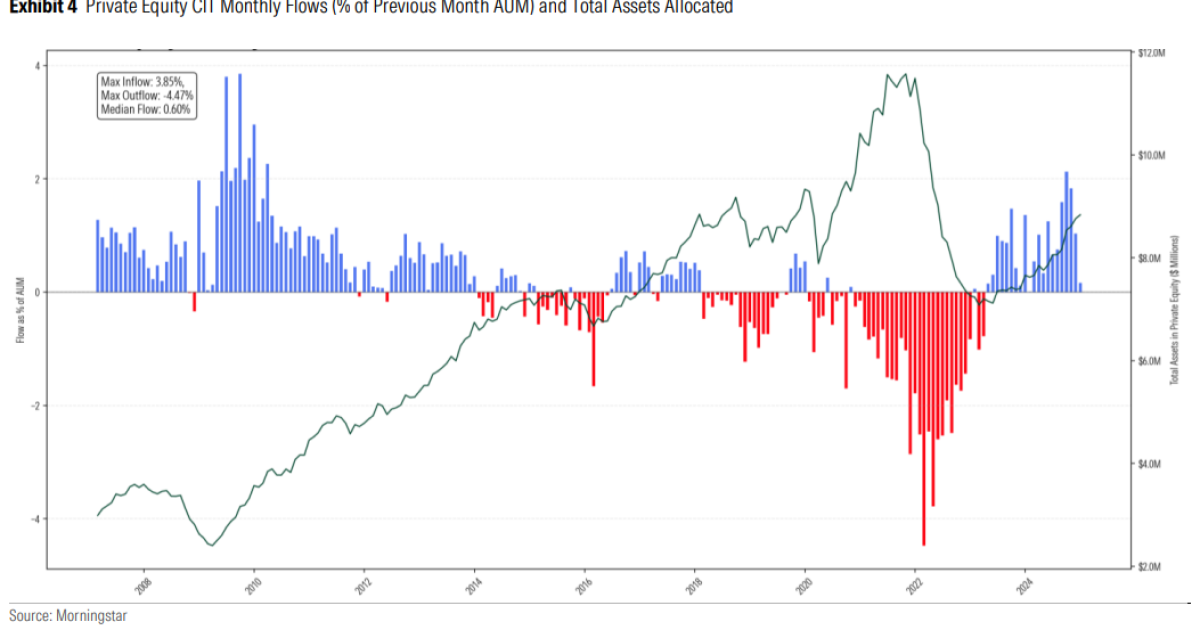
“Outflows tend to cluster,” the researchers found, meaning consecutive small withdrawals can rapidly drain liquidity buffers. During market stress in 2022, Morningstar’s model showed assets in the private equity CIT declining by nearly 40%.
To withstand these conditions, the analysis concluded that semiliquid private vehicles may require liquidity sleeves as large as 40%, far higher than many product designs currently envision.
That creates a difficult tradeoff. Larger liquidity sleeves improve operational resilience but reduce exposure to private assets, limiting both return potential and fee revenue.
“Ultimately, this becomes a balancing act for asset managers: optimizing liquidity to meet participant needs while maintaining sufficient capital for deployment into private investments,” the researchers wrote.
READ MORE: Passion in the portfolio: Luxury collectibles as alternative assets
Why private markets may disappoint inside 401(k)s
Liquidity pressure is not only an operational issue. It also directly affects performance.
Earlier Morningstar research already suggested future private equity returns are likely to be lower than historical norms. Adding a large liquidity sleeve invested in public markets or cash further dampens the return profile.
Hal Ratner, Morningstar’s head of research for investment management, previously told Financial Planning that the primary benefit of private market exposure in 401(k)s “may likely be a diversification benefit … as opposed to astronomical returns.”
Once liquidity requirements are fully accounted for, private market strategies appear likely to lose much of the performance edge used to justify their cost and complexity.
READ MORE: To jumpstart centers of influence referrals, think outside the CPA
Advisors await word from the DOL
Many of the details around the inclusion of such assets in retirement accounts will hinge on final guidance from the Department of Labor. In an executive order last August, President Trump instructed the agency to outline how fiduciaries should balance the higher costs of these investments with their potential long-term gains and diversification benefits.
The Office of Management and Budget, a branch of the executive government, usually has 90 days to review proposals, though it can move faster. Once approved, the DOL’s Employee Benefits Security Administration will publish the proposal, starting a 60-day public comment period, after which the department will finalize the rule.











-1024x683.jpg "Florida Roads Become a Battleground for Illegal Immigration")