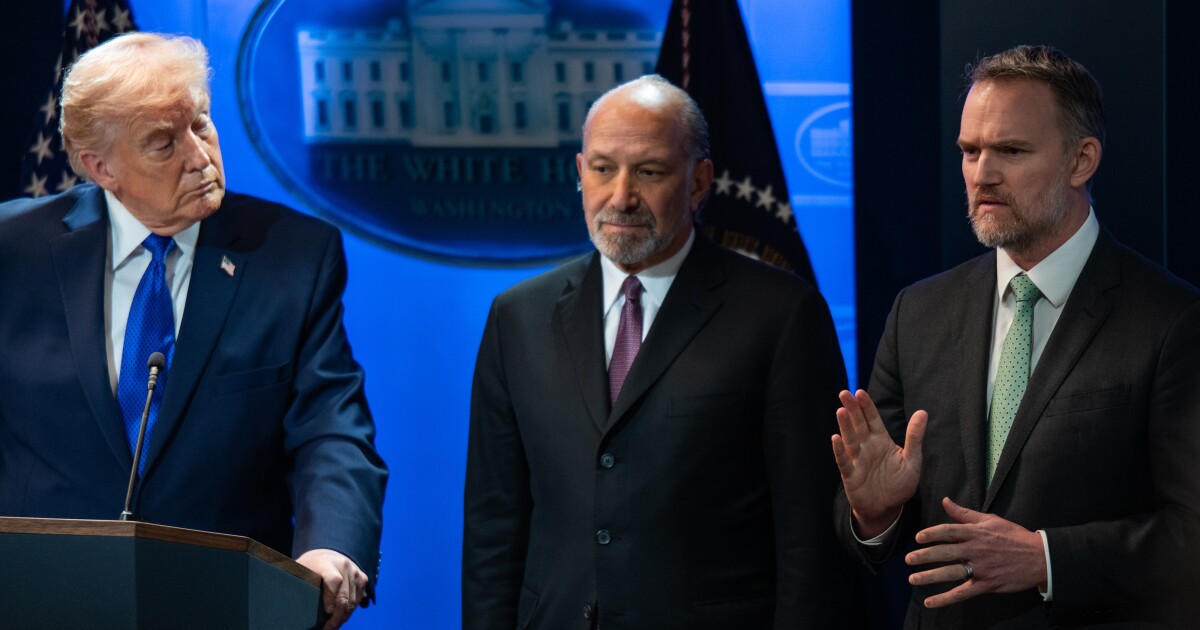
The Supreme Court on Friday dealt a significant blow to President Donald Trump’s economic agenda, striking down the tariffs he imposed under the International Emergency Economic Powers Act (IEEPA), including the so-called reciprocal tariffs.
Processing Content
The 6-3 ruling invalidates one of Trump’s signature economic policies. But while the decision is consequential, advisors and other experts say market volatility is likely to persist.
After the ruling, Trump remained defiant, promising a 10% global tariff. However, the law it’s based on, Section 122 of the Trade Act of 1974, limits such measures to 150 days.
READ MORE: Tech serving higher-value clients beats expanding capacity: Kitces
Inflation pressures
The decision adds another layer of uncertainty to the inflation outlook, said Stephen Kolano, chief investment officer at Integrated Partners in Wenham, Massachusetts, as the Trump administration will likely continue exploring other methods, he said.
“Near-term reactions indicate an easing of tariff-related inflationary pressure, but there is a high probability that the administration will use other legislative means to impose some type of tariff going forward,” he said.
In the short term, the removal of tariffs could lower input costs while opening up supply chains that had come under pressure amid trade uncertainty, said Eric Parnell, chief market strategist at Great Valley Advisors in Berwyn, Pennsylvania.
“Moreover, the cost of capital for companies impacted by the tariffs is likely to be lower than anticipated going forward, thus supporting marginally higher profit margins and earnings than previously expected,” he said.
Still, broader uncertainty is likely to remain. Financial Planning’s February Financial Advisor Confidence Outlook (fielded before the ruling) showed advisor sentiment trending downward amid persistent policy volatility and inflation concerns, underscoring that trade uncertainty is just one part of the wider macro picture.
READ MORE: How advisors can get noticed in a no-click search world
More noise than signal
Given the widespread expectation that some form of tariffs will be reimplemented, the effect on portfolios from the decision is likely to be limited.
If anything, investors may be wise to prepare for more “headline volatility,” said Brandon Zureick, chief economist and senior managing director at Johnson Investment Counsel in Cincinnati, as the administration outlines new country-specific plans to replace the IEEPA tariffs under alternative measures.
“Should efforts to re-implement trade policy fail, that would likely provide modest relief to companies that rely heavily upon imported goods but at this point it seems likely that the administration plans to use new avenues to re-implement the IEEPA tariffs,” he said.
Clint Sorenson, chief investment officer at Ascentis Asset Management in Dallas, said his firm considers this SCOTUS decision as “more noise than signal.”
“The noise will have short-term market implications,” he said. “Trade uncertainty is likely to persist due to the deglobalization trend. Tariffs are a symptom of a multipolar world with ongoing trade negotiations and geopolitical tension.”
One major unresolved issue is the approximately $150 billion in tariff revenue that could potentially be subject to refund, said Mike Serio, chief investment officer at Trilogy Financial in Denver. That possibility introduces an additional level of uncertainty, though it could be good news for the recipients if refunds materialize.
“In the short-term, any time there is some uncertainty, it tends to lead to some volatility,” he said. “Given the other alternative measures to continue with tariffs, we can see this being dragged on for several months. However, factoring in tariffs going down to 10% broadly, it might be quite bullish for the multinationals.”











-1024x683.jpg "Florida Roads Become a Battleground for Illegal Immigration")