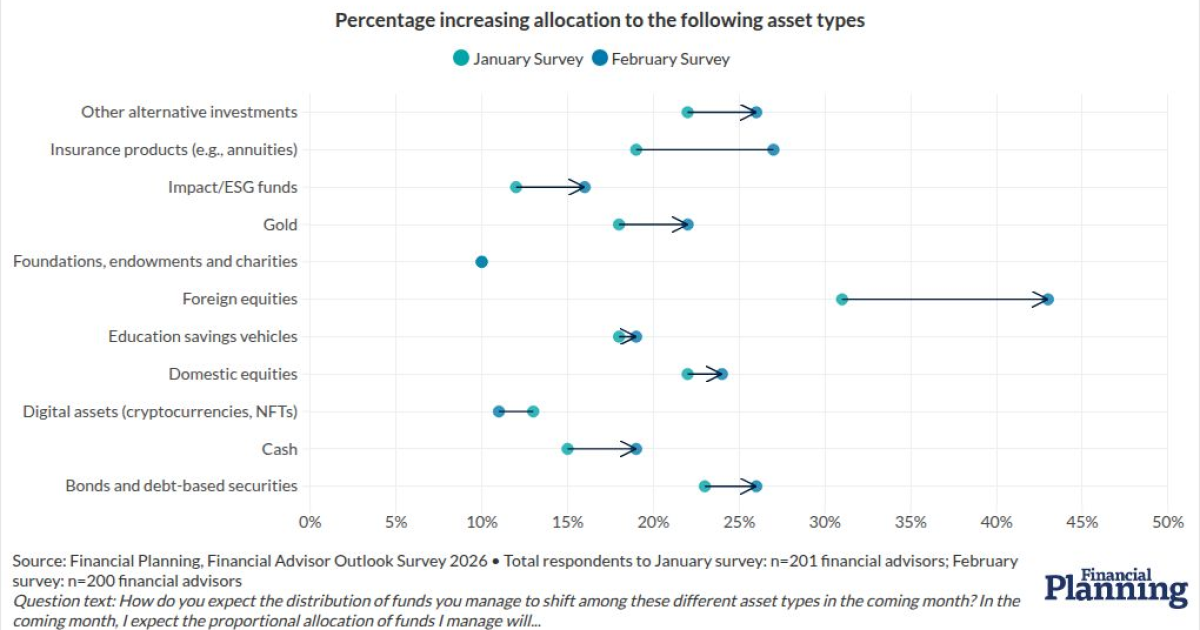
Financial advisors are increasingly looking overseas, with 43% expecting to raise allocations to foreign equities in the coming month, up from 31% in January.
Processing Content
The shift, reflected in February’s Financial Advisor Confidence Outlook (FACO) survey, follows a strong year for international markets. Non-U.S. stocks returned 30% last year as of mid-December, outpacing the S&P 500 Index by double digits, according to Fidelity.
Foreign equities ranked in the latest FACO survey as the top asset category where advisors plan to increase exposure, as macroeconomic trends and diversification concerns make them more attractive, though experts warn that due diligence remains essential.
READ MORE: How advisors can get noticed in a no-click search world
What’s behind the trends
Advisors’ growing interest in international investments is primarily driven by efforts to reduce concentration risk following strong runs in U.S. equity markets, said Jared Kessler, founder of foreign exchange research platform Forex Broker.
“Advisors now have a chance to make adjustments to their clients’ portfolios with many international markets, both developed and emerging, being priced at lower multiples as they have been outperformed for many years, and therefore are less likely to be overpriced or ‘over-valued,'” he said.
Another main reason foreign equities have been outperforming U.S. indices is that economic growth is being fueled by increased fiscal spending in places like Germany, Japan and even China, said Sonu Varghese, vice president and global macro strategist at Carson Group in Chicago.
“A weaker dollar has also boosted international equities, as stronger local currencies provide a tailwind for foreign equities denominated in dollars, which tends to be the case of investors in the U.S.,” he said.
Kessler added that easing inflation overseas, improving supply chains and slowing U.S. growth have helped make international returns more predictable.
“This can be the catalyst for renewed interest in foreign stocks before that renewed interest is reflected in long-term asset allocation data,” he said.
Rather than broad index exposure, some advisory firms are focusing on markets where fundamentals are improving, balance sheets are strong and there is a clear monetary policy, said Kessler.
“Through such an approach, advisory firms can better manage the potential risks associated with a decline in their clients’ investments,” he said.
READ MORE: How teaming with relatives gives advisors an edge
What makes for a good foreign equities investment
Kessler said when it comes to international stocks, advisors should focus less on headlines and more on fundamentals like earnings consistency, currency stability and governance standards within that country.
Varghese said his firm noticed these trends since last year and moved model portfolios to be neutral-weight on international stocks, which boosted absolute performance as both developed and emerging markets outperformed U.S. equities.
Advisors should be sure investors are comfortable with the level of international equities in their portfolios and be aware of their level of exposure to developed markets versus emerging markets, said Varghese. His firm is overweight on developed markets in its models, as these provide potential diversification to the rest of the equity basket, which already tends to be tech-heavy in the U.S. and even emerging markets, he said.
“Emerging markets can also be more volatile, and it’s important to understand that some of those countries, like Taiwan, provide even more exposure to the technology and AI theme while others, in Latin America, provide exposure to the commodity complex,” he said.
Kessler said that political risk, currency fluctuations and capital controls can add risk. High-growth foreign equities may be attractive due to their potential for gains, but such growth does not necessarily protect investors from losing all of those gains rapidly due to policy changes by the host country government.
“Investing in foreign equities requires patience and research, much more so than speed,” he said.